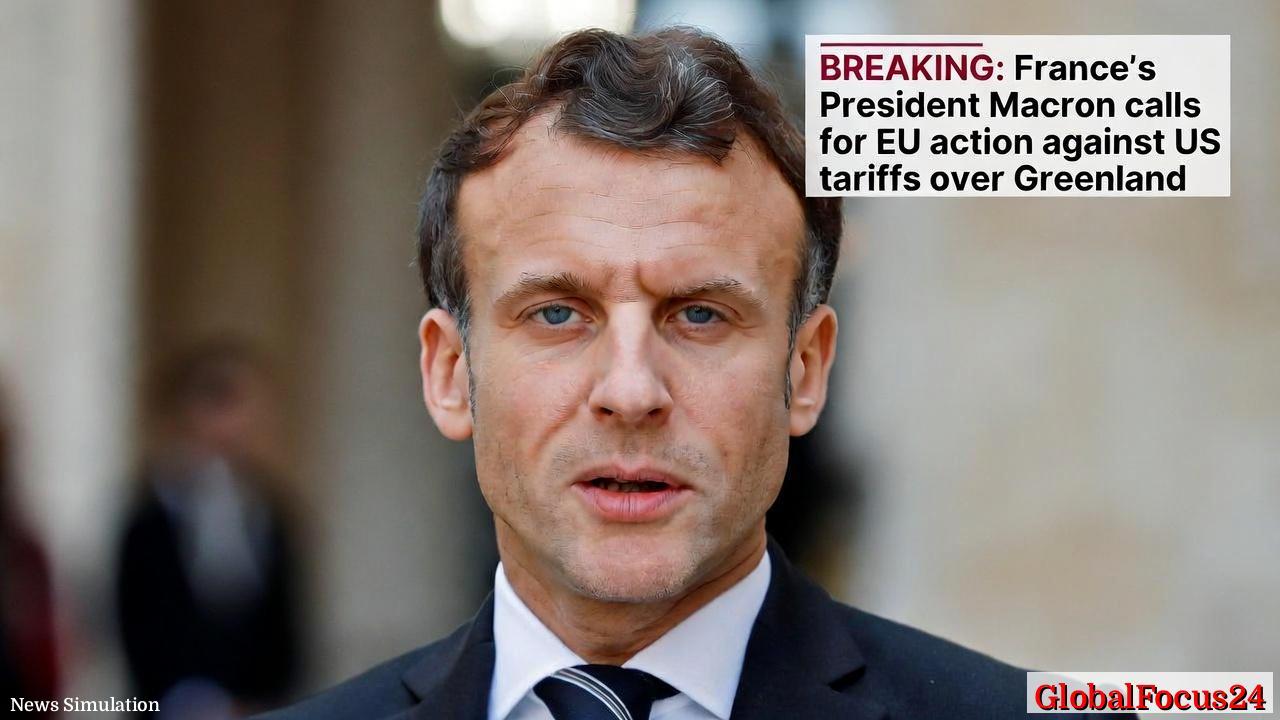
Macron Urges EU to Deploy Powerful Trade Tool Against US Over Greenland Tariffs
French President Emmanuel Macron has urged the European Union to activate its newly established “anti-coercion instrument,” a powerful trade defense mechanism designed to counter economic pressure from foreign governments. The move follows escalating tensions with Washington after U.S. President Donald Trump’s renewed threats to impose tariffs on European goods in response to what he described as “unfair restrictions” linked to Greenland’s resource policies.
The proposal marks one of the most assertive European reactions to U.S. trade measures in recent years, raising concerns about a potential transatlantic economic rift at a time of global uncertainty.
The Anti-Coercion Instrument Explained
The anti-coercion instrument (ACI), adopted by the European Union in 2023, allows the bloc to take retaliatory action when another country deploys economic pressure or trade restrictions to influence EU policy decisions. It gives the European Commission authority to impose tariffs, restrict market access, or suspend trade benefits if a negotiation-based resolution fails.
To date, the ACI has never been used, and its activation against the United States would represent a historic shift in the EU’s trade posture. Designed largely in response to years of economic coercion from different global powers—including previous American tariffs under the 2018–2020 trade disputes—the instrument was created as a deterrent, not a first-resort measure. Macron’s recommendation, therefore, indicates a significant deterioration in diplomatic trust between Paris and Washington.
According to EU trade officials, Macron’s call came after internal consultations within the European Council, where several member states reportedly expressed concern that the U.S. tariffs could disrupt Europe’s access to critical raw materials connected to Greenland. The Arctic territory, an autonomous Danish dependency, has become a focal point in global competition for rare earth minerals, crucial to renewable energy and defense technologies.
Greenland’s Strategic and Economic Importance
Greenland’s vast deposits of rare earth elements and strategic minerals—including neodymium and dysprosium, vital for electric vehicle motors and wind turbines—have drawn increasing attention from Western governments seeking to reduce reliance on Chinese supply chains. The United States has argued that European regulations and investment conditions favor EU-based consortia, marginalizing American companies interested in Arctic mineral ventures.
President Trump’s tariff threats, according to U.S. trade representatives, aim to “restore balance” in access to Arctic resources. European leaders, however, see the move as economic coercion designed to force Denmark and the EU to modify environmental and sovereign investment policies regarding Greenland.
Historically, Greenland has been central to geopolitical rivalries in the North Atlantic. During the Cold War, it hosted American military installations, including the Thule Air Base, underscoring its value in global security strategy. In the 21st century, climate change has added a new dimension, as melting ice has uncovered resource-rich areas and opened maritime routes that were once inaccessible.
Macron’s warning reflects broader European unease over what officials call “resource nationalism” — the use of economic leverage to extract political or commercial concessions.
Rising Economic Stakes and Transatlantic Tensions
Analysts say Europe’s economic exposure to U.S. trade measures remains high. The United States is the European Union’s largest export market, with trade in goods and services exceeding €1 trillion in 2025. New tariffs could potentially harm key sectors, including automotive manufacturing, aerospace, and agri-food exports.
If the EU deploys its anti-coercion instrument, the consequences could ripple through global markets. The European Commission would gain the authority to restrict the operations of major U.S. technology companies within the single market, bar American financial institutions from public procurement, or impose retaliatory tariffs on a range of goods.
Such steps would mark a significant escalation in transatlantic trade relations, echoing the tense period of 2018–2019 when Trump’s administration imposed tariffs on European steel and aluminum and threatened levies on automotive imports. Those measures cost billions in lost revenue and temporarily chilled investment on both sides of the Atlantic.
Macron’s latest push signals that Europe intends to act with greater unity and firmness in defending its economic sovereignty. “Europe must show that it will not be blackmailed,” a senior French official was quoted as saying, emphasizing that the EU should use all tools available under international law.
Balancing Unity Within the European Union
Despite Macron’s strong rhetoric, European consensus on deploying the anti-coercion instrument is far from guaranteed. Several member states—particularly those with large export ties to the United States, such as Germany and the Netherlands—are urging caution. They fear that retaliatory measures could trigger a tit-for-tat escalation detrimental to both economies.
Germany, whose car industry depends heavily on U.S. markets, has called for “maximum dialogue” before any decision is made. Nordic states, including Denmark and Sweden, also advocate diplomatic resolution, especially given Greenland's unique constitutional ties to Denmark and the sensitivity surrounding Arctic governance.
Nonetheless, Macron’s stance has echoed in southern Europe, where countries like Spain and Italy have backed a firm collective response. They argue that inaction could embolden future economic coercion, not only from Washington but also from other powers such as China or Russia.
The European Commission, led by President Ursula von der Leyen, is expected to review the request and issue a formal assessment in the coming weeks. Any eventual activation of the ACI would require a qualified majority within the Council of the European Union—a threshold that may prove difficult to reach amid divergent national interests.
A Broader Test of Strategic Autonomy
This confrontation arrives at a critical moment in Europe’s pursuit of “strategic autonomy,” a concept championed by Macron as the continent seeks to reduce dependency on both U.S. security guarantees and global supply chains dominated by non-European actors.
Since the disruptions of the COVID-19 pandemic and subsequent energy crisis triggered by Russia’s invasion of Ukraine, the European Union has accelerated efforts to regulate foreign investments in critical sectors, boost domestic production of semiconductors, and assert more control over vital resources. The Greenland dispute, therefore, goes beyond trade — it touches on Europe’s broader ambition to assert sovereignty in global economic governance.
Historically, Europe and the United States have navigated a delicate balance between economic interdependence and competition. While their alliance underpins global stability through NATO and joint climate initiatives, disputes over digital regulation, defense spending, and subsidies for green technologies have tested the partnership. The current tariff threats, analysts say, could deepen this divide unless both sides reestablish mutual trust.
Global Market Response and Investor Anxiety
Financial markets have reacted cautiously to Macron’s remarks. The euro slipped slightly against the dollar, while European equities, particularly in export-oriented sectors like luxury goods and automotive manufacturing, showed volatility. Analysts warn that even the suggestion of activating the anti-coercion instrument could influence investor perceptions of transatlantic stability.
Multinational corporations with operations in both jurisdictions are preparing contingency plans. European banks fear possible retaliatory measures from Washington that could target access to dollar transactions or regulatory approvals. Meanwhile, American tech firms operating under EU data privacy frameworks may face additional scrutiny if tensions escalate.
The World Trade Organization (WTO) has yet to comment on the issue, but trade experts have noted that the EU's instrument aligns with WTO rules as long as it is applied proportionately and in response to demonstrated coercion. This distinction will be crucial if the case advances toward formal measures.
Regional Comparisons and Diplomatic Outlook
Compared to other major economies, the EU’s anti-coercion instrument stands out as one of the most comprehensive frameworks for deterring economic pressure. Japan and Canada have adopted narrower versions, relying primarily on case-by-case retaliation through existing trade bodies. China, on the other hand, maintains broad “counter-measures” provisions under its Anti-Foreign Sanctions Law, which the EU cited as partial justification for developing its own system.
The transatlantic dispute also mirrors tensions in the Indo-Pacific, where countries are increasingly adopting defensive trade tools to guard against coercive practices. The EU’s response to the U.S. over Greenland could set a precedent with far-reaching geopolitical implications, signaling to other actors that Europe intends to enforce reciprocity with its largest partners.
Diplomatic channels remain open. Both French and American foreign ministries confirmed ongoing discussions aimed at de-escalation. Some analysts suggest that a negotiated compromise over investment access and environmental standards in Greenland remains possible, though time is running short before the U.S. tariffs take effect.
Looking Ahead
Should the EU invoke its anti-coercion instrument for the first time, it would signify a turning point in the global trade order — challenging the long-standing assumption of cooperative transatlantic dominance. For Macron, the move would bolster his image as a defender of European sovereignty but also test his ability to unite a divided bloc around a shared strategic vision.
The coming weeks will determine whether this episode becomes another transient flare-up in a complex U.S.–EU partnership or the first step toward a deeper realignment of Western economic power. In a world increasingly defined by resource competition and geopolitical fragmentation, Europe’s next decision may shape not only its own future, but the very dynamics of global trade for years to come.