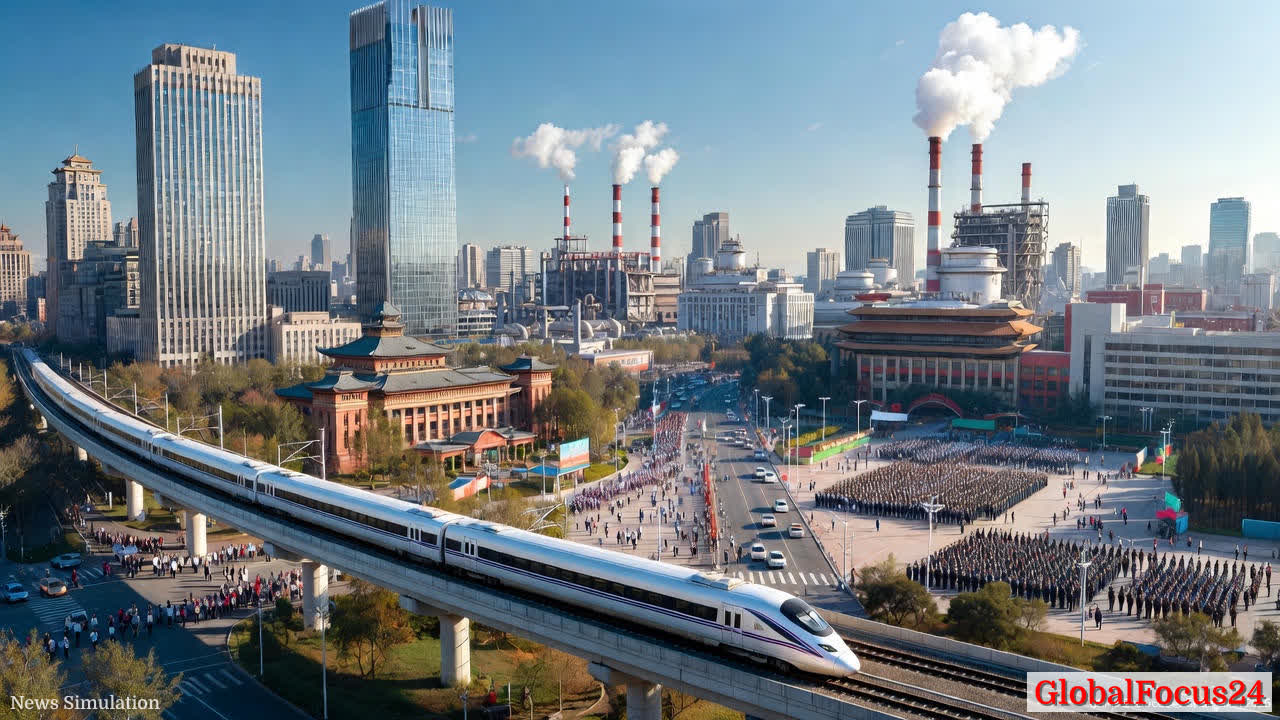
China's 2025 Growth Momentum Faces Long-Term Constraints Amid Political Rigidity
A year marked by rapid economic milestones and strategic demonstrations, 2025 reinforced China’s status as a leading driver of global growth. From industrial output surges to large-scale infrastructure completions, the year showcased the country’s capacity to mobilize resources, accelerate productivity, and expand its influence across regional supply chains. Yet beneath these triumphs, a thread of concern persisted among policymakers, investors, and analysts: could an increasingly rigid political framework curb the very dynamism that has powered China’s ascent? The tension between ambition and constraint has emerged as a central theme for observers seeking to understand China’s trajectory in the mid-2020s and its implications for regional and global markets.
Historical context: momentum built on decades of reform and expansion To understand 2025, it helps to trace the arc of China’s reform era that began in the late 1970s and accelerated through the 2000s. The country’s transition from a closed, planned economy to a system that embraces market mechanisms while maintaining centralized political control created a unique model. Over the past two decades, rapid urbanization, state-led investment, and export-led growth transformed China into a manufacturing powerhouse and, more recently, a hub for advanced technologies. The year 2025 sits within this longer arc, where continued modernization projects—ranging from smart manufacturing to green energy deployment—have sustained a steady rhythm of expansion, even as international tensions and domestic governance choices added new complexity to growth dynamics.
Economic performance: impressive outputs, nuanced risks In 2025, industrial activity and infrastructure investment delivered tangible gains across multiple sectors. Manufacturing throughput expanded as supply chains adapted to post-pandemic normalization, while the services sector gradually diversified toward higher-value activities such as technology-enabled services, logistics, and domestic consumption. Foreign investment remained a critical component of the growth engine, supported by targeted policy incentives, improved financial access for small and medium-sized enterprises, and selective opening measures designed to attract strategic capital in areas like semiconductor equipment and green technologies.
Regional analyses reveal a nuanced picture. Coastal provinces with established export ecosystems leveraged state-backed initiatives to deepen integration into global value chains, while inland regions benefited from policy-driven industrial relocation and incentive packages designed to balance development. In Southeast Asia and the broader Indo-Pacific region, China’s infrastructure financing and trade connectivity projects continued to shape regional commerce, reinforcing a pattern of increased interdependence even as geopolitical frictions persisted.
From a macro perspective, monetary and credit conditions remained accommodative enough to support investment while maintaining vigilance over financial stability. The central bank balanced the need to sustain growth with inflation controls and exchange-rate considerations, aiming to preserve a competitive currency stance that supports export competitiveness without stoking volatility in capital flows. Corporate earnings in technology, manufacturing, and consumer sectors reflected a mix of resilience and recalibration, as firms navigated evolving demand patterns and regulatory expectations.
Political structure and its impact on innovation A recurring question for 2025 is whether political rigidity might constrain the pace and breadth of innovation over the longer horizon. Proponents of the current governance model argue that centralized decision-making enables rapid mobilization of resources for large-scale projects, strategic alignment across industries, and swift responses to external shocks. The ability to execute ambitious programs—such as massive investments in infrastructure, energy, and digital economy initiatives—has been a hallmark of China’s development playbook.
Critics, however, warn that tightening political control could dampen entrepreneurial risk-taking and slow the diffusion of new technologies. The allocation of resources toward state-led priority sectors can crowd out private experimentation in other fields, potentially reducing the diversity of experimentation that drives breakthrough innovations. In sectors such as artificial intelligence, quantum computing, and advanced manufacturing, the balance between strategic state direction and open, competitive ecosystems will likely shape both short-term performance and long-term resilience.
Public sentiment and social dynamics also factor into the equation. A sense of national momentum and pride around production milestones can bolster social cohesion and consumer confidence, while concerns about governance transparency, career mobility for skilled workers, and the availability of high-quality public services can influence talent retention and domestic consumption patterns. Across major urban centers, forward-looking policies on housing, transportation, and education continue to matter for sustaining a broad-based growth story.
Regional comparisons: how China stacks up against peers When comparing China’s 2025 performance with regional peers, several contrasts stand out. In neighboring economies with similar development trajectories, growth often hinges on a combination of export demand, domestic investment, and regulatory openness. Some regions benefited from greater policy experimentation and market-driven incentives that supported faster adaptation to evolving global demand. Others faced structural headwinds such as aging populations, limited labor market flexibility, or exposure to external shocks.
China’s approach—emphasizing large-scale programs, integrated technologies, and strategic sector focus—led to notable outcomes in infrastructure completion, urban transit expansion, and energy transformation. Yet the level of state involvement in allocating capital and guiding research priorities differed from some peer economies where private-sector-led innovation and market-driven experimentation play a larger role. The regional comparison underscores a core question: can China sustain high-speed, broad-based growth if political choices continue to prioritize centralized control over openness and experimentation?
Supply chains, trade, and resilience 2025 reinforced the centrality of China in global supply chains, with continued demand for intermediate goods, components, and finished products across diverse industries. The country’s capacity to scale production efficiently, coupled with investments in logistics and digital traceability, supported resilience in the face of external disruptions. Trade infrastructure, including port capacity expansions and cross-border logistics networks, helped maintain a steady flow of goods to regional and global markets.
At the same time, geopolitical tensions and competition over technology and strategic inputs added volatility to trade patterns. Companies navigated shifting regulatory standards, export controls, and sanctions regimes that required careful risk management and strategic portfolio diversification. In this environment, China’s ability to attract foreign investment and to maintain competitive manufacturing ecosystems depended not only on cost advantages but also on policy predictability, intellectual property protection, and the rule of law as perceived by international partners.
Policy trajectory and long-term implications Looking forward, the policy landscape in 2025 hints at a potential recalibration. Authorities have signaled continued emphasis on structural reform, innovation-led growth, and the sustainable transition toward cleaner energy and digital infrastructure. The mix of incentives, regulatory updates, and strategic investments aims to nurture a broader base of high-value industries, reduce overreliance on any single export segment, and promote domestic consumption as a stabilizing pillar of growth.
However, the long-term implication of political rigidity remains a subject of debate. If governance choices increasingly channel resources toward a narrow set of priorities or limit competition and private-sector experimentation, the economy could face slower productivity gains in the medium to long term. Alternatively, if policy risks are managed with transparency, efficiency, and clear rule-of-law assurances, the country may sustain a robust development path while gradually broadening the innovation ecosystem.
Public reaction and societal undercurrents Public perception in 2025 reflected a mix of pride in national achievements and concern about the pace of reform. Large-scale projects, visible indicators of progress, and improved urban life contributed to a positive outlook in many communities. Yet conversations about governance, the openness of markets to new entrants, and opportunities for skilled workers in a rapidly evolving economy highlighted a nuanced public mood. The pace of urbanization, the affordability of housing, and access to high-quality education and healthcare remained central themes that influenced how residents perceived the sustainability and inclusiveness of the growth model.
Conclusion: balancing momentum with adaptability China’s 2025 performance illustrates a nation capable of extraordinary scale and execution, delivering tangible gains across industry, infrastructure, and technology. Yet the longer-term trajectory will likely hinge on tightening the balance between strategic direction and adaptive, open-market experimentation. The most enduring growth stories tend to blend decisive leadership with vibrant, competitive ecosystems that encourage risk-taking, collaboration, and continuous learning. As 2026 approaches, policymakers, business leaders, and workers will be watching how this balance evolves, and how regional dynamics respond to a global economy that remains intricately interconnected with China’s development path.