Canada’s Trade Deal with China Marks Shift Away from U.S. Reliance
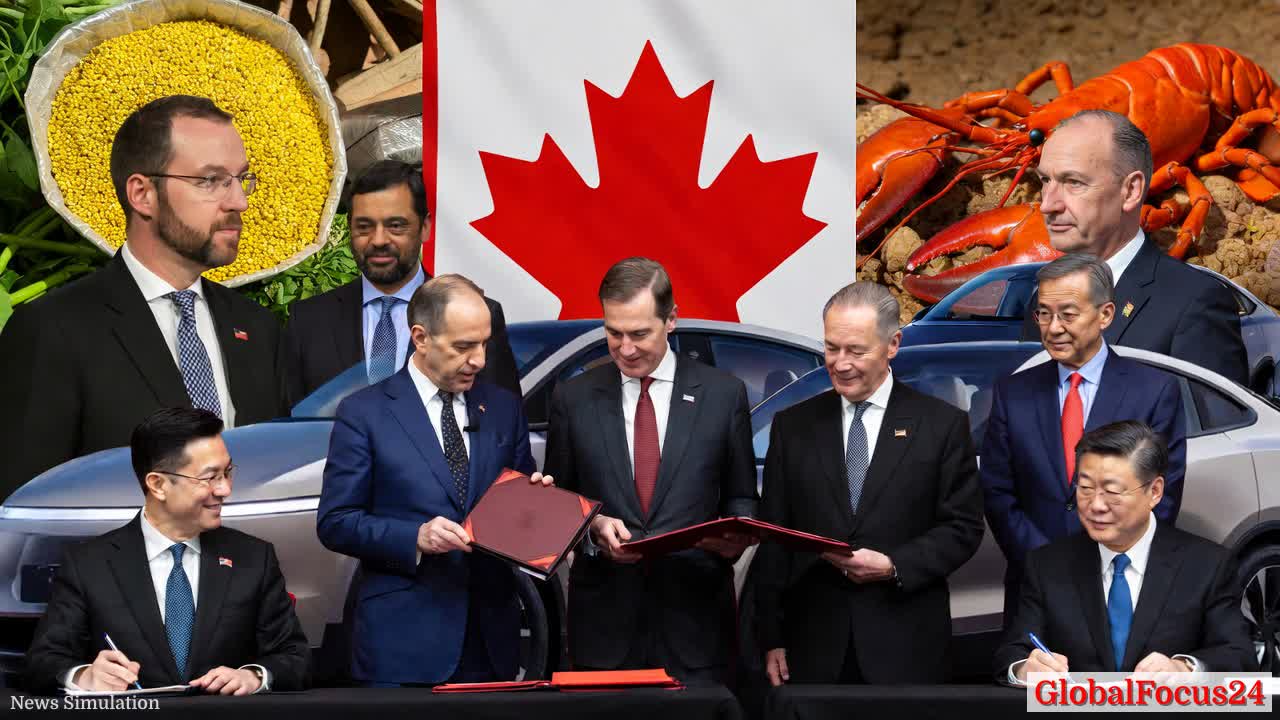
Canada has announced a sweeping new trade agreement with China that reshapes its international economic strategy and signals a deliberate pivot away from heavy reliance on the United States. The deal, which lowers tariffs on Chinese electric vehicles (EVs) and secures reduced barriers for Canadian agricultural exports, marks one of the most significant changes to Canada’s trade posture in a generation.
Prime Minister Mark Carney described the agreement as a pragmatic realignment in response to shifting global realities. “The world has changed,” he said during a press conference in Ottawa. “Our partnership with China is increasingly predictable, while our relationship with the United States continues to face political and economic uncertainty.”
Historic Context: A Pattern of Dependence
Canada’s economic trajectory has long been intertwined with its southern neighbor. Since the North American Free Trade Agreement (NAFTA) took effect in 1994—later replaced by the United States-Mexico-Canada Agreement (USMCA) in 2020—roughly 75% of Canada’s exports have gone to the United States. This dependence historically made domestic industries vulnerable to U.S. policy shifts, tariffs, and supply chain disruptions.
Trade friction escalated in recent years, renewing debate over Canada’s need for diversification. U.S. tariffs on Canadian aluminum and steel in 2024 and the ongoing review of the USMCA under President Donald Trump’s renewed administration created instability among Canadian exporters. Against this backdrop, the new deal with China appears as both economic necessity and strategic recalibration.
Terms of the Agreement: EVs for Agriculture
At the center of the accord lies a mutual easing of trade restrictions across two high-value sectors—automobiles and agriculture. Canada agreed to reduce tariffs on Chinese electric vehicles from 100% to 6.1% for the first 49,000 vehicles imported annually, with an allowance to increase that volume to 70,000 over five years.
In exchange, China will lower tariffs on Canadian canola seed from 84% to 15% by March 1. Tariffs on processed canola meal, lobsters, crabs, and peas will be suspended through year-end, offering immediate relief to agricultural exporters battered by recent trade disruptions. China also agreed to waive visa requirements for Canadian visitors, a gesture expected to boost business mobility and tourism.
Carney highlighted the long-term strategic value of the deal, emphasizing opportunities for Chinese investment in Canadian manufacturing. “China’s capacity to produce affordable, energy-efficient vehicles aligns with our clean technology and climate objectives,” he noted. “This is not just about trade—it’s about positioning Canada for the next economy.”
Economic Impact: Growth and Growing Pains
Economists estimate that the agreement could add $4–6 billion to Canada’s GDP over the next five years, driven by increased exports and consumer spending tied to more affordable vehicles. Canadian farmers are expected to gain substantial relief, particularly in Prairie provinces where canola is a cornerstone crop. Saskatchewan Premier Scott Moe applauded the move, saying, “Our farmers have been waiting for real relief. This is very good news for rural Canada.”
Yet the benefits are uneven across sectors. Ontario, Canada’s industrial heartland, has expressed deep concern about the potential influx of low-cost Chinese EVs. Ontario Premier Doug Ford criticized the agreement, warning it could “open the floodgates” for foreign competition that threatens the viability of Canadian auto jobs. “We support Canadian workers and auto innovation,” he said. “This deal risks undercutting both.”
Industry analysts predict the impact on Canada’s auto sector will depend on government policy response. Vivek Astvansh, a business professor specializing in global trade, projected that Chinese EVs could capture up to 10% of Canada’s market share by 2027. “The short-term effect will be greater consumer choice and lower prices,” he said. “But without targeted industrial policy, Canada’s domestic EV manufacturing could struggle to compete.”
Regional Perspectives: Provinces Divided
The deal’s reception reflects deep regional economic divides. Western provinces reliant on resource exports have viewed the pact as a long-overdue diversification measure. In Saskatchewan and Alberta, where canola exports to China once reached nearly $3 billion annually before tariff disputes, producers now see a reopening of vital trade routes.
In contrast, Ontario and Quebec—which together produce most of Canada’s vehicles—fear the agreement could stall domestic EV initiatives and slow job creation. Windsor, known as the “Automotive Capital of Canada,” relies heavily on supply chains linked to U.S. and domestic assembly plants. Local leaders worry the easing of Chinese imports will deter future investment from North American automakers.
Reaction from the United States: Caution and Criticism
The U.S. response to Canada’s pivot has been both cautious and critical. U.S. Trade Representative Jamieson Greer called the agreement “problematic,” suggesting it undermines regional alignment under the USMCA framework. However, President Donald Trump struck a different tone, saying, “If Canada can get a good deal with China, they should do it. We’re doing our own deals too.”
This variation in American sentiment underscores a broader uncertainty about North American trade relations. With the USMCA up for review later this year, Canada’s move may serve as both a hedge and a statement of independence. As trade adviser Eric Miller put it, “Canada is showing it won’t wait passively for Washington’s decisions. The world doesn’t stop because of U.S. politics.”
China’s Global Trade Strategy: A Broader Shift
China’s role in this development reflects its broader strategy to expand EV exports and counter Western tariffs. As the world’s largest electric vehicle producer—accounting for over 70% of global output—China faces overcapacity challenges and a growing need for diversified markets.
The new agreement with Canada mirrors similar outreach efforts across Europe, Latin America, and Southeast Asia, where China has sought to leverage its manufacturing strength in green technology. Reduced Canadian tariffs make the country an attractive destination for Chinese EV brands like BYD, NIO, and SAIC Motors, which are eager to gain a foothold in North America despite U.S. restrictions.
China’s reciprocal tariff reductions also serve a domestic purpose: stabilizing access to agricultural imports essential for food security and trade diversification amid an uneven global recovery.
Consumer and Market Reactions: A Mixed Picture
For Canadian consumers, the immediate outcome is likely positive. Lower EV prices could accelerate the country’s transition to cleaner transportation, helping meet its 2035 zero-emission vehicle target. Analysts estimate price reductions of up to 25% on entry-level EV models once supply chains adjust.
However, domestic manufacturers and unions are bracing for turbulence. The Canadian Auto Workers Union has called for enhanced policy protections and tax incentives to level the playing field. “Competition is fine, but it has to be fair,” said union president Lana Collins. “We need to invest in Canadian innovation, not just open the gates.”
Financial markets responded in measured fashion. The Canadian dollar rose slightly following the announcement, reflecting optimism over agricultural gains. Meanwhile, shares of domestic automakers and EV startups dipped amid worries about foreign competition.
International Comparisons: Learning from Europe and Australia
Canada’s decision aligns with a broader global trend of recalibrating trade relationships outside traditional Western blocs. The European Union has cautiously advanced economic ties with China in renewable energy and transport sectors, despite political tensions. Similarly, Australia’s phased restoration of trade with China since 2022 has highlighted the pragmatic balance between economic opportunity and strategic caution.
For Canada, the challenge will be managing similar complexity. Strengthening ties with China could bring substantial short-term gains, but it risks irritating the U.S.—still its dominant trading partner. Navigating this balance demands deft diplomacy and a clear long-term industrial vision.
Looking Ahead: A New Trade Era for Canada
As global trade realigns amid economic nationalism and technological transformation, Canada’s deal with China could define a new chapter in its economic identity. The agreement reflects both flexibility and risk: flexibility in rebalancing trade partnerships, and risk in exposing key sectors to competitive pressures.
Prime Minister Carney framed the decision as a necessary evolution. “We’re entering a new world order,” he said. “Canada must be agile, outward-looking, and strategic. This deal gives us that footing.”
Whether this pivot yields lasting prosperity or new vulnerabilities will depend on how Canada supports its industries in adapting to global competition. For now, the agreement underscores a bold truth: Canada is shaping its future, even if it means stepping beyond the familiar embrace of its southern neighbor.