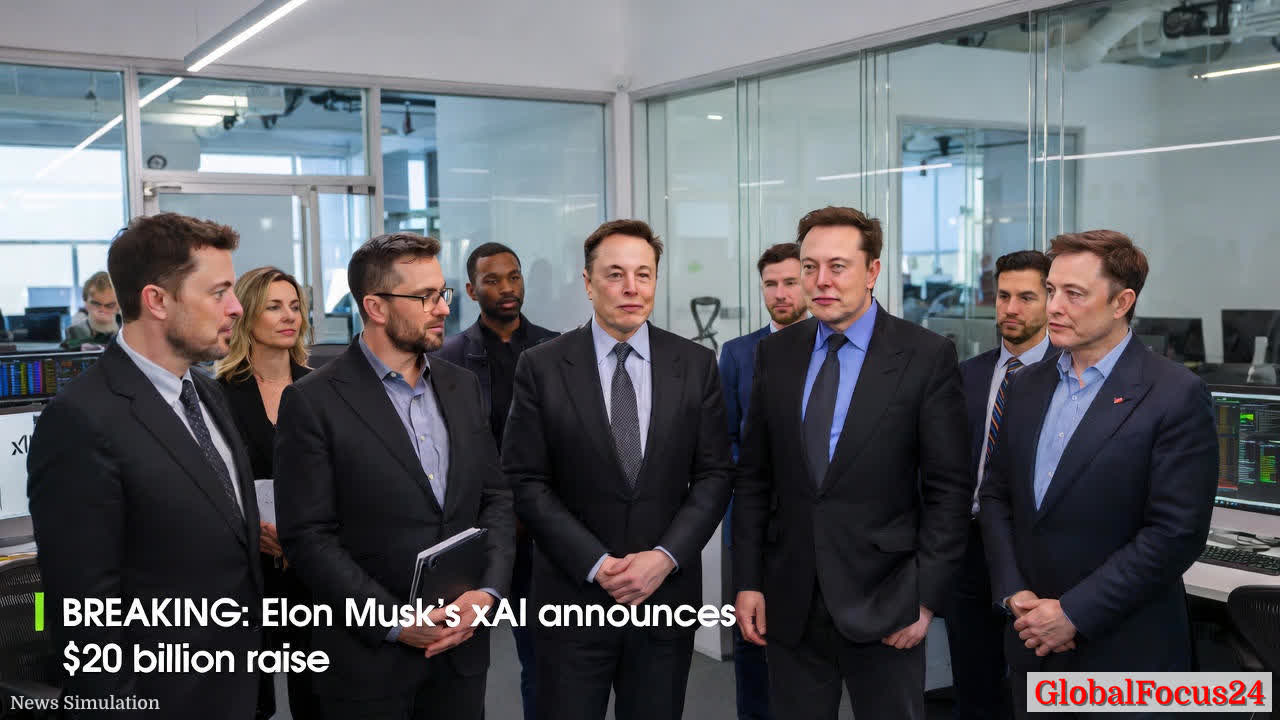
xAI Raises $20 Billion in Upsized Series E Funding Round, Signals Rapid AI Infrastructure Expansion
xAI has completed an upsized Series E funding round, securing $20 billion as it scales its increasingly ambitious AI infrastructure and product roadmap. The company initially targeted $15 billion but drew strong interest from a mix of strategic and institutional investors seeking to accelerate the deployment of next-generation AI systems, data center expansion, and research initiatives tied to understanding large-scale computational models and related scientific applications.
Historical context and evolution of funding in AI infrastructure
The surge in corporate financing for AI infrastructure reflects a broader industry shift that began in the late 2010s and accelerated through the early 2020s. Major cloud and hardware players redirected capital toward specialized accelerators, high-performance networks, and energy-efficient data centers to support ever larger neural networks and real-time deployment. The latest round by xAI marks a continuation of that trend, signaling confidence in the business case for massive compute farms, specialized GPUs, and the resilient, modular architectures needed to support diverse AI workloads—from general-purpose generation to domain-specific inference pipelines.
Investors and strategic significance
The round announced by xAI features a blend of financial backers and strategic partners. Valor Equity Partners, StepStone Group, Fidelity Management & Research Company, Qatar Investment Authority, MGX, and Baron Capital Group represent a broad spectrum of capital providers with interests in technology, growth equity, and long-term strategic value. The participation of strategic investors NVIDIA and Cisco Investments underscores the emphasis on scalable hardware infrastructure and integrated networking solutions, as well as the importance of interoperability across ecosystems in enterprise AI deployment.
NVIDIA’s involvement, in particular, aligns with the industry-wide push to optimize GPU-accelerated workloads and to push multi-tenant, cloud-based AI services that require substantial compute density. Cisco Investments, meanwhile, signals value in mature networking stacks, data-center resilience, and secure, scalable connectivity that underpins complex AI training and inference pipelines. Together, these strategic arms aim to fast-track the buildout of the largest GPU clusters in the world, a development that could reshape regional competition in AI-centric infrastructure hubs.
Economic impact and potential ripple effects
The infusion of $20 billion into xAI’s expansion plans is poised to yield several direct and indirect economic effects. In the short term, the funding supports the construction and modernization of data centers, the procurement of high-end accelerators, and the expansion of regional compute nodes. This can create construction jobs, spur demand for specialized electrical and cooling systems, and stimulate local supply chains in regions hosting new facilities. Over the medium term, accelerated AI product development and deployment may lead to productivity gains across multiple industries, as enterprises leverage more capable models for research, design optimization, predictive maintenance, and decision support.
regions seen as AI-friendly or strategically important stand to gain from such investments. In North America and Europe, existing data-center ecosystems could deepen, as new clusters complement established hyperscale campuses. In Asia-Pacific, where several technology hubs are expanding, the influx of capital could help diversify regional capacity and resilience against supply-chain disruptions. The heightened focus on GPU clustering and optimized compute pipelines may also influence energy markets and policy debates around data-center efficiency and grid reliability, given the substantial electricity demand associated with large-scale AI workloads.
Technological trajectory: Grok 5 and Colossus data centers
xAI is advancing its Grok 5 model, a continued evolution in the family of large-scale language and multi-modal models. While exact specifications remain proprietary, the progression from earlier iterations typically involves larger parameter counts, improved training efficiency, and enhanced alignment and safety features. Grok 5’s development is closely tied to the company’s data-center expansion, notably the Colossus facilities, which are being scaled to accommodate rising training throughput and high-availability inference services.
The company ended 2025 with more than one million H100 GPU equivalents, a milestone that signals substantial compute capacity intended for both research exploration and commercial deployment. The emphasis on increased GPU density aligns with industry-wide efforts to reduce training times and improve model refresh cycles, enabling faster iteration of product features and deployment scenarios. As compute resources grow, attention to operational efficiency, cooling technology, and power usage effectiveness will remain central to maintaining sustainable growth.
Regional comparisons: where xAI’s strategy fits in the global AI race
- North America: The region continues to host a dense cluster of hyperscale facilities, venture capital activity, and regulatory collaborations aimed at governing AI safety and governance. xAI’s investment could bolster cloud and enterprise-facing AI services, reinforcing the region’s role as a core hub for large-scale AI experimentation.
- Europe: With a keen focus on data privacy, governance, and energy efficiency, Europe presents both challenges and opportunities for new data-center investments. The influx of capital may accelerate localization of compute resources and foster collaborations with regional research institutes on responsible AI development.
- Asia-Pacific: Fast-growing digital infrastructure markets and government initiatives toward digital transformation position APAC as a critical battleground for AI competitiveness. xAI’s expansion could contribute to regional capacity-building, supplier diversification, and collaboration with local technology ecosystems.
Operational considerations and risk management
- Energy and sustainability: Large AI centers consume significant power, generating scrutiny around energy sourcing, cooling efficiency, and carbon footprints. Companies at this scale typically pursue advanced cooling techniques, waste-heat recovery, and renewable energy procurement to mitigate environmental impact and align with corporate ESG goals.
- Supply chain and component risk: Securing access to GPUs, power electronics, and high-speed networking equipment remains a top concern. Diversified supplier ecosystems and long-term procurement contracts are common strategies to minimize outages and price volatility.
- Talent and retention: Attracting and retaining AI researchers, engineers, and data-center specialists is essential for sustaining momentum. Competitive compensation, professional development opportunities, and collaboration with academic institutions are often part of such growth plans.
Public reception and market expectations
Investors and industry observers typically scrutinize the long horizon for returns in AI infrastructure plays. While the immediate impact is concentrated in capital expenditure and capacity-building, markets expect to see measurable improvements in model training throughput, reduced time-to-market for AI-enabled products, and stronger competitive positioning for the company’s software and services. Public reaction to such large-scale funding rounds often includes heightened interest in AI safety, fairness, and transparency, especially as models scale across industries.
Conclusion: positioning in a transformative era for AI infrastructure
The $20 billion Series E upsizing reinforces xAI’s commitment to building out a world-spanning, multi-region compute network designed for the next generation of AI capabilities. With strategic backers and technology partners at the table, the company is well-positioned to accelerate its Grok 5 development, push forward Colossus data-center expansions, and translate compute innovation into practical tools and applications for researchers, developers, and enterprises alike.
As the global AI ecosystem continues to evolve, investments of this magnitude underscore the central role that scalable hardware infrastructure, optimized networks, and robust operational ecosystems play in turning ambitious AI models into reliable, real-world solutions. The coming years will likely reveal how such capital infusions translate into tangible advances across science, industry, and everyday technology use, shaping the contours of AI-enabled progress for businesses and consumers alike.