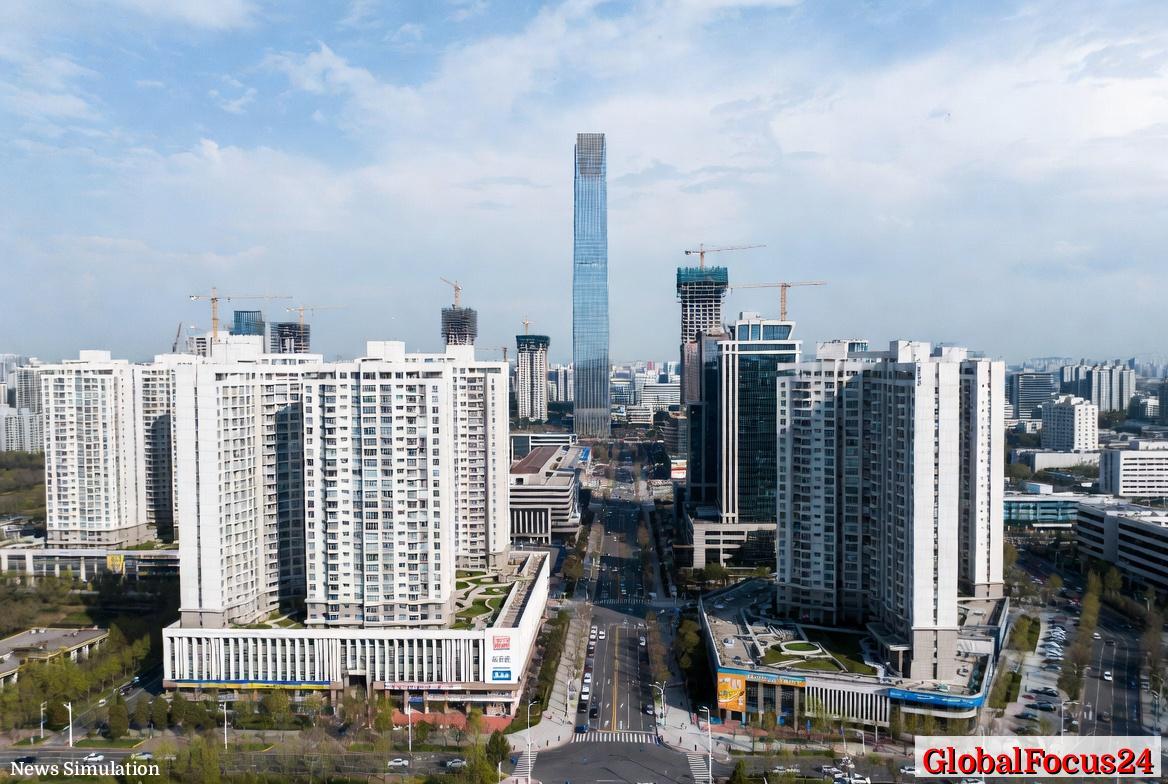
Xiongan New Area: How China’s Showcase City Is Shifting Toward An Exclusive Administrative Enclave
XIONGAN, Hebei Province — Once promoted as a bold experiment in balanced regional growth, Xiongan New Area is increasingly taking shape as a highly managed urban district dominated by state institutions, privileged employees, and carefully selected residents. The shift reflects both the scale of Beijing’s long-term planning ambitions and the limits of trying to build a new city around administrative power rather than an open market.
Announced in 2017 as a development zone intended to ease pressure on Beijing and create a modern model for urbanization, Xiongan was envisioned as a “millennium plan” for China’s future. The project was designed to absorb non-capital functions from the national capital, support technological innovation, and set a new standard for green, high-density city building. Eight years later, the area is still under construction, but its direction is clearer: Xiongan is not becoming a typical metropolis. It is becoming something closer to an elite state-backed enclave, with housing, jobs, and services shaped to serve the government system first.
A City Built From Policy
Xiongan’s origins lie in one of the most ambitious urban-planning efforts in modern China. The new area was announced as part of a broader strategy to redistribute growth away from Beijing, whose congestion, pollution, and soaring housing costs had become symbols of the strains created by decades of centralization. The idea was not simply to build another satellite city. It was to create a new urban core from scratch, guided by long-term state planning rather than speculative development.
That approach gave Xiongan a different character from earlier development zones and special economic areas. Cities such as Shenzhen became famous for market liberalization, entrepreneurial energy, and a flood of private-sector investment. Xiongan, by contrast, has been driven more by government directives, public capital, and institutional relocation. Its role has been less about incubating broad-based commerce than about absorbing public functions and demonstrating what a state-led urban future might look like.
The result is a place where the most important clients are ministries, state-owned enterprises, research bodies, and public-sector workers. That model can produce order and efficiency, but it also narrows the social base of the city. As a result, the people benefiting most from the new infrastructure are often those already closest to power.
Housing Perks And Targeted Incentives
Xiongan has offered a range of incentives to attract residents and workers, including improved infrastructure, planned housing support, and a suite of public services intended to make relocation easier. These perks have helped build momentum around the district and signal official commitment to its future. In a region where affordability and access to quality housing remain pressing concerns, the promise of a new, orderly urban environment carries obvious appeal.
Yet the design of those incentives also reveals who the city is meant to serve. Housing support in Xiongan is not primarily aimed at the general public in the way a broad municipal housing program might be. Instead, it has helped draw in government-affiliated workers, professionals linked to state institutions, and households with access to the networks needed to benefit from official relocation plans.
This has contributed to an urban pattern seen in several Chinese policy projects: a showcase district with superior amenities, but one that remains selectively open. In practice, that means the city can appear modern, spacious, and well equipped while still functioning as a guarded system of privilege.
Why The Shift Matters
The transformation of Xiongan into a more exclusive administrative enclave matters because the city was originally presented as a model for national development. If it becomes mostly a destination for state elites and institutional personnel, it may fall short of its broader promise to relieve Beijing and spread opportunity more evenly across northern China.
The concern is not only symbolic. Urban development works best when it supports diverse economic activity. A city dependent on public-sector relocation and state-directed employment may create stable demand for housing, retail, and services, but it can also struggle to generate the spontaneous business ecosystems that drive long-term innovation. Private firms, independent entrepreneurs, and middle-income families often look for flexibility, dense commercial activity, and social openness. A heavily managed district may not offer enough of any of those ingredients.
This is especially important in the context of China’s slowing property market and more cautious investment climate. Large-scale city-building projects once relied on rising land values and steady developer enthusiasm. Today, those conditions are less certain. That makes the question of who lives in Xiongan even more consequential. A district filled with well-connected residents may look successful on paper, but it may not produce the wider economic spillovers that were supposed to justify the project.
Economic Impact And Spillovers
Xiongan has already created economic activity through construction, infrastructure spending, and the relocation of institutions. Roads, transit links, utilities, public buildings, and residential projects require enormous labor and material inputs. In the short term, that has supported employment and demand across the surrounding region.
Longer term, the city could still generate meaningful spillovers. If major agencies, research centers, and administrative services continue moving in, they can pull demand for legal services, consulting, logistics, food service, education, and healthcare. New neighborhoods can also stimulate regional real estate markets and improve connectivity in nearby counties.
But the economic effects remain uneven. A city designed primarily for official use tends to concentrate benefits in a narrow band of sectors. The gains are real, but they are not always widely shared. Local residents outside the favored circles may see fewer opportunities than the narrative of a national showcase suggests. In that sense, Xiongan resembles other large Chinese development schemes where state investment creates visible change, but the distribution of that change is tightly controlled.
Historical Parallels In China
Xiongan fits into a long Chinese tradition of using cities as instruments of policy. From the early special economic zones of the reform era to the fast rise of coastal megacities, urban development has often been tied to national strategy rather than purely local demand. The difference today is that the country’s growth model has matured, land finance is more constrained, and the political purpose of new development zones has become more pronounced.
Shenzhen offers the clearest contrast. It began as a test case for opening up, eventually becoming a global technology and manufacturing hub with broad commercial depth. Pudong in Shanghai followed a similar logic, although with stronger state steering. Xiongan belongs to a newer class of projects in which the central goal is not simply growth, but restructuring: redistributing authority, controlling density, and showcasing planning discipline.
That makes Xiongan less like a conventional city and more like a state-built operating system for urban life. The trade-off is obvious. Tight control can deliver order, green space, and efficient infrastructure. It can also limit the diversity and unpredictability that make a city economically dynamic.
Regional Comparisons In North China
Compared with surrounding cities in Hebei and the wider Beijing-Tianjin-Hebei region, Xiongan stands out for the scale of its investment and the clarity of its mission. Many nearby urban areas have long struggled with weaker industrial bases, lower household incomes, and slower population attraction than the capital region’s main cores. Xiongan is intended to change that balance by creating a new magnet for talent and public-sector activity.
But the comparison also highlights Xiongan’s risks. Nearby cities such as Baoding have historically grown through a mix of manufacturing, trade, and everyday urban services. Their economies are broader, if less glamorous. Xiongan’s reliance on planned institutions and elite residency can make it look more polished, but also more dependent on policy support. If the flow of relocated bodies and budgets slows, the city may find it harder to sustain momentum than a more diversified regional center.
That tension is central to the Xiongan story. It is meant to be both a regional engine and a national symbol. Those roles are not always compatible.
Public Perception And Practical Limits
For residents and observers, Xiongan inspires both fascination and skepticism. The area’s new roads, public buildings, green corridors, and carefully arranged neighborhoods give it a clean, future-oriented image. At the same time, the city’s exclusivity has fueled doubts about whether it will ever function as a truly broad-based urban community.
There is also the practical question of population formation. Cities do not become vibrant simply because they are planned that way. They need schools, small businesses, informal networks, cultural life, and room for social mixing. A district populated mainly by officials and institutional workers may remain orderly and comfortable, but it may not develop the same resilience or spontaneity as a city that grows through diverse migration.
That is the central test for Xiongan now. It has already proven it can attract investment and policy attention. What remains uncertain is whether it can evolve beyond a showcase for the state and into a genuinely living city with a wide social and economic base.
What Xiongan Represents Now
Xiongan New Area remains one of China’s most closely watched development projects because it captures a larger national debate about how cities should be built. Is the future best shaped by market forces and broad competition, or by strong state direction and carefully managed urban form? Xiongan offers a clear answer from the government’s perspective: planning can be used to create order, efficiency, and prestige at massive scale.
But the city’s direction also illustrates the limits of that vision. As perks and incentives draw in more residents, the benefits appear increasingly concentrated among those already inside the system. That may help the project function as an administrative center, but it raises questions about whether it can still serve as a model for wider national development.
For now, Xiongan stands as both a showcase and a caution. It is a city of broad ambitions, heavy investment, and carefully measured access. Whether it becomes a true engine of balanced growth or a polished enclave for insiders will shape how the project is remembered for decades.