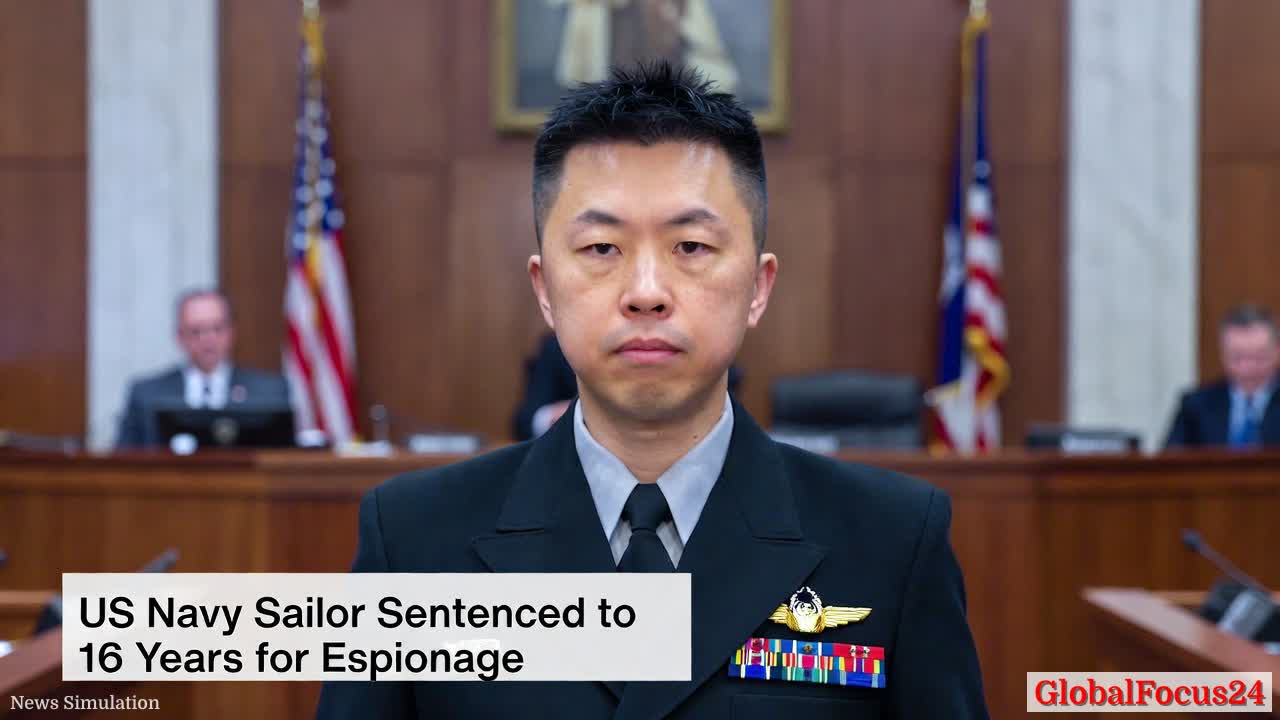
US Navy Sailor Sentenced to 16 Years for Selling Secrets to China
In a case that has reignited concerns over insider espionage and foreign recruitment efforts targeting U.S. armed forces, a U.S. Navy sailor has been sentenced to 16 years in federal prison for providing sensitive military information to a Chinese intelligence officer. The sentencing, handed down in San Diego, marks one of the harshest penalties imposed in recent years for espionage linked to the People’s Republic of China.
A Pattern of Espionage Within the Ranks
Jinchao Wei, 25, was convicted of conspiring to commit espionage and transmitting national defense information to a foreign agent. According to prosecutors, Wei, a naturalized U.S. citizen born in China, began communicating with an individual he believed to be a Chinese shipbuilding executive but who was, in fact, a Chinese intelligence operative. These communications spanned from early 2022 until Wei’s arrest in 2023.
During this period, Wei supplied photos, videos, ship schematics, and details of advanced weapons systems. Information relayed included data on U.S. amphibious assault ships, technical manuals, and operational protocols for deployment. The sailor earned roughly $12,000 over 18 months — compensation that, prosecutors noted, amounted to nearly 20 percent of his annual military salary.
Investigators later discovered that Wei’s handler, known to him as “Big Brother Andy,” used encrypted communication platforms and digital dead drops to conceal the exchange of data. Wei also received encrypted devices and instructions on how to erase evidence of their ongoing collaboration.
Betrayal From Within
Court records revealed that Wei’s mother, living in Wisconsin, not only knew about her son’s contact with the Chinese agent but encouraged him to continue. Prosecutors stated that she told Wei participation could help him secure a job in China’s government in the future. While there are currently no charges against her, evidence showed she discussed the intelligence-sharing activities in text messages.
During his sentencing, U.S. District Court Judge John W. Holcomb condemned Wei’s betrayal, describing his actions as “a profound violation of the oath taken to defend the United States.” The judge pointed to Wei’s calculated decisions — the acceptance of payments, the continuous transmission of classified material, and efforts to conceal his espionage — as evidence of deliberate intent rather than youthful naivety.
Wei, who enlisted in the Navy in 2019 and served aboard the USS Essex, was reportedly in the process of applying for U.S. citizenship when he made contact with the Chinese agent. Trial prosecutors argued that he used his position as a machinist’s mate to obtain access to ship systems, maintenance schedules, and restricted areas, all of which he later photographed and transmitted.
The Legal Groundwork and Historical Context
Wei’s conviction included violations under both the Espionage Act and the Arms Export Control Act — laws that strike at the core of national security protection. The Espionage Act, first enacted in 1917 during World War I, has been central to prosecuting individuals accused of leaking classified or defense information. While the law has historically been applied in limited, high-stakes cases, recent years have seen a resurgence in its use amid increased tensions with adversarial nations, including China and Russia.
The Arms Export Control Act and the accompanying International Traffic in Arms Regulations (ITAR) restrict the disclosure of military technology and technical data to foreign entities. Wei’s actions, prosecutors argued, violated these directly by transmitting naval technical manuals and schematics outside authorized channels.
Although espionage prosecutions had declined following the Cold War, the past decade has witnessed a notable uptick. The Department of Justice’s “China Initiative,” initially launched in 2018 to counter state-sponsored theft of U.S. trade secrets and research, placed significant attention on identifying and preventing infiltration in both military and industrial sectors. Even though the formal initiative ended in 2022 following criticism of bias, the underlying counterintelligence priorities remain active.
Espionage as a Growing Geopolitical Risk
The case reflects broader trends in intelligence operations and geopolitical rivalry. Analysts note that China’s intelligence services have increasingly focused on human intelligence (HUMINT) — cultivating sources within government, military, and research institutions rather than relying solely on cyber tactics. Such methods aim to exploit personal financial pressures or family ties, as in Wei’s case.
A senior counterintelligence official familiar with the investigation stated that China’s recruitment strategies often target foreign nationals or dual citizens who have access to sensitive data. The appeal can be both ideological and financial, though monetary incentives often play a significant role. "Espionage doesn’t always start with ideology,” the official explained. “It frequently starts with an opportunity and a misplaced sense of loyalty or obligation.”
Wei’s case was part of a pattern: in 2024, another California-based sailor, Wenheng Zhao, was sentenced to 27 months in prison for a separate espionage conspiracy involving the transfer of information on U.S. naval operations. Collectively, the cases underscore ongoing vulnerabilities within the lower tiers of military access structures.
Economic and Security Ramifications
The disclosure of sensitive naval information carries economic implications beyond immediate national security risks. Every breach of defense data compromises the substantial investments made by U.S. taxpayers in research, design, and operational readiness. Naval ship systems, particularly those related to electronic warfare, propulsion, and amphibious deployment, represent billions of dollars in development costs. When such materials are leaked, the ensuing need to modify systems or redesign operational protocols can trigger cascading financial strain across defense programs.
Experts warn that the indirect economic toll of espionage extends to private contractors and manufacturing partners supplying the Navy. Industrial espionage has historically eroded intellectual property advantages, as adversarial nations replicate U.S. technologies, shortening innovation cycles and diminishing competitive edge. The Department of Defense has, in response, strengthened compliance measures and re-examined contractor access to restricted materials, expanding oversight to smaller subcontractors frequently overlooked in traditional audits.
Regional and Strategic Impact
Wei’s espionage occurred during a period of heightened strategic competition in the Indo-Pacific region. The U.S. Navy has maintained a significant presence in the Pacific as a counterweight to China’s growing military influence and maritime claims. Leaked information on ship maintenance, deployment patterns, and capability upgrades could theoretically assist Chinese naval planners in refining their approach to U.S. fleet movements and readiness assessments.
Comparatively, similar cases have emerged among allied countries encountering espionage from foreign states. Australia, Canada, and the United Kingdom have each strengthened their counterintelligence statutes following incidents involving defense contractors or research institutions. The consistent pattern across these nations suggests a coordinated effort by adversaries to gather technical know-how that enhances their conventional and cyber warfare planning.
Security experts point out that while the U.S. has sophisticated cyber defenses, insider threats remain one of the hardest challenges to mitigate. The Navy, like other service branches, relies on thousands of junior personnel to keep ships and systems operational. Those individuals often have proximity — if not clearance — to sensitive data. It is this proximity that makes insider recruitment a persistent concern despite extensive background checks and monitoring protocols.
The Human Cost and Institutional Reflection
Wei’s sentencing, prosecutors said, sends a firm message regarding accountability. “This is not a financial crime — it is a betrayal,” one federal attorney stated after the hearing. “Every piece of information he transmitted had the potential to harm service members and compromise national defense.”
For Wei, who wrote a letter of remorse admitting he had “screwed up,” the case concludes with a heavy sentence and the forfeiture of his naval career. His legal team argued that his decision stemmed not from ideology or animosity toward the United States but from immaturity and poor judgment. The court, however, gave little weight to these claims, pointing out the duration and depth of his actions.
The Navy has since reviewed internal procedures governing access to restricted digital archives and is conducting new risk assessments to prevent similar breaches. Enhanced education on espionage indicators and mandatory reporting of suspicious contacts are expected to form part of an expanded counterintelligence framework across the service.
Looking Ahead
As U.S.-China relations continue to evolve within a competitive global framework, espionage cases like that of Jinchao Wei underline the enduring complexity of modern intelligence warfare. With the boundary between cyber and human espionage increasingly blurred, the enforcement of counterintelligence laws becomes not just a matter of national defense but of global economic security and technological preservation.
Wei’s conviction demonstrates the severe consequences for those who compromise classified information and serves as a warning amid growing recruitment efforts by foreign governments. For U.S. national security agencies, the challenge remains twofold: deterring insider threats through vigilance and cultivating a culture of integrity strong enough to resist the subtle promises that have ensnared more than one uniformed service member.