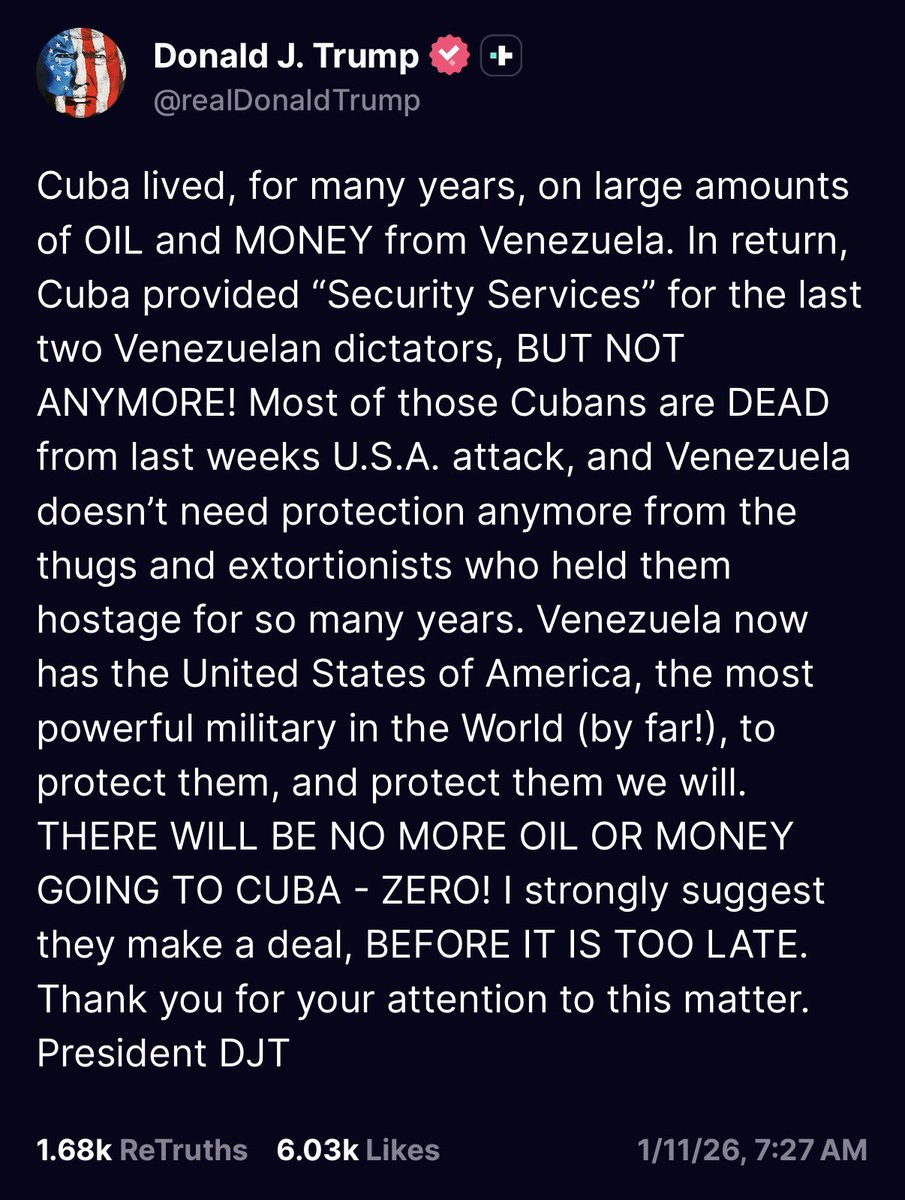
Trump Urges Cuba to Strike Deal as Venezuela realigns with U.S. Security Framework
In a high-stakes turn of regional diplomacy, former President Donald J. Trump is pressing Cuba to negotiate a settlement amid a shifting bloc of influence in the Caribbean and South American region. The public rationale centers on longstanding economic and security ties between Cuba and Venezuela, historically anchored by oil shipments and financial support in exchange for Cuban security personnel assisting Venezuela’s leadership. The new dynamic, Trump argues, follows a rapid realignment in which Venezuela receives U.S. protection and a substantially altered security posture, reshaping how regional actors engage with Havana.
Historical Context: A Ramos of Oil and Security Ties
Cuba’s relationship with Venezuela stretches back to the early 2000s, when the two nations formalized what many observers describe as a reciprocal alliance built on resource exchange and political solidarity. Venezuela’s oil surplus, often priced at favorable terms, flowed to Cuba at scale, helping the island nation sustain its economy and public services during periods of strain. In return, Cuban medical, security, and military personnel were deployed across Venezuela’s political landscape, contributing to governance and social programs while intertwining the two states’ strategic ambitions.
Over time, those ties became a defining feature of Caribbean geopolitics. They also created a complex dependency: Cuba benefited from energy and financial lifelines, while Venezuela leveraged Cuban expertise to support domestic security apparatus and governance initiatives. The relationship thus stood at the intersection of energy diplomacy, regional influence, and ideological alignment, shaping how neighboring countries approached cooperation, sanctions, and political partnerships.
Shifting Dynamics: What the New Arrangement Entails
The current discourse centers on a marked shift in Venezuela’s geopolitical orientation, commonly described by analysts as a pivot toward a security framework backed by U.S. protection and a broader international security architecture. Advocates of this view argue that a new balance of power in the region is emerging, with Washington’s security guarantees altering incentives for both Caracas and Havana. The claimed outcome: diminished Cuban leverage derived from oil and security services, and the possibility of new negotiation avenues that could alter longstanding economic arrangements.
Supporters of the policy shift highlight several mechanisms by which Venezuela’s alignment with U.S. security interests could influence regional diplomacy. First, enhanced U.S. protection is presented as a deterrent against external coercion, potentially recalibrating Venezuela’s cost-benefit calculus in its dealings with adversaries and allies alike. Second, the enhanced security framework may create channels for international cooperation that bypass traditional bilateral arrangements, inviting broader participation in regional governance, energy strategy, and disaster-response coordination. Third, the change may prompt Havana to re-evaluate its economic models, seeking diversification beyond oil-linked assistance to attract alternative investment, trade partnerships, and technology transfers.
Economic Impact: From Oil to Opportunity
The reshaping of Venezuela’s relationship with the United States has potential economic implications for Cuba, Venezuela, and neighboring economies that depend on energy flows and regional trade. For Cuba, the prospect of reduced reliance on Venezuelan oil could accelerate efforts to import diversified energy sources or accelerate domestic energy reforms. This transition could influence pricing, fuel security, and the pace of industrial and agricultural modernization, especially in sectors historically supported by subsidized or preferential oil terms.
For Venezuela, the new alignment with a security-enhanced international framework could unlock access to international markets, capital, and investment that may have been constrained by previous policy stances. The outcome could include more favorable terms on trade, finance, and infrastructure development, depending on how multinational lenders and partner nations assess risk and political stability. The broader regional economy could experience shifts in energy pricing, currency flows, and the reliability of supply chains as oil flows are recalibrated under new diplomatic arrangements.
Regional Comparisons: Similar Shifts, Distinct Trajectories
Nearby nations in the Caribbean and northern South America have observed comparable pushes toward recalibrated security arrangements and diversified energy strategies. Some regional players have pursued deeper integration with international partners to bolster energy resilience and economic diversification. In practice, this means a mix of public-private partnerships, foreign direct investment in energy infrastructure, and efforts to reduce exposure to single-source energy dependencies. The comparative takeaway is that regional stability increasingly hinges on multi-actor diplomacy, where traditional allies and new players shape policy trajectories in concert.
Public Reaction and Social Dimensions
Public reaction to any major realignment in the region tends to be nuanced and multifaceted. In Cuba, segments of the population historically accustomed to state-led economic models may view shifts toward diversification with a mix of caution and optimism. In Venezuela, communities that have weathered long-standing economic fluctuations may interpret changes in security guarantees as a signal of greater stability and international engagement, even as concerns about sovereignty, governance, and living standards persist. Across the region, businesses, farmers, and workers weigh the potential for more predictable energy access, new investment, and improved infrastructure against the risks that accompany rapid geopolitical realignments.
Operational Realities: What Would Negotiated Arrangements Look Like?
If diplomatic talks move forward, negotiators could focus on several practical areas to establish a sustainable framework. These include electricity and energy supply arrangements, transitional financing mechanisms, and governance protocols to manage shifts in security commitments. Other focal points may involve debt restructuring options, transparent terms for any state-backed loans or credit facilities, and shared regional initiatives in health, education, and disaster preparedness. A successful negotiation would likely require clear performance metrics, independent oversight, and mechanisms to protect civilian interests while ensuring regional stability.
Regional Infrastructure and Energy Security
Energy security remains a central thread in discussions about regional diplomacy. The Caribbean basin’s energy landscape is characterized by a mix of hydrocarbons, renewables, and cross-border pipelines, with fluctuations in supply affecting industries from manufacturing to agriculture. Diversifying energy sources can reduce exposure to single-provider dependencies, enhancing resilience for households and businesses alike. Investments in modernization—such as grid upgrades, storage capacity, and distributed generation—could bolster reliability and spur local job creation, contributing to broader economic development goals across the region.
Geopolitical Implications: A Broader International Picture
The evolving dynamic in Venezuela and its neighbors reflects a broader trend in which regional powers negotiate through a spectrum of security guarantees, economic incentives, and diplomatic engagement. This pattern is not isolated to the Caribbean; it resonates with global shifts toward multipolar diplomacy where alliances are more fluid and policy choices carry long-term consequences for trade, investment, and social welfare. Observers emphasize the importance of predictable, rule-based cooperation that prioritizes civilian well-being, transparent governance, and durable partnerships that can weather political transitions.
What Comes Next: Scenarios and Outlook
While it is difficult to forecast with precision, several plausible scenarios could shape the coming months and years. In a best-case trajectory, Cuba and Venezuela reach a mutually beneficial arrangement that stabilizes energy access, accelerates infrastructure projects, and expands regional trade networks, while preserving civilian rights and market-driven reforms. A more cautious scenario might see mixed results, with partial implementations of reforms and continued negotiation to resolve outstanding debt, energy terms, and governance concerns. A less favorable path could involve renewed tensions if security commitments fail to translate into tangible economic improvements or if external pressures complicate the diplomatic process.
Conclusion: A Turning Point for Caribbean Climate of Cooperation
As regional players navigate this period of transition, the emphasis remains on building durable, transparent, and mutually beneficial arrangements that can endure political changes and market fluctuations. The evolving context in Venezuela and its relationship with neighboring nations underscores the central role of energy security, economic diversification, and multilateral diplomacy in shaping long-term stability. Across cities, ports, and industrial zones, businesses and communities are watching closely, with hopes that careful negotiations will translate into steadier energy supplies, more reliable investment, and a more resilient regional economy.
Notes for Readers: Context and Caution
- The situation reflects ongoing developments in regional diplomacy, with actors weighing economic and security considerations alongside geopolitical signals.
- Observers stress the importance of safeguarding civilian livelihoods and ensuring that any security arrangements translate into real economic benefits for ordinary people.
- Regional comparisons highlight that diversified energy strategies and collaborative governance can help mitigate risk in a volatile global energy market.
End of article.