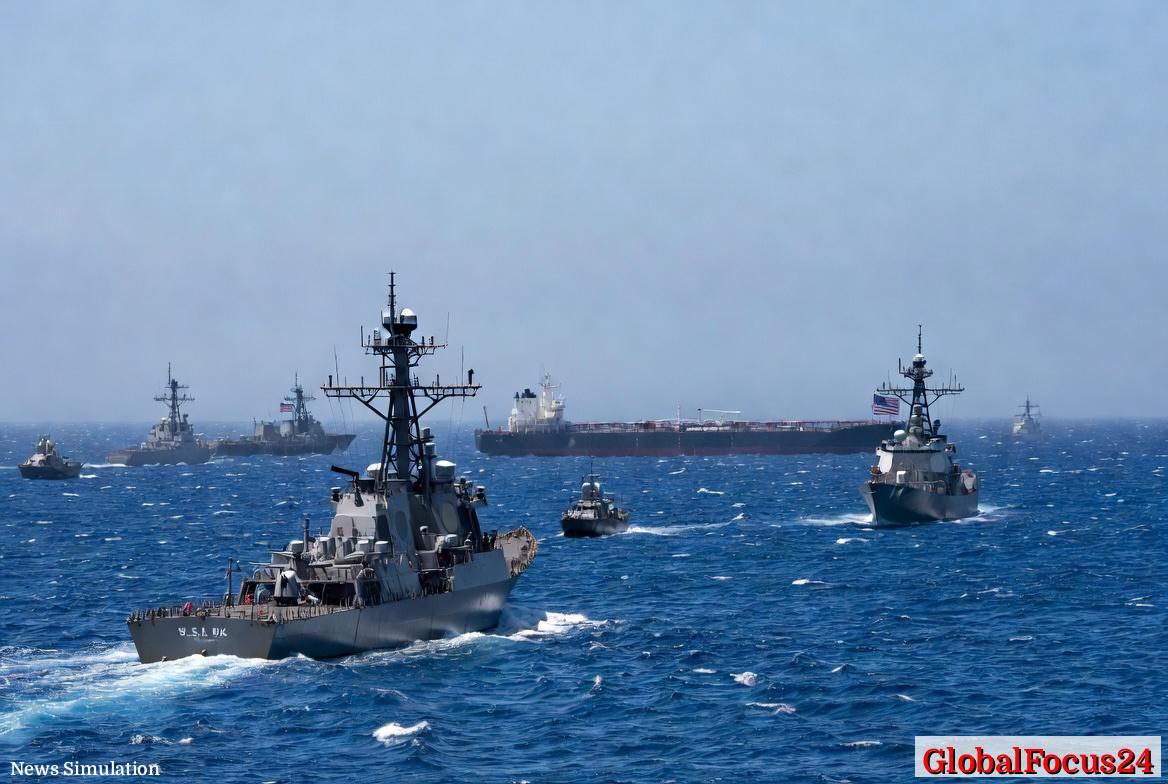
U.S. Announces Naval Blockade of Strait of Hormuz After Collapse of Iran Peace Talks
In a dramatic escalation of tensions following the breakdown of negotiations with Iran in Islamabad, President Donald Trump announced that the United States Navy will begin enforcing a full blockade of the Strait of Hormuz, one of the world’s most critical maritime oil passages. The decision marks one of the most consequential military maneuvers in the region in decades, raising concerns about global energy prices, shipping routes, and the stability of the Persian Gulf.
Trump declared that the blockade would target all vessels attempting to enter or exit the strait, and specifically those that have paid what he described as an “illegal toll” to Iran. “No one who pays an illegal toll will have safe passage on the high seas,” the president said, adding that allied nations were expected to join the effort without specifying which countries would participate. He accused Iran of “extortion” and “nuclear ambitions” and pledged that any hostile action against U.S. forces or civilian ships would meet with overwhelming military response.
A Strategic Chokepoint With Global Consequences
The Strait of Hormuz has long held immense strategic importance. Only about 21 miles wide at its narrowest point, it serves as a vital conduit for nearly one-fifth of the world’s crude oil. Tankers from Saudi Arabia, Kuwait, Iraq, the United Arab Emirates, and Qatar depend on open access to the passage to deliver shipments to energy-hungry markets across Asia, Europe, and North America.
Any interference in the strait’s functioning reverberates through the global economy. Historically, even minor disruptions—from mining operations to skirmishes between Iranian patrol boats and foreign vessels—have sent oil prices soaring. Analysts are warning that a blockade of this scale could surpass the economic shock felt during previous regional crises, including the “Tanker War” of the 1980s and Iran’s brief closure attempts during the tensions of 2019.
Several energy-sector observers describe the current situation as a “perfect storm” of geopolitical instability. With Iranian mines discovered in recent days and the U.S. Navy already mobilizing to clear them, industry experts are watching for signals that international shipping insurers could withdraw coverage for vessels in the Gulf. If that occurs, traders expect oil futures to surge rapidly, potentially exceeding levels not seen since the early 2020 pandemic recovery.
Historical Context: From Cold War Rivalries to Modern Tensions
The announcement recalls earlier confrontations between Washington and Tehran that reshaped maritime strategy in the Persian Gulf. During the Iran-Iraq War in the mid-1980s, Iranian forces targeted oil tankers belonging to Gulf states aligned with the U.S., prompting Operation Earnest Will—a major American escort campaign that saw direct clashes and mine-related sinkings. Those encounters helped define the modern doctrine of U.S. naval dominance in the region.
Movements to control the Strait of Hormuz have frequently coincided with broader attempts by Tehran to leverage its geographic position for economic and political gain. While Iran’s control of territory along the strait gives it partial oversight of traffic through its coastal waters, international law under the United Nations Convention on the Law of the Sea guarantees free passage for commercial vessels in non-conflict conditions. The present crisis challenges that framework and could set a precedent for maritime enforcement operations in contested regions beyond the Middle East.
Military historians note that past blockades have tended to draw in allied navies over time, transforming local security initiatives into multinational patrol efforts. If other countries do join what Trump termed a “coalition operation,” the Strait of Hormuz could witness one of the largest naval concentrations since the Gulf War, when combined forces enforced extensive no-fly and embargo zones.
Economic Impact: Energy Markets Brace for Shock
Global energy markets began reacting even before the official announcement was broadcast. Crude prices jumped overnight as traders assessed the implications of potential long-term closure. Analysts estimate that nearly 18 to 20 million barrels of oil typically pass through the Strait of Hormuz daily; any sustained interruption could remove a significant portion of global supply within days.
Countries heavily dependent on Gulf exports—such as Japan, South Korea, and India—are already exploring emergency energy diversification strategies. Some governments have initiated talks with alternative suppliers, including the United States, Brazil, and Norway, while others seek to expand storage capacities as a buffer against short-term shortages. European refineries, still recovering from the reshuffling of global oil flows after sanctions on Russia in recent years, could also face renewed strain.
Economic experts caution that even if the blockade does not fully halt shipments, insurance costs, rerouting delays, and heightened risk premiums could push energy transport expenses upward. That ripple effect might lead to inflationary pressures worldwide, impacting fuel, manufacturing, and food prices. The International Energy Agency has previously warned that prolonged closure of the Hormuz route could result in a temporary global oil price hike of 30–40%, depending on the duration and intensity of hostilities.
Regional stock exchanges in Dubai, Riyadh, and Doha also experienced noticeable declines following the announcement, reflecting investor anxiety over potential military engagements and shipping disruptions. In contrast, defense and energy stocks in Western markets saw immediate gains amid expectations of increased military spending and higher oil values.
Military Operations and International Response
Pentagon sources confirmed that several U.S. naval assets, including aircraft carriers and destroyers, have already been repositioned toward the Gulf. Mine-clearing formations and surveillance drones are operating in international waters to identify and neutralize sub-surface threats reportedly placed by Iranian forces. While the Department of Defense has not released detailed operational timelines, analysts expect a 24-hour readiness posture to remain in place until maritime routes are declared secure.
Trump’s statement indicated that the blockade will not only prevent Iranian vessels from navigating freely but also interdict foreign ships that pay fees or tolls to Iranian authorities for passage. That stance expands the scope of enforcement beyond direct military deterrence, effectively challenging Iran’s economic ability to profit from controlling transit in the area.
Reactions from international capitals have been mixed. Gulf Cooperation Council members have largely expressed relief that the U.S. is taking decisive measures to ensure open waterways, though they have stopped short of officially pledging military participation. Meanwhile, European and Asian nations have called for restraint, urging renewed diplomatic engagement to avoid escalation that could endanger crews and civilian shipping. China, a major importer of Gulf crude, has reiterated its support for “freedom of navigation” but warned against unilateral military actions that could destabilize global markets.
Lessons From Regional Comparisons
The crisis in the Strait of Hormuz shares striking similarities with past maritime stand-offs, such as the closure of the Suez Canal during the Six-Day War in 1967 and piracy disruptions off the Horn of Africa in the last two decades. In each instance, sustained interference in strategic waterways triggered worldwide logistical realignments and prompted new forms of international security cooperation.
But unlike those earlier cases, the Hormuz blockade involves a direct confrontation between two state militaries with deep-rooted ideological and security rivalries. This increases the risk of prolonged engagement and reduces the likelihood of quick resolution through diplomatic channels. Observers point out that the narrow geography of the region—bordered tightly by Iran to the north and Oman to the south—leaves little margin for maneuvering large fleets without breaching territorial limits.
For Iran, historically reliant on oil exports to sustain its economy, losing access to revenues generated through transit and toll collection would compound domestic pressures already aggravated by sanctions. The United States, meanwhile, must manage rising operational costs and geopolitical fallout while ensuring that global commerce continues uninterrupted.
Outlook: Uncertain Path Ahead
With mine-hunting operations underway and a blockade now formally in motion, the Strait of Hormuz has again become the focal point of international tension. The next several weeks are expected to test both the resilience of global energy supply chains and the credibility of diplomatic mechanisms designed to prevent open conflict.
Military experts observe that while the United States possesses unmatched naval capability, prolonged enforcement could strain resources if Iran or its regional allies engage in persistent harassment or asymmetric tactics. Civilian shipping companies face a daunting decision: whether to risk traversing a militarized zone or reroute vessels thousands of miles around Africa’s Cape of Good Hope, incurring substantial costs and delays.
What began as faltering peace talks in Islamabad now threatens to reshape global trade flows and revive memories of the Gulf confrontations that defined earlier eras of U.S.–Iran relations. As warships converge on the world’s most contested strait, the balance between ensuring maritime freedom and preventing wider regional conflict appears increasingly fragile. Whether diplomacy can reemerge as an alternative to force remains an open question—one with profound consequences for every economy linked to the flow of oil through the narrow waters of Hormuz.