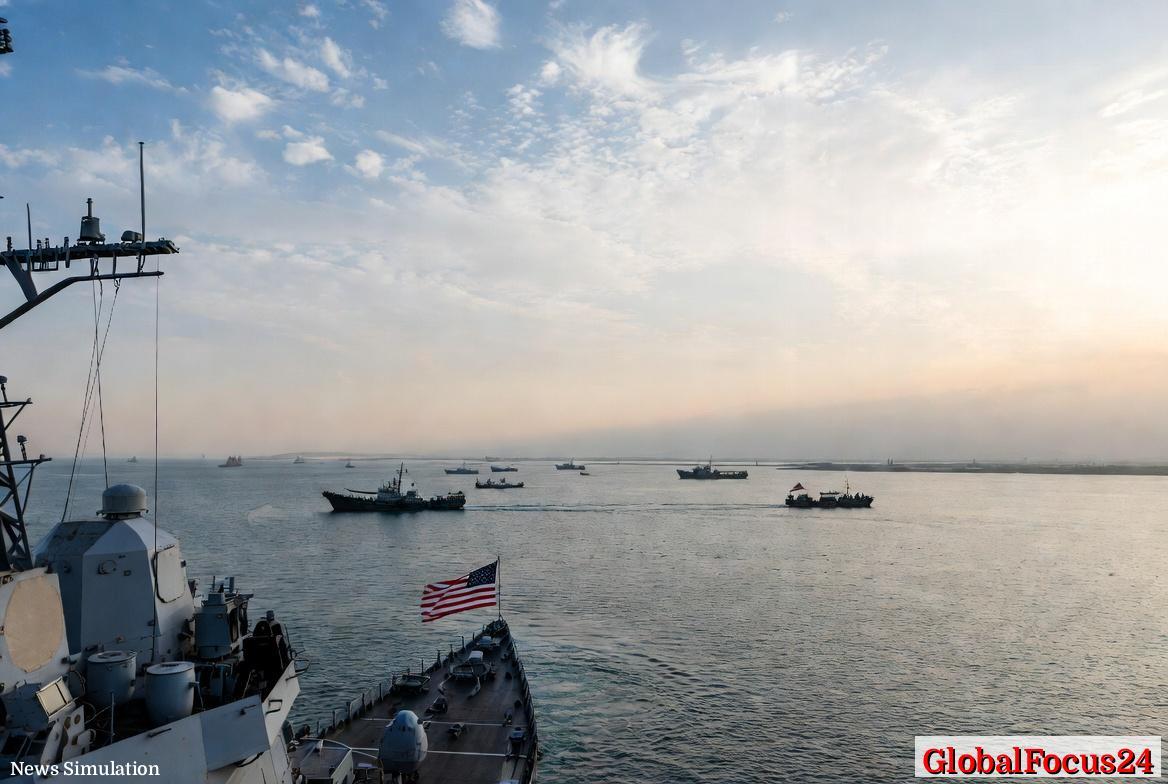
U.S. Military Enforces Blockade of Strait of Hormuz Amid Rising Global Energy Tensions
A New Phase in the Persian Gulf Standoff
The United States military has officially begun a full blockade of the Strait of Hormuz, declaring that the measure will be imposed equally on vessels of all nations seeking entry to or exit from Iranian ports and coastal areas. In its statement, the U.S. Department of Defense emphasized that freedom of navigation will remain protected for ships transiting the strait to and from non-Iranian ports, but vessels linked to Iranian commerce will be subject to interdiction.
This development marks a significant escalation in one of the world’s most strategic maritime chokepoints—a narrow waterway through which roughly one-fifth of global oil supply typically passes. The operation represents the most direct military enforcement action by U.S. forces in the Persian Gulf in more than a decade and introduces new uncertainty into global energy markets already grappling with tight supply and volatile prices.
The Strategic Importance of the Strait of Hormuz
The Strait of Hormuz connects the Persian Gulf to the Gulf of Oman and the Arabian Sea, serving as the primary maritime export route for the oil-rich nations of the region. Historically, the strait has been regarded as a geopolitical pressure point, particularly during times of heightened tension between Iran and Western powers.
At its narrowest, the strait is just 21 miles wide, yet it handles around 20% of the world’s petroleum liquids consumption under normal conditions. Any disruption, even temporary, can send shockwaves through the global economy. For decades, Iran has exercised a degree of de facto control over traffic through the strait—both through geography and through threats of closure during diplomatic crises. The new U.S. blockade effectively reverses that dynamic, tightening the military and economic containment around Tehran.
Impact on Iranian Oil Exports
Before the imposition of the blockade, Iranian ports were still operating with relative consistency, and the country managed to export over 2 million barrels of oil per day—primarily to Asia, including China and India. Those revenues have been a crucial lifeline for Iran’s economy, already constrained by extensive sanctions targeting its financial and energy sectors.
The blockade now cuts off most of that remaining trade. Analysts describe the move as a decisive blow to Iran’s oil-dependent revenue stream. With maritime access to its ports restricted, Tehran’s ability to export crude or import refined products will shrink dramatically. Land routes through neighboring Iraq or across the Caspian Sea offer limited capacity and higher logistical costs, meaning that major disruptions are inevitable.
Historically, even partial closures or threats involving Hormuz have driven prices sharply upward. In 2011–2012, for example, when tensions spiked over Iran’s nuclear program, crude prices temporarily surged above $110 per barrel. The current blockade could have an even broader effect, given today’s tighter global inventories and ongoing instability in several other energy-producing regions.
Global Oil Markets React
International oil markets responded almost immediately to the U.S. announcement. Benchmark Brent crude rose more than 9% within hours, reaching levels not seen since early 2023. West Texas Intermediate (WTI), the U.S. crude benchmark, followed a similar trajectory. Traders and analysts now forecast sustained prices above $100 per barrel if the blockade remains in place for more than a few weeks.
Beyond futures markets, the impact on retail fuel prices is already being felt. U.S. gasoline averages have climbed steadily throughout the week, with national prices now projected to exceed $4.25 per gallon—a level not reached since the energy shocks of the early 2020s. The West Coast, particularly California, where fuel costs are typically higher due to refining and environmental regulations, could see prices approach or exceed the $5 mark.
Energy-intensive industries and global shipping operators are bracing for operational cost spikes. The surge in oil prices could also exert inflationary pressures across multiple sectors, testing central banks and potentially delaying interest-rate cuts in major economies.
Historical Context: The Gulf and Blockades
The Persian Gulf has a long history of maritime confrontations, embargoes, and “tanker wars.” During the 1980–1988 Iran–Iraq War, both nations attacked commercial vessels transiting the Gulf, prompting the U.S. Navy to begin escort operations under what became known as Operation Earnest Will. That mission marked a precedent for today’s intervention: safeguarding international waterways while simultaneously countering Iranian influence.
However, the current blockade differs in both scope and intent. Rather than merely protecting transiting vessels, U.S. forces are now actively restricting Iranian commercial activity. Military analysts note that this approach reflects a broader strategic shift toward economic denial and containment, using maritime dominance to apply pressure without direct confrontation on land.
If maintained over a prolonged period, the blockade could surpass even Cold War–era embargoes in its effectiveness, given modern tracking, satellite surveillance, and artificial intelligence-based enforcement technologies.
Regional Repercussions and Diplomatic Fallout
Neighboring Gulf states, including Saudi Arabia, the United Arab Emirates, and Qatar, have expressed measured concern. While these countries are key partners of the United States and major oil exporters themselves, the risk of regional escalation remains. Any maritime miscalculation could jeopardize civilian shipping or lead to retaliatory acts by Iranian proxies across the Middle East.
European governments and Asian energy importers have already convened emergency meetings with U.S. officials to evaluate supply alternatives. Many nations are tapping strategic reserves to prevent domestic fuel shortages. Meanwhile, global shipping insurers have begun reassessing risk premiums for vessels transiting the wider Persian Gulf, which could further raise the cost of energy transport.
Iran’s initial response, delivered through state media, denounced the blockade as an “act of economic warfare.” While no direct military retaliation has been reported, Iranian naval and Revolutionary Guard units have reportedly increased patrol activity near Bandar Abbas and the Qeshm Island area. Military observers warn that even a brief skirmish could inflame the entire region.
Economic Consequences at Home and Abroad
For the United States, the immediate economic impact centers on fuel costs. Rising gasoline prices threaten to sap consumer spending power, slow economic growth, and complicate efforts to sustain moderate inflation. Trucking and logistics companies, key components of the national supply chain, will face steeper operating costs, potentially passing those expenses on to consumers.
Globally, higher energy prices could accelerate a shift toward renewable energy investment, but in the short term, the shock could harm emerging markets dependent on imported fuel. Asian economies such as India, Japan, and South Korea—heavily reliant on Gulf oil—face difficult sourcing decisions. Some may seek expanded supplies from Africa, Latin America, or the United States itself, though existing production capacities may not fully offset Iranian losses.
In Europe, still recovering from earlier supply disruptions linked to conflicts in Eastern Europe, the blockade renews debates about energy independence and diversification. Liquefied natural gas (LNG) demand may rise as utilities seek to limit reliance on volatile oil imports.
Comparison with Previous Energy Crises
This situation invites comparisons with earlier oil shocks: the 1973 Arab oil embargo, the 1990 Gulf War, and the 2019 attacks on Saudi oil infrastructure. Each event disrupted global supply chains and reshaped energy policy debates. Yet today’s environment differs fundamentally—world production is more diversified, renewable energy and electric vehicles are rising, and strategic reserves are larger.
However, the nature of global interdependence means that even marginal reductions in Gulf exports can send prices soaring. The U.S. blockade, by design, curtails roughly 2 million barrels per day of potential Iranian supply—comparable to the entire output of a mid-sized producer such as Mexico or Norway.
Some market economists argue that this could trigger a medium-term supply gap lasting several quarters. Others note that higher prices may incentivize U.S. shale producers to increase output, potentially softening the shock by late 2026.
The Road Ahead: Duration and Uncertainty
Pentagon officials have declined to specify how long the blockade will remain in effect, stating only that enforcement will continue “until Iran demonstrates verifiable compliance with international norms.” The ambiguity leaves markets guessing whether the measure represents a short-term show of strength or a sustained campaign to erode Iran’s economic foundation.
For now, around-the-clock aerial patrols, naval destroyers, and drone surveillance platforms are monitoring the strait. Shipping data from regional ports indicate that traffic to Iranian terminals has dropped by more than 80% in just 48 hours, signaling the blockade’s immediate effectiveness.
If sustained, this enforcement could reshape global energy logistics for years, pushing major economies to adapt with alternate trade routes, enhanced production capacity, and renewed investment in energy resilience.
A Turning Point in Global Maritime Strategy
The U.S. blockade of the Strait of Hormuz represents more than an isolated military decision—it marks a turning point in the strategic balance of the Gulf and the global energy market’s delicate equilibrium. While the move strengthens Washington’s hand in deterring Iranian influence, it also exposes consumers worldwide to renewed volatility and economic strain.
As tankers reroute, oil markets churn, and diplomats scramble for solutions, the world once again faces a reminder of how a single maritime chokepoint—no wider than a few dozen miles—can hold the global economy in suspense.