Iran War Resolution Blocked as Strait of Hormuz Tensions and Fuel Costs Rise
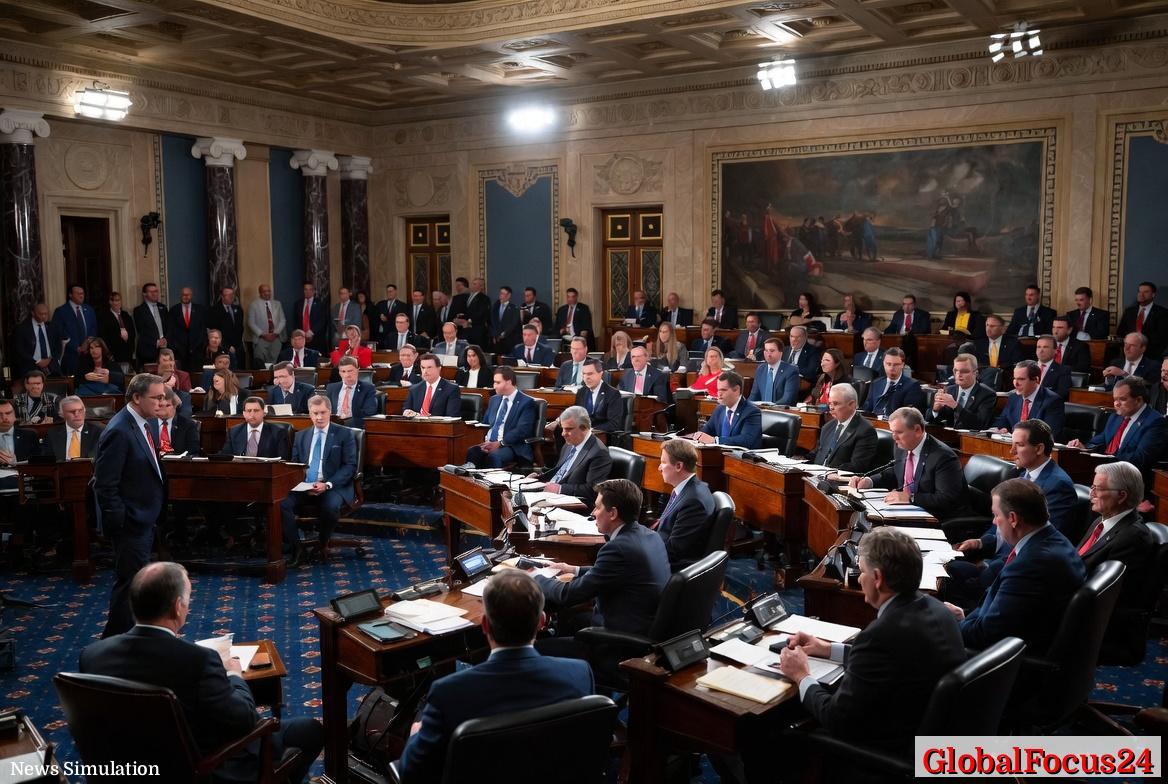
Senate Republicans on Wednesday blocked a Democratic-led resolution that would have curtailed President Trump’s authority to wage war on Iran, deepening a high-stakes debate in Washington as the conflict enters its seventh week and economic pressures continue to build. The measure failed 52-47 after Democrats forced a vote on war powers, underscoring how the crisis has become both a military and economic test for the United States and for the wider Middle East.
Senate Vote Deepens War Powers Fight
The failed resolution marked the fourth attempt in recent weeks by Democrats to reassert congressional authority over military action involving Iran. Republicans overwhelmingly opposed advancing the measure, while Sen. John Fetterman of Pennsylvania broke with most Democrats to side with the GOP. Sen. Rand Paul of Kentucky, meanwhile, was the lone Republican to support the Democratic effort.
The vote reflects a familiar constitutional tension that has resurfaced in moments of overseas conflict: how much leeway a president should have to use force without a formal declaration of war. That debate has shadowed U.S. policy for decades, from Vietnam to Iraq, and it returns now against the backdrop of a fast-moving confrontation in one of the world’s most strategically important waterways.
Strait of Hormuz Under Pressure
At the center of the crisis is the Strait of Hormuz, the narrow passage through which a large share of the world’s seaborne oil travels. Reports this week described dueling blockades and mounting disruption to traffic through the strait, with shipping delays and uncertainty adding to the strain on global energy markets.
The Strait of Hormuz has long been a geopolitical pressure point. For decades, every major flare-up involving Iran has raised fears that disruptions there could ripple far beyond the Gulf, affecting refineries, tanker traffic, insurance costs and the price of fuel in markets from Europe to Asia and North America. That history helps explain why even limited military activity in the area can send economic shock waves through far-flung economies.
Fuel Prices and Consumer Strain
The economic fallout is already being felt in the United States, where several Republicans have voiced concern about higher gasoline prices. Sen. Josh Hawley of Missouri said he hopes an exit strategy can be reached that would protect U.S. security interests and bring down fuel costs, an acknowledgment that foreign policy in the Gulf can quickly become a domestic pocketbook issue.
That concern is not theoretical. Oil shocks have repeatedly filtered into U.S. inflation, transportation costs and household budgets, especially in states where commuters depend heavily on cars. In broad regional terms, the Middle East remains the most exposed to direct disruption, but Europe and parts of Asia are also highly vulnerable because of heavier dependence on imported energy. The United States has more insulation than it did in past decades thanks to domestic production, yet it still cannot escape the effects of sustained price spikes.
Diplomatic Talks Stall
Efforts to calm the situation have so far failed to produce a durable breakthrough. Diplomatic talks remain at a standstill, while the fragile cease-fire is showing signs of fraying. The result is a tense standoff in which each side appears to be testing the limits of the other’s resolve, while shippers, governments and energy traders wait for clearer signals.
That uncertainty matters because markets often react not just to actual supply disruptions but to the fear of them. Even the perception that tanker routes might be obstructed can raise freight and insurance premiums, encourage precautionary stockpiling and lift benchmark oil prices. Those effects can spread quickly into broader inflation readings, especially when food, transportation and industrial inputs all move higher together.
Economic Impact Spreads Beyond Energy
The conflict’s economic impact extends well beyond fuel. An oil shock can weaken growth by squeezing consumer spending, raising business costs and complicating central bank policy. The International Monetary Fund recently lowered its global growth outlook in response to the Middle East war, warning that the outlook could darken further if the conflict drags on and damages energy infrastructure more severely.
For emerging markets, the strain can be especially harsh. Many developing economies are more exposed to imported fuel costs, foreign exchange pressure and food inflation than wealthier countries. By contrast, major energy exporters may benefit from higher prices in the short term, even as they face broader instability in trade routes and financial markets. This divide is one reason the conflict’s economic consequences look different in the Gulf, in Europe and in the United States, even though the shock begins in the same narrow stretch of water.
Regional Comparisons Across Markets
Across the Gulf, the conflict is particularly disruptive because critical trade, tourism and shipping networks are concentrated in a relatively small area. Gulf states have invested heavily in diversification, logistics and aviation hubs, yet those gains can be vulnerable when transport lanes are threatened or when investor confidence weakens. The region’s dependence on energy revenues also means that any prolonged disruption can create a complicated mix of higher oil income and higher operational risk.
Europe faces a different challenge. It is less directly exposed to Gulf shipping bottlenecks than Asia, but it remains sensitive to rising energy prices because of its import dependence and already uneven growth outlook. In the United States, the immediate effect is usually seen first at the gas pump and then more broadly through transportation, manufacturing and consumer sentiment. In each region, the same oil shock tends to arrive through a different channel, but the result is similar: slower growth and higher inflation.
Historical Echoes of Energy Shock
This is not the first time conflict in the Middle East has unsettled energy markets. Previous crises in the Gulf showed how quickly political and military tension can become an economic story, especially when ships are threatened or oil infrastructure comes under pressure. Those episodes left policymakers with a durable lesson: energy security is inseparable from national security.
The current standoff echoes that pattern. Even if the fighting remains geographically limited, the interconnected nature of modern oil markets means that traders react immediately to any sign of prolonged disruption. That reaction can become self-reinforcing, lifting prices before a full supply shortage actually emerges and complicating the policy response for governments trying to balance security and affordability.
Public Reaction and Political Pressure
Public reaction has been shaped less by abstract strategy than by practical concerns. Higher gasoline prices are a visible and immediate sign that events overseas are affecting everyday life, and that visibility often intensifies pressure on lawmakers of both parties. The Senate vote showed that war powers are only part of the story; the other part is whether the U.S. can manage the conflict without pushing fuel costs higher or creating fresh instability in global trade.
Even among Republicans, unease is emerging over how long the confrontation can continue without a clear off-ramp. The dispute over congressional authority, the strain on shipping lanes and the risk of more expensive energy are converging into a single political and economic problem. For now, neither the cease-fire nor the diplomacy appears strong enough to restore confidence on its own.
What Comes Next
The immediate outlook depends on whether shipping through the Strait of Hormuz can normalize and whether talks between the United States and Iran can restart. If the blockade pressure eases, markets may quickly unwind some of the recent spike in prices. If not, the conflict could continue to weigh on growth, stoke inflation and keep the world’s most important energy chokepoint at the center of global attention.
For businesses, policymakers and consumers, the message is stark: a conflict that began as a military confrontation is now also a test of economic resilience. With fuel markets unsettled, diplomatic channels stalled and congressional divisions widening, the crisis is shaping up to be one of the most consequential foreign policy and economic stories of the season.