U.S. Navy to Enforce Full Blockade of Strait of Hormuz Amid Rising Tensions with Iran
US Announces Naval Blockade in the Strait of Hormuz
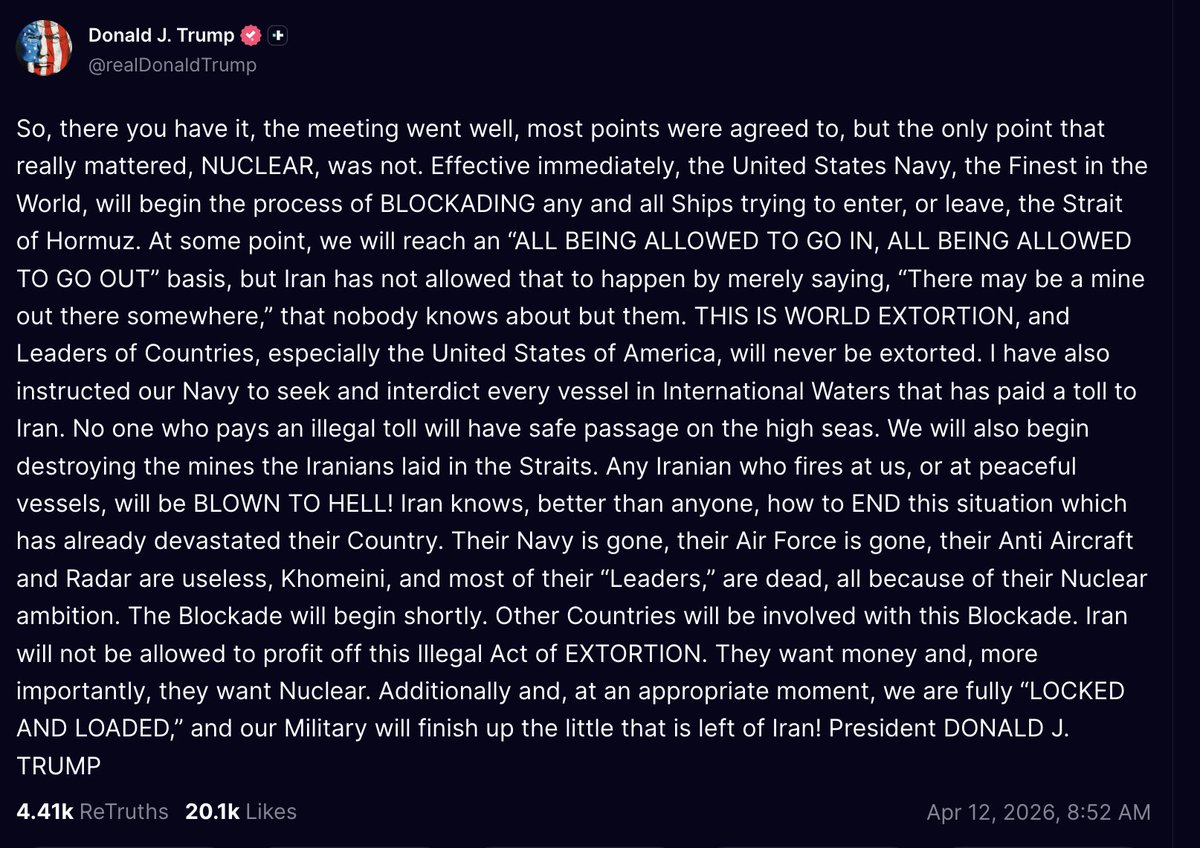
In a dramatic escalation of maritime tensions, President Donald Trump announced that the United States Navy will begin enforcing a full blockade of the Strait of Hormuz, one of the world’s most critical oil transit routes. The announcement came after weeks of increasing hostility between Washington and Tehran, prompting global concern over potential disruptions to international trade and energy markets.
“Any Iranian who fires at us, or at peaceful vessels, will be blown to hell,” Trump declared during a press briefing from the White House, signaling a firm stance intended to deter aggression and safeguard what he described as “the free passage of neutral ships.”
The Strait of Hormuz, a narrow chokepoint between the Persian Gulf and the Gulf of Oman, carries nearly 20% of global petroleum exports each day. Its strategic importance has made it a frequent flashpoint in U.S.–Iran relations. The new blockade marks the most significant U.S. naval action in the region since the Iran–Iraq War in the 1980s.
Historical Context: A Century of Strategic Struggle
Control over the Strait of Hormuz has shaped regional and global geopolitics for decades. During the 1980s “Tanker War,” Iran and Iraq targeted oil shipping in the Gulf, prompting the U.S. to escort reflagged Kuwaiti tankers under Operation Earnest Will. That operation represented the last major U.S. commitment to direct naval protection of shipping lanes in the region.
Tensions resurfaced in 2019, when a series of tanker attacks and drone incidents raised fears of a direct confrontation. The current blockade, however, represents a qualitative shift — from defensive patrols to active maritime interdiction. According to Pentagon officials, U.S. forces will now intercept, board, or turn back vessels suspected of transporting Iranian crude oil, weapons, or dual-use technologies.
While U.S. administrations have long used sanctions to restrict Iran’s oil exports, this move extends beyond economic measures. A full blockade carries legal and diplomatic implications, potentially classifying the action as an act of war under international law if not supported by a United Nations mandate.
Economic Fallout: Oil Markets React and Shipping Pauses
Oil prices spiked immediately following the announcement, with Brent crude climbing nearly 12% in early Asian trading. Energy analysts warn that prolonged disruption in the Strait could push global prices past $150 per barrel, levels not seen since 2008. Major importers in Asia — particularly China, India, Japan, and South Korea — face the greatest exposure, as they rely heavily on Middle Eastern crude transported through this narrow corridor.
Shipping insurers have already begun raising rates for vessels transiting the Gulf, citing “extraordinary risks.” Some logistics firms are redirecting routes through longer journeys around Africa via the Cape of Good Hope. The shift could strain an already volatile maritime freight industry still recovering from years of congestion and post-pandemic instability.
The International Energy Agency (IEA) stated it is “closely monitoring developments” and reiterated that member nations maintain strategic petroleum reserves sufficient to offset several months of supply disruptions. However, analysts note that even short-term interruptions in Hormuz traffic could trigger cascading impacts on inflation, fuel costs, and consumer prices worldwide.
Military Readiness and Regional Posturing
The Pentagon confirmed that two aircraft carrier strike groups — the USS Gerald R. Ford and USS Abraham Lincoln — are now operating in or near the Arabian Sea. Additional support ships, including guided missile destroyers, amphibious assault vessels, and reconnaissance drones, have been deployed to increase surveillance and enforce the blockade perimeter.
U.S. Central Command emphasized that the mission’s primary goal is to “ensure freedom of navigation” and “deter Iranian aggression.” Iran, meanwhile, has denounced the blockade as an “act of hostility” and vowed to defend its territorial waters. Iranian Revolutionary Guard commanders issued statements warning that any attempt to halt Iranian ships will be met with “immediate retaliation.”
Defense analysts point out that Iran’s naval capabilities, though limited compared to the United States, rely on asymmetric strategies — including fast-attack boats, sea mines, and anti-ship missiles stationed along the coast. Such tactics, designed to harass larger vessels, could make enforcement of a prolonged blockade both dangerous and costly.
Legal and Diplomatic Implications
Under international law, blockades are typically recognized only during declared conflicts. A unilateral blockade without United Nations authorization could provoke dissent among allies and complicate global diplomatic coordination. European Union leaders have already expressed concern that the move risks escalation at a time when efforts to revive nuclear diplomacy with Iran remain stalled.
China and Russia called for restraint, with Moscow accusing Washington of “unilaterally destabilizing regional shipping lanes.” Both nations have deep economic ties to Iran, particularly through oil trade and energy infrastructure projects. Diplomatic observers anticipate that the blockade may drive Tehran closer to these powers, strengthening non-Western coalitions that challenge U.S. dominance in maritime security.
The U.S. State Department, responding to questions about international legality, argued that the action falls within the scope of “defensive measures to secure freedom of navigation” under customary maritime law. Yet maritime legal scholars remain divided, noting that the distinction between interdiction and blockade can quickly blur in practice.
Regional Comparisons: Gulf States Brace for Impact
Neighboring Gulf nations, including Saudi Arabia, the UAE, and Qatar, maintain strategic energy corridors that help bypass the Strait of Hormuz, but these alternatives offer limited capacity. Saudi Arabia’s East-West Pipeline, which connects the Arabian Gulf to the Red Sea, can handle roughly half of its total export volume, while the UAE’s Fujairah terminal offers another partial outlet.
Oman, positioned along the southeastern edge of the strait, has called for “calm and dialogue” and offered to host emergency diplomatic talks. Historically neutral in U.S.-Iran disputes, Oman often serves as a quiet facilitator of backchannel negotiations between the two states.
Regional financial markets reacted sharply, with stock indices across the Gulf Cooperation Council falling by 3–6%. Energy-linked sectors bore the brunt of the decline, while defense and infrastructure firms saw moderate gains on expectations of increased government spending.
Domestic and Global Reactions
In Washington, reactions were swift and polarized. Supporters praised the move as a strong show of American resolve against Iranian threats, while critics warned that the blockade could drag the United States into a costly and prolonged maritime conflict. Congressional leaders have requested classified briefings on the legal basis and projected duration of the operation.
Globally, port authorities and shipping consortia have suspended scheduled transits through Hormuz until U.S. Navy procedures and communication channels become clear. Logistics operators warn that confusion over boarding rules and identification protocols could lead to accidental confrontations.
Meanwhile, energy-importing nations such as Japan and South Korea have begun exploring emergency releases from strategic reserves. India, one of Iran’s largest oil customers before U.S. sanctions tightened, faces particular challenges balancing diplomatic relations with both Washington and Tehran.
The Broader Strategic Picture
Analysts view the blockade not only as an immediate response to rising tensions but also as part of a broader U.S. effort to contain Iran’s regional influence and reassert dominance over global sea lanes. The move also signals Washington’s willingness to use hard power at a time when maritime disputes are intensifying from the South China Sea to the Eastern Mediterranean.
“This is as much a message to Beijing and Moscow as it is to Tehran,” noted one Gulf-based security expert. “The U.S. is demonstrating that its naval projection in critical chokepoints remains unmatched.”
Still, the risks of miscalculation loom large. A single incident — such as the interception of a vessel with mixed ownership or unclear registration — could spark direct hostilities, especially amid heightened political rhetoric on both sides.
Looking Ahead: Energy Security in an Uncertain Era
As the world watches the Strait of Hormuz, policymakers face renewed questions about energy security and dependence on vulnerable supply routes. The crisis may accelerate the global push for diversification — whether through increased domestic production, alternative pipeline routes, or renewable energy expansion.
For now, shipping fleets are repositioning, markets are roiled, and diplomats are scrambling to prevent the blockade from igniting a broader conflict. The U.S. Navy’s actions in the days ahead will determine not only the immediate security of the Persian Gulf but also the trajectory of global energy stability for years to come.