Drought in Turkana County Pushes Thousands to the Brink of Hunger as Livelihoods Collapse
A Deepening Humanitarian Crisis in Northern Kenya
In the vast, arid lands of north-western Kenya’s Turkana County, the steady hum of survival has quieted into despair. Once teeming with life and herds of livestock, the semi-desert now bears the marks of a climate crisis that has turned rivers into dust and grazing fields into barren stretches of ash-colored sand. For thousands of residents like Lotkoy Ebey, a mother in her early fifties, the drought has left not only the soil stripped bare but also the fragile livelihoods that have sustained her community for generations.
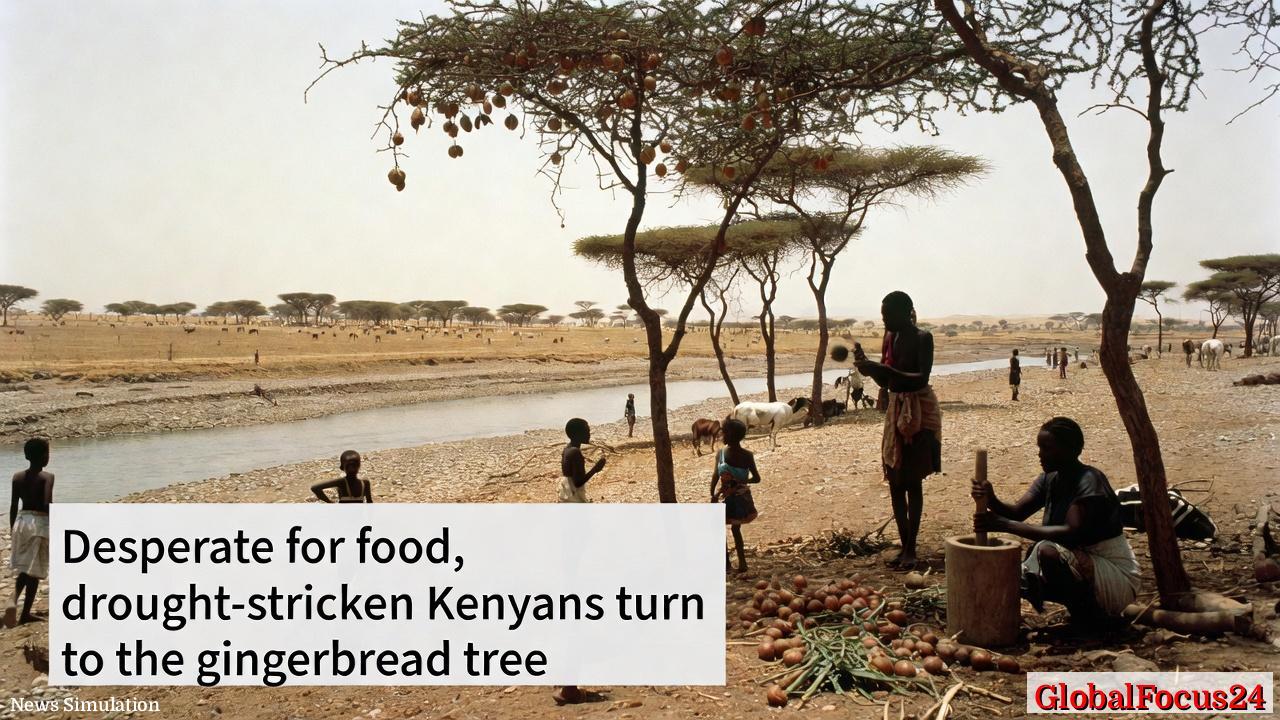
Ebey once owned a robust herd of 50 goats—symbols of wealth, pride, and tradition among Turkana pastoralists. Today, she watches over the five gaunt animals that remain, their ribs visible against patchy hides. Eating twice a day has become a memory. More often, she and her family subsist on a single modest meal or go hungry for days, walking miles under a punishing sun to forage for wild fruits from the gingerbread tree, known locally as the doum palm or mikwamo.
“Our goats used to survive even in the hardest seasons,” she says, her voice carrying both exhaustion and quiet dignity. “Now, even the goats have nothing to eat.”
Foraging to Survive: The Bitter Fruits of Drought
In villages like Kakwanyang and Latimani, community life revolves around survival rituals long forgotten in times of plenty. Under sparse acacia shade, women gather daily to pound the brown, knobby fruits of the doum palm—hard and wiry on the outside but yielding a faintly sweet, gingerbread-like pulp.
“We eat these because of hunger,” says Regina Ewute Lokopuu, who shares what she gathers among her children and her last remaining goat. In prosperous years, these fruits were little more than a snack for children tending herds; now, they are the only means to quiet rumbling stomachs. The doum fruit can fill the belly quickly, but it comes with side effects — excessive consumption causes severe stomach pains and fatigue.
When fortune permits, the women shape palm leaves into brooms for sale in nearby markets. The few coins earned buy maize flour, allowing families to mix the two food sources for better nutrition and fewer side effects. For most, however, even this small trade has become increasingly difficult as local markets shrink and transport costs rise due to failing roads and fuel shortages.
Displacement and the Fragmented Family Structure
The drought has not only withered crops and killed livestock but also fractured family structures across Turkana. With pastures exhausted, many men have migrated in search of distant grazing land, some crossing into neighboring Uganda, South Sudan, or Ethiopia. Women and children now bear the burden of survival, left in parched homesteads without resources or protection.
In Latimani, 38-year-old mother Kerio Ilikol has gone three days without food, surviving on a handful of fruit given by a neighbor. “Help us now that you’ve come to visit. We don’t have food; even goats don’t have food,” pleads another villager, Akale Helen, her voice barely carrying over the wind that sweeps through the empty riverbeds.
Why the Drought Persists
Turkana County lies within Kenya’s arid and semi-arid lands, which cover over 80 percent of the country. These regions have long been prone to dry spells, but in recent years, climate patterns have shifted dramatically. The failure of two consecutive rainy seasons—typically a lifeline for herders—has plunged the area into its harshest conditions in decades.
According to the National Drought Management Authority (NDMA), more than 320,000 people in Turkana urgently require food aid. Across Kenya, the figure nears three million, while the broader Horn of Africa—including parts of Ethiopia, Somalia, and South Sudan—counts over 26 million people facing extreme hunger.
Jacob Letosiro, part of Turkana’s drought management team, cautions that recent rainfall in other Kenyan regions offers no quick fix: “Even if the rains fall now, they won’t bring immediate relief. It will take months for water sources and grazing lands to recover.”
The Economic Toll on Livelihoods
The economic consequences of this prolonged drought stretch far beyond empty pastures. Livestock deaths have erased both income and savings for millions of pastoralists who rely on the sale of animals for food, school fees, and medical costs. With herds gone, trading hubs like Lodwar, Kakuma, and Lokichar have seen sharp declines in business activity.
Local markets that once bustled with the sound of buyers and sellers now stand half-deserted. Maize and sorghum prices have surged, sometimes doubling in just months, while clean water—hauled in by trucks from distant boreholes—has turned into a scarce and costly commodity. In a county where the majority live on less than two dollars a day, such price hikes are devastating.
This ripple effect extends to the national economy. Agriculture contributes roughly one-third of Kenya’s GDP and remains the primary livelihood for much of the population. Chronic drought undermines food security, weakens export revenue, and increases government expenditure on emergency relief and imports.
History Repeats in a Warming Climate
Drought is not new to Turkana. Historical records dating back to the 1970s show recurring dry spells roughly every five to ten years. However, the frequency and severity of these events have intensified amid global climate change.
In 1980 and again in 2011, the region suffered crippling food shortages that led to widespread displacement and livestock deaths. Each crisis has eroded the community’s resilience, leaving families with fewer animals, fewer coping options, and less access to traditional grazing corridors that are increasingly constrained by land disputes and insecurity.
Unlike earlier decades, when recovery was aided by predictable seasons and smaller populations, today’s crises compound faster. The population of Turkana County has grown, putting pressure on meager water resources. At the same time, surface temperatures have risen steadily, and traditional pastoral migration routes are complicated by modern borders and development projects.
Comparing Regional Struggles
Turkana’s plight is echoed across the Horn of Africa, where similar environmental pressures have triggered food insecurity on an unprecedented scale. In Somalia, two-thirds of the population remains vulnerable after five failed rainy seasons. Southern Ethiopia’s pastoral zones report massive livestock losses, while parts of Sudan grapple with both drought and conflict-driven scarcity.
Uganda’s Karamoja region, just across the border from Turkana, faces near-identical conditions: failed harvests, loss of grazing land, and communities surviving on wild fruits and humanitarian aid. These interlinked crises illustrate how East Africa’s environmental and economic systems are deeply connected. When drought strikes one region, its effects ripple across borders through food prices, migration, and resource competition.
Aid Efforts and Government Response
Near Lodwar, the regional capital, humanitarian activity hums in sporadic bursts. At a Kenyan Red Cross depot, workers load sacks of maize flour and beans onto trucks destined for remote villages. Rukia Abubakar, who coordinates the local relief operations, says their efforts barely scratch the surface of the need. “We have only a little food, which cannot reach everyone. We are asking for more support from partners and well-wishers.”
Aid organizations such as the World Food Programme, World Vision, and the International Rescue Committee are scaling up food distributions, cash transfers, and water trucking services. Yet logistical challenges—poor road infrastructure, rising fuel costs, and limited air access—slow delivery to some of the hardest-hit areas.
The Kenyan government has pledged more support through its National Drought Contingency Fund, promising food distributions, livestock feed supplements, and long-term water projects. However, bureaucratic delays and limited funding have tempered expectations among local leaders.
A Fragile Relief and a Question of the Future
For families like Ebey’s, daily existence revolves around uncertainty. The doum fruits that line her compound offer both sustenance and reminder—an ancient tree now carrying the weight of modern hunger. “We wake up and search for something, anything to feed our children,” she says quietly. “We just wait for rain.”
Experts warn that without significant investment in drought preparedness—such as resilient agriculture, community water projects, and livestock insurance schemes—Turkana’s cycle of crisis will persist. Climate adaptation programs have shown promise in parts of southern and central Kenya, where smallholder farmers have switched to drought-tolerant crops, irrigation, and water harvesting. Bringing similar interventions north could provide a way forward.
Still, relief alone cannot rebuild what has been lost. As water holes vanish and children grow up in hunger’s shadow, Turkana faces a crossroads between endurance and transformation. The county’s resilience, tested through generations, may yet endure, but only if the world acts quickly enough to turn empathy into meaningful aid and sustainable development.
In the sun-scorched expanse of north-western Kenya, time and rainfall are running out.