China’s Clean Air Campaign Faces Slower Progress After a Decade of Gains
A Nation That Declared War on Smog
When China’s leadership announced an all-out “war on pollution” in 2014, the country was grappling with some of the world’s worst air quality. Rapid industrialization, urban expansion, and a growing appetite for coal had left major cities, including Beijing, shrouded in toxic smog. Schools closed on bad air days, flights were grounded, and citizens donned masks long before the pandemic era made them common worldwide.
Twelve years later, the air across much of China is markedly cleaner. Levels of harmful fine particulate matter (PM2.5) — tiny airborne particles that penetrate deep into the lungs — have been cut by more than half nationwide since the campaign’s launch. Beijing, once synonymous with “airpocalypse”s, now frequently reports air quality within national safety limits. These achievements reflect one of the fastest documented improvements in air quality ever recorded for a country of China’s size.
Yet momentum has slowed. The steep declines that characterized the campaign’s first years have tapered off. Researchers and environmental analysts warn that the next phase of cleaner air will be harder won — requiring not only technical upgrades but systemic changes to China’s growth model.
The Early Years: A Drive Led by Policy and Technology
China’s initial successes in combating air pollution were built on a foundation of aggressive policy tools. After 2014, authorities rolled out the Air Pollution Prevention and Control Action Plan, setting binding targets for key regions such as Beijing-Tianjin-Hebei, the Yangtze River Delta, and the Pearl River Delta. Provincial governments were held accountable for meeting emissions goals, with local leaders’ career prospects tied to performance.
Power generation and heavy industry were the first targets. Thousands of small coal-fired boilers were replaced or shut down. Larger coal plants were outfitted with advanced scrubbers and catalytic converters. Steel mills and cement factories installed filters to capture soot and dust. Vehicle emissions standards were tightened to levels comparable with those in the European Union, and restrictions were placed on older, high-emission vehicles in major cities.
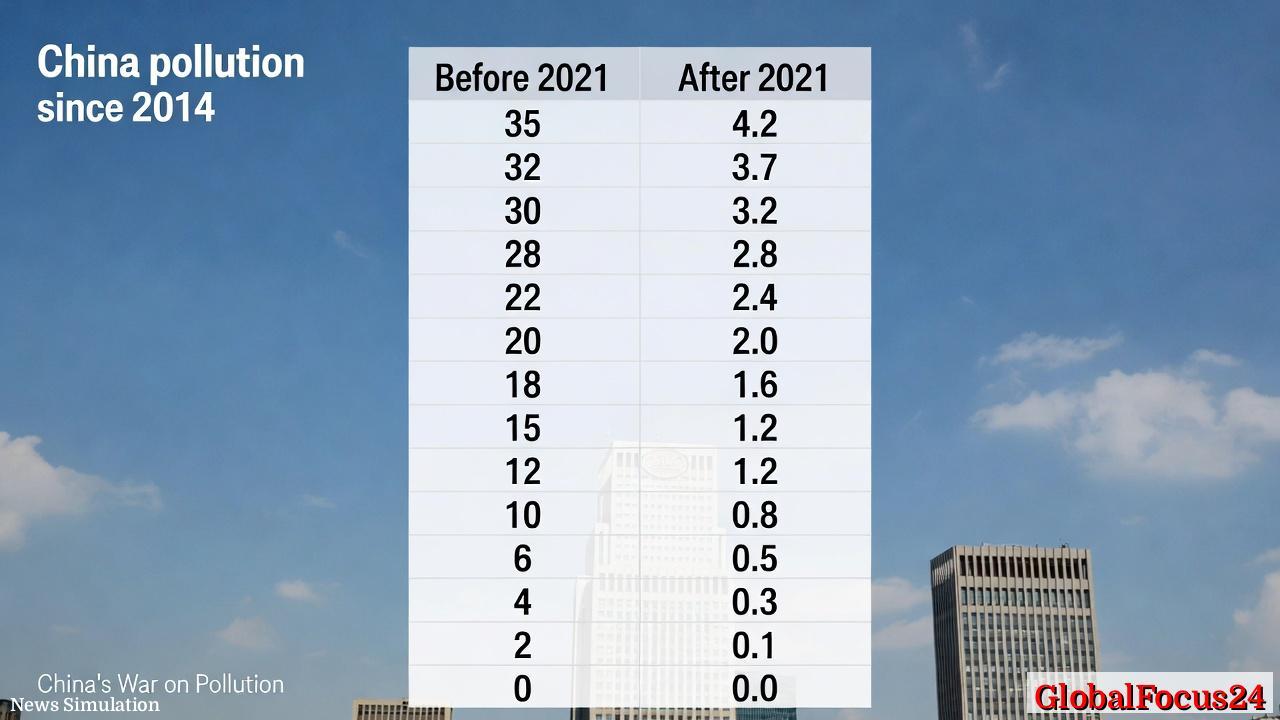
These measures delivered dramatic results. Between 2013 and 2020, average PM2.5 concentrations nationwide fell from around 72 micrograms per cubic meter to near 33 — a decline of more than 50%. In Beijing, the average level fell even more sharply, leading international health organizations to cite China as an example of rapid, large-scale air quality improvement.
Slowing Gains and Shifting Challenges
Since 2021, however, the pace of improvement has slowed. PM2.5 concentrations have decreased by roughly 0.5 micrograms per cubic meter annually, compared with average annual reductions of 4.2 micrograms in the earlier years. Experts attribute the deceleration to the completion of “low-hanging fruit” — the relatively straightforward reforms such as retrofitting power plants and eliminating outdated production capacity.
What remains are structural challenges deeply embedded in China’s economic geography and energy system. Heavy industries such as steel, aluminum, and chemicals, which remain vital to employment and regional growth, are difficult to decarbonize and clean up without slowing economic output. Many of these industries have relocated westward to inland provinces like Shanxi, Shaanxi, and Inner Mongolia. This shift has redistributed pollution rather than fully eliminating it.
While eastern cities have achieved clearer skies, western regions are increasingly bearing the burden of resource extraction and industrial activity. Satellite data indicate that nitrogen dioxide and sulfur dioxide emissions have plateaued or risen slightly in some inland regions. Environmental NGOs warn that if industrial transfer continues without robust regulation, it could entrench new pollution hotspots.
Comparing Regional Efforts and Global Standards
Despite recent slowdowns, China’s average air quality has improved more rapidly than that of most developing economies over the past decade. In 2013, annual PM2.5 concentrations in China were around five times higher than the global average and three times higher than India’s levels. Today, China’s urban air is cleaner than that of many South Asian and Middle Eastern cities, though still higher than the World Health Organization’s updated guideline of 5 micrograms per cubic meter.
Within China, disparities remain wide. Coastal megacities like Shanghai and Shenzhen now report frequent “blue sky days,” benefiting from cleaner industries and stronger enforcement. Industrial centers in northern provinces such as Hebei and Henan still struggle with winter smog linked to coal heating and manufacturing surges. The government has introduced regional cap-and-trade programs for emissions and expanded the national carbon market, but these mechanisms are still young and limited in scope.
Economic Trade-Offs and the Cost of Clean Air
China’s air quality campaign has also reshaped parts of its economy. Investments in environmental technology, clean energy, and regulatory enforcement have created new industries and millions of jobs. Wind and solar power now play a central role in China’s energy mix; by 2024, renewable capacity exceeded coal-fired generation for the first time. Cleaner air has also delivered public health dividends — a 2023 study estimated that life expectancy in some major cities has increased by more than two years compared with a decade ago.
However, the cost of sustaining progress remains high. Local governments, under fiscal pressure from slowing real estate markets and pandemic-era debt, have struggled to fund additional environmental infrastructure. Some industries, including metallurgy and petrochemicals, face tighter profit margins due to more stringent emissions standards. Policy analysts note that the next phase of pollution reduction will depend heavily on integrating carbon neutrality goals with air quality management — aligning incentives across energy, transport, and industrial sectors.
Technological Innovations and Green Transitions
Advances in monitoring and digital governance are helping maintain progress even amid economic headwinds. China now operates one of the world’s most extensive air quality monitoring networks, with real-time data from over 1,500 sites nationwide. This transparency allows for rapid enforcement: factories caught exceeding emissions limits can be penalized within hours.
At the same time, technological innovation is reshaping entire industries. Automobile manufacturers are accelerating the shift toward electric vehicles (EVs), reducing emissions from one of the largest remaining urban pollution sources. In 2025, one in three new cars sold in China was electric, a trend supported by extensive charging infrastructure and subsidies for consumers.
The construction sector, long reliant on high-emission materials, is also evolving. “Green building” standards now guide major urban developments, encouraging the use of recycled materials and energy-efficient designs. Cities such as Chengdu and Hangzhou have launched pilot zones where all construction must adhere to stricter environmental criteria.
Public Awareness and Societal Change
Perhaps one of the most profound shifts since the 2014 campaign has been in public consciousness. Ten years ago, discussions of “smog days” and “mask-wearing weather” were common on social media, reflecting frustration with the lack of transparency and accountability. Today, air quality data is accessible via smartphone apps and widely discussed. Environmental education, once limited, now features in school curricula, shaping a generation more aware of the link between lifestyle, energy use, and environmental impact.
Public demand for clean air also exerts pressure on policymakers to stay the course. Surveys show that environmental protection remains one of the top concerns among urban residents, alongside housing affordability and healthcare. That sustained civic interest, analysts suggest, may help prevent a full backslide, even if short-term economic priorities compete for attention.
Looking Ahead: The Final Frontier of Clean Air
China’s air quality story is far from over. The easy victories of the past decade are behind it; the next phase will unfold in harder terrain — transitioning the energy system away from coal, ensuring cleaner industrial relocation, and balancing local economies with ecological health. Meeting those challenges will determine whether China can sustain its environmental turnaround or settle into a stalled equilibrium.
International observers note that China’s experience holds lessons for other developing economies seeking to grow without repeating the environmental mistakes of the industrial age. Rapid, top-down measures can deliver dramatic early progress, but long-term success depends on economic transformation and sustained governance.
Over the past decade, China has shown that a nation can reverse air pollution trends in record time when public will, political commitment, and technological innovation align. As the country enters the second stage of its clean-air journey, the question is whether that alignment can endure — and whether cleaner skies can remain a defining feature of China’s urban future, not just a fleeting achievement of the past.