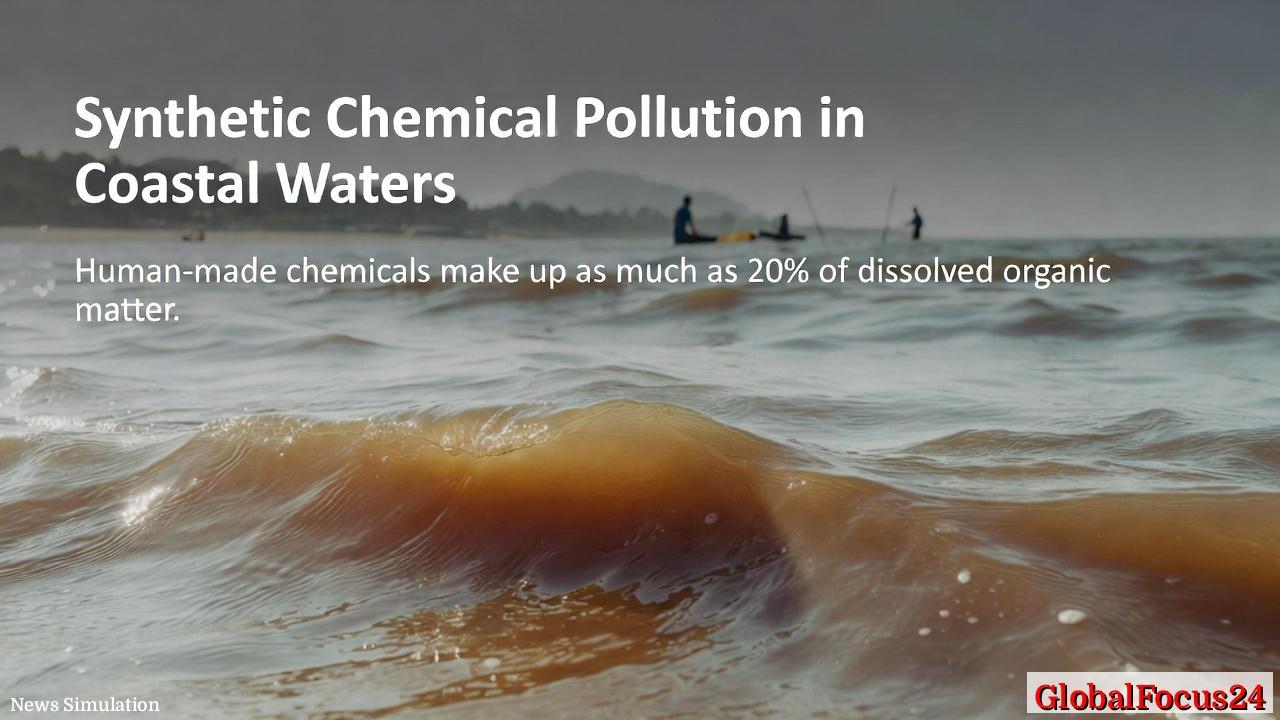
Human-Made Chemicals Now Account for One-Fifth of Organic Matter in Coastal Oceans, Global Survey Finds
A Wider View of Ocean Pollution
A global survey of more than 2,300 seawater samples has revealed that human-made chemicals — substances originating from plastics, personal-care products, pesticides, and pharmaceuticals — have infiltrated nearly every corner of the world’s oceans. The meta-analysis shows that in some coastal and estuarine waters, synthetic compounds now make up as much as 20 percent of all dissolved organic matter, and in the most heavily impacted zones, such as river mouths receiving untreated wastewater, this figure exceeds 50 percent.
The findings mark a critical moment in marine science, offering the clearest evidence yet that modern industrial and consumer activities have chemically altered ocean environments on a planetary scale. Even in the open ocean, far from direct sources of urban or agricultural runoff, measurable traces of synthetic compounds persist at levels of around 0.5 percent — proof that these substances disperse widely through atmospheric and oceanic currents.
Tracing Chemical Footprints Across the Seas
Researchers analyzed chemical compositions across tropical, temperate, and polar waters, identifying 248 distinct human-made compounds across the dataset. Common among them were industrial additives such as plasticizers, UV filters from sunscreens, and synthetic fragrances. More than 30 percent of all samples contained at least one of these compounds, underscoring the pervasive reach of human influence across marine ecosystems.
The study’s global scope allowed for unprecedented comparisons between regions. Coastal zones near densely populated or industrialized areas — including parts of the North Atlantic, the Mediterranean, and the South China Sea — showed the highest concentrations. By contrast, remote oceanic regions and polar environments exhibited far lower but nonzero levels, suggesting that even Earth’s most isolated waters are not immune to chemical contamination.
The Hidden Layer of Pollution
While plastic waste floating on the surface of the ocean has long drawn attention, scientists emphasize that this newly quantified “dissolved pollution” represents a more insidious and complex challenge. These chemicals are not visible, nor do they accumulate in obvious debris fields. Instead, they dissolve in seawater, where they interact with natural organic compounds, potentially altering nutrient cycles and impacting marine food webs.
Dissolved organic matter (DOM) — a vast pool of carbon-based molecules derived from decaying plants, plankton, and microorganisms — is fundamental to ocean chemistry. It serves as both a nutrient source and a carbon reservoir. The discovery that one-fifth of DOM in coastal waters can now be traced back to synthetic sources means that humanity has directly modified a crucial element in the planet’s carbon cycle.
From Personal Products to Persistent Pollutants
The compounds detected originate from a wide range of human activities. Plasticizers, for example, are used to make flexible plastics such as PVC and are often leached into waterways during manufacturing and waste decomposition. UV filters from sunscreens — notably benzophenones and oxybenzone derivatives — wash off swimmers and persist in the marine environment, where they can impact coral health. Synthetic fragrances used in detergents and personal-care products resist breakdown and accumulate over long distances.
Pharmaceutical residues and pesticides, carried downstream from rivers and wastewater outlets, contribute additional layers of contamination. Once in the ocean, these molecules can undergo transformation through sunlight or microbial action, forming new compounds that are often poorly understood.
Historical Context: From Industrial Growth to Global Dispersion
Chemical pollution of the oceans is not a new phenomenon, but its scale and variety have grown dramatically since the mid-20th century, when synthetic chemistry revolutionized manufacturing, agriculture, and daily life. The so-called “Great Acceleration” — the post-World War II surge in industrial output — corresponded with the rise of plastics, petroleum-based products, and synthetic fertilizers and pesticides.
By the 1970s, scientists were detecting traces of PCBs, DDT, and hydrocarbons in marine organisms and sediments. Subsequent bans and regulations curbed the most toxic legacy pollutants, yet thousands of newer substances — from microplastic precursors to cosmetic additives — have since entered circulation, many without comprehensive environmental assessment. Unlike visible bottles or fishing nets, these molecular pollutants disperse invisibly and interact chemically with natural organic matter in unpredictable ways.
Economic and Ecological Implications
The infiltration of synthetic compounds into marine ecosystems carries economic as well as ecological consequences. Fisheries and aquaculture industries depend on clean coastal environments to sustain yields and ensure seafood safety. The accumulation of chemical residues in shellfish, finfish, or seaweed could threaten both livelihoods and public health, particularly in regions where coastal populations rely heavily on local marine resources.
Tourism may also feel the effects. In tropical destinations where coral reefs are key attractions, sunscreen-derived pollutants have been linked to coral bleaching and developmental disorders in marine invertebrates. Some governments, including those of Hawaii, Palau, and Thailand, have already banned or restricted certain UV filters from sunscreens sold within their borders.
Economically, the cost of monitoring and mitigating chemical pollution is substantial. Treatment of municipal wastewater to remove microcontaminants remains technologically complex and energy-intensive. Developing nations, where infrastructure lags behind industrial growth, often discharge untreated effluent directly into rivers and estuaries — a practice that sharply increases the pollutant load entering the ocean.
Comparing Regional Pollution Patterns
Regional disparities highlight the close link between coastal population density, industrial activity, and chemical load. European and East Asian coastal waters exhibited the highest percentages of synthetic compounds relative to total dissolved organic matter, reflecting heavy industrial output and intensive wastewater discharge. North American coastlines showed moderate contamination levels, while the Southern Hemisphere’s open waters, particularly around the South Pacific and Southern Ocean, recorded the lowest concentrations, though still measurable.
In tropical zones, high temperatures and sunlight accelerate the breakdown of some organic molecules, yet others, such as fluorinated compounds, remain chemically stable and persist for decades. The Arctic presents a different paradox: despite its distance from direct pollution sources, atmospheric transport carries volatile chemicals northward, where cold conditions slow degradation, allowing pollutants to accumulate in ice and sediments.
The Science Behind the Measurement
The meta-analysis synthesized data from dozens of independent studies conducted over the past decade. Using advanced mass spectrometry techniques, researchers were able to detect thousands of molecular fingerprints in tiny concentrations — parts per trillion in some cases. Machine learning algorithms helped separate naturally occurring organic molecules from synthetic ones by comparing structural features and isotopic signatures.
This technological progress marks a turning point in environmental chemistry. Even a decade ago, the molecular complexity of oceanic organic matter was largely beyond analytical reach. Today, scientists can identify and track specific chemical families across large spatial scales, enabling a more accurate assessment of human impact on marine biogeochemistry.
Toward Global Solutions
Experts agree that reducing the flow of anthropogenic chemicals into the ocean will require coordinated international action. Improved wastewater treatment, stricter regulation of industrial discharges, and development of biodegradable alternatives for everyday products are crucial steps. Encouragingly, some progress has already been made: the European Union’s REACH framework, for example, mandates safety data for new chemicals, while United Nations initiatives aim to standardize global monitoring of ocean pollutants.
Public awareness plays a growing role as well. Campaigns urging consumers to choose reef-safe sunscreens or limit single-use plastics reflect a cultural shift toward recognizing invisible forms of pollution as part of the same continuum that produces visible debris. Yet experts caution that individual choices alone cannot offset the scale of industrial emissions driving the problem.
A Changing Chemical Horizon
As ocean temperatures rise and circulation patterns shift under climate change, the behavior of these synthetic compounds could evolve further. Chemical reactions depend heavily on temperature and light, meaning that warming seas might accelerate degradation for some substances while aiding persistence and bioaccumulation for others. The interplay between climate dynamics and chemical pollution is likely to become a central theme of marine research in the coming decades.
For now, the new global survey provides a sobering benchmark: synthetic chemicals, produced by and for human convenience, have become a permanent component of the ocean’s complex chemical makeup. Once viewed as the planet’s final frontier and vast cleansing system, the sea now bears an indelible signature of industrial civilization — a molecular watermark on the very chemistry of life beneath the waves.