SpaceX Prepares Historic $1.75 Trillion IPO, Poised to Reshape Global Markets
A Monumental Leap Toward the Public Markets
SpaceX, the privately held aerospace powerhouse founded by Elon Musk, is reportedly preparing for one of the largest initial public offerings in history, potentially valuing the company at $1.75 trillion or higher. This milestone would not only be the largest IPO ever recorded but also mark a defining moment in the evolution of privately funded space exploration and technology. Investors, analysts, and competitors are watching closely as the company transitions from a private enterprise into a publicly traded entity capable of shifting global capital flows.
The anticipated IPO underscores SpaceX’s strategic maturity after years of exponential growth fueled by rapid innovation in satellite networks, reusable rocket technology, and human spaceflight. With its Starlink satellite broadband service gaining global traction and a proven launch record in government and commercial contracts, SpaceX’s debut on public exchanges could recalibrate valuations across several industries—from telecom to defense to aerospace manufacturing.
Surging Private Market Valuation Signals Investor Confidence
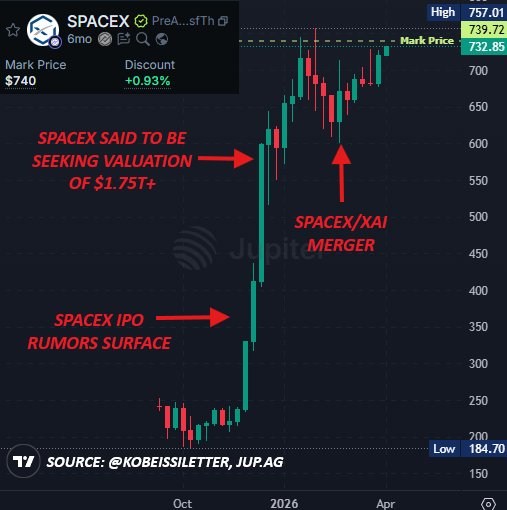
SpaceX’s trajectory toward public markets has already generated extraordinary activity within the private equity ecosystem. In October 2025, pre-IPO shares of SpaceX were trading near $185, reflecting cautious optimism amid a broader market slowdown in venture-backed assets. These shares, structured through special purpose vehicles (SPVs) providing one-to-one exposure to the company’s private valuation, became a popular instrument for investors seeking indirect participation ahead of the IPO.
By December 2025, rumors of an imminent listing ignited an unprecedented rally, driving the share price up 135 percent. Fast forward to early 2026, these same instruments are now trading at approximately $733 per share, a nearly 300 percent increase in just half a year. This surge reflects both investor enthusiasm and SpaceX’s reputation for defying conventional market cycles. Analysts suggest liquidity constraints and pent-up demand among institutional investors have contributed to the rapid appreciation.
Historical Context: From Bold Vision to Economic Powerhouse
Founded in 2002, SpaceX’s progression from a fledgling startup to a trillion-dollar enterprise has been one of the most audacious success stories in modern industrial history. Its early achievements, including the Falcon 1 in 2008 and Dragon capsule missions to the International Space Station, established a new narrative for private companies operating in a domain once dominated by government agencies.
The pivotal breakthrough came with the Falcon 9 and the Starship programs, which introduced reusability and scalability into the launch sector—key elements that drastically reduced per-launch costs. This innovation transformed SpaceX into the preferred partner for NASA, defense entities, and satellite operators. Over time, each technical milestone—such as successful booster recoveries and high-volume Starlink satellite deployments—translated into surging enterprise value.
By 2021, the company had already surpassed a $100 billion valuation, making it the most valuable venture-backed company in the world. Four years later, the prospective $1.75 trillion mark would place SpaceX alongside or even beyond major tech giants in market capitalization, cementing its role as an anchor of twenty-first-century industrial expansion.
Economic Implications of the SpaceX IPO
The ripple effects of a SpaceX IPO at this scale would extend beyond aerospace and defense circles. Global financial institutions are preparing for massive capital rotation as investors seek exposure to one of the most transformative companies of the century. The listing could generate tens of billions in trading volume within the first few days, reshaping index compositions and ETF allocations across major exchanges.
Economists anticipate that such a listing would influence the technology sector similarly to the way Alibaba’s $25 billion IPO did in 2014, though on a far larger magnitude. The offering could also drive renewed confidence in venture-backed science and engineering startups, signaling that the high-risk innovation cycle remains intact even amid tighter monetary conditions worldwide.
A valuation above $1.75 trillion would place SpaceX near the scale of Apple or Microsoft, corporations whose market presence has historically catalyzed shifts in investment strategy and policy. Moreover, a public SpaceX could unlock new funding pathways for infrastructure associated with interplanetary travel, orbital logistics, and space-based telecommunications, industries once considered speculative but now central to future economic forecasts.
Regional and Sector Comparisons
From an industrial standpoint, SpaceX’s valuation dwarfs traditional aerospace rivals. Boeing, with a current market capitalization hovering around $100 billion, and Lockheed Martin, near $110 billion, represent legacy incumbents whose growth remains bounded by cost-heavy production and regulatory dependencies. SpaceX’s modular design philosophy and private financing strategy have delivered an efficiency that competitors struggle to emulate.
Regionally, the upcoming IPO places the United States in a commanding position within the global space economy. In Europe, companies such as ArianeGroup and startups like Isar Aerospace have accelerated development in reusable launch systems, yet remain far behind in scale and revenue potential. Meanwhile, China’s government-backed programs, including CASC and Landspace, continue expanding domestically but have limited international equity exposure due to regulatory restrictions.
SpaceX’s public offering could further bolster Silicon Valley’s reputation as the innovation hub for next-generation industrial ventures, reaffirming California’s dominance in high-value engineering and technology investment. For emerging markets such as India and Brazil, where private space firms are still in developmental phases, this IPO serves as both inspiration and benchmark, revealing the scale possible when commercial viability intersects with technical audacity.
Investor Expectations and Market Strategy
Analysts predict strong institutional participation once SpaceX opens trading. Hedge funds, sovereign wealth funds, and pension portfolios are expected to compete for early allocations, despite likely constraints on retail investor access during the offering stages. Bankers anticipate that the float size will be relatively limited compared to the total valuation, ensuring scarcity and maintaining price pressure to stabilize post-listing performance.
Key questions remain about whether SpaceX will pursue a dual-class share structure, similar to other founder-led firms, to preserve strategic control while dispersing capital ownership. The company’s reliance on long-term projects—such as Martian colonization infrastructure and orbital logistics networks—requires consistent leadership to balance market expectations against engineering timelines.
Financial strategists also note potential volatility following the debut, as public investors adjust to SpaceX’s revenue cycles. The company’s mix of commercial launches, Starlink subscriptions, and experimental development streams could produce quarterly fluctuations uncommon in traditional industrial stocks but typical of frontier technology ventures.
Broader Impact on the Space Economy
Beyond market dynamics, SpaceX’s public transition signifies a crucial cultural and technological moment. The space economy, once an obscure corner of defense procurement, is rapidly becoming a mainstream investment category. Private capital is now funding satellite constellations, microgravity manufacturing, and lunar resource exploration, all bolstered by the public’s growing fascination with off-Earth activity.
SpaceX’s dominance in launch cadence—it completed over 120 missions in 2025 alone—has made orbital access more affordable and routine. As the company scales further under public ownership, experts predict spillover effects for scientific research, remote sensing, and global connectivity through Starlink’s ever-expanding constellation. Each successful launch strengthens the case for the space industry as a foundational pillar of twenty-first-century economic infrastructure.
Challenges Ahead: Regulation and Sustainability
Despite the optimism, SpaceX faces scrutiny from regulators and environmental groups over increased launch frequency and the proliferation of low-Earth-orbit satellites. Concerns about space debris, radio interference, and atmospheric impact remain unresolved, prompting discussions over stricter international coordination. A public listing could intensify this debate, as transparency requirements bring operational practices under closer examination.
Furthermore, scaling at trillion-dollar valuations introduces governance complexities. Balancing visionary goals with shareholder expectations will be a defining challenge for SpaceX’s executive leadership. Analysts caution that while the company’s growth model has thrived under private control, public accountability and quarterly reporting cycles may pressure innovation pacing.
The Road Ahead
If successful, SpaceX’s historic IPO will not only redefine its corporate trajectory but also mark a turning point in how humanity funds and manages access to space. The shift from venture-driven capital to open market participation signifies maturity—where exploration meets commerce at unprecedented scale.
In the years ahead, the company’s valuation and technological milestones will likely serve as benchmarks for a generation of firms navigating the intersection of frontier science and financial engineering. Whether launching satellites, transporting cargo to Mars, or expanding global broadband access, SpaceX continues to challenge the boundaries of possibility. Its public debut, if executed as projected, will affirm not just financial worth—but the enduring appeal of ambition itself.