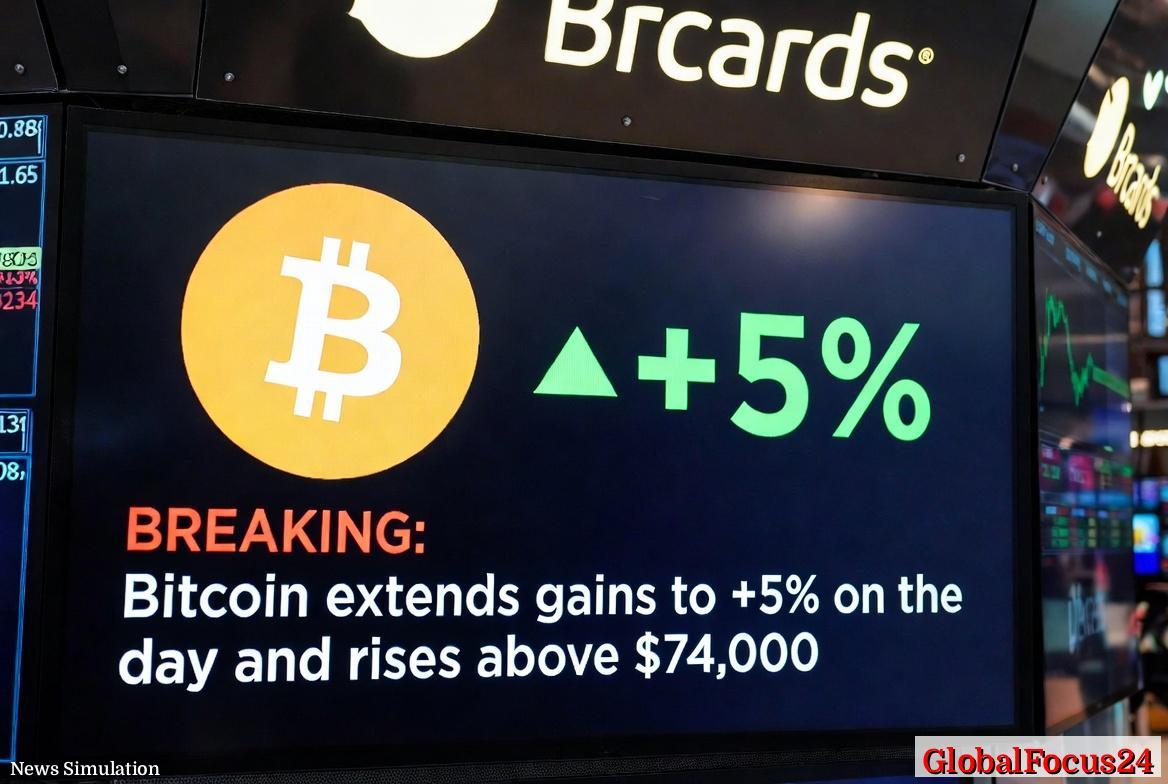
Bitcoin Surges Past $74,000 as Market Momentum Builds Ahead of Halving Event
Bitcoin Hits New Milestone Amid Growing Investor Optimism
Bitcoin soared above $74,000 on Monday, marking its highest level in over a month and reinforcing renewed optimism in the cryptocurrency market. The digital asset climbed more than 5 percent in daily trading, reaching an intraday high of $74,093 in the afternoon. The rally comes as investors position themselves ahead of the network’s upcoming “halving” event, expected later this month, which historically has acted as a catalyst for bullish sentiment and price momentum.
Market analysts link the latest surge to a combination of factors — including increased institutional participation, rising anticipation surrounding Bitcoin’s supply reduction, and broader optimism across risk assets. Bitcoin’s resilience is particularly notable given the shifting landscape of global monetary policy and the lingering uncertainty in traditional markets.
Institutional Inflows and Renewed Market Confidence
A primary force behind Bitcoin’s latest rally has been strong institutional inflows. Several spot Bitcoin exchange-traded funds (ETFs) in the U.S. have reported consistent investor demand, helping to absorb market supply while contributing to upward price pressure. Since their approval earlier this year, these ETFs have attracted billions of dollars in assets, signaling growing mainstream acceptance of Bitcoin as part of a diversified investment portfolio.
Market strategists also note the increased participation of hedge funds and family offices, which view Bitcoin as both a hedge against inflation and an alternative asset class with long-term growth potential. This institutional credibility has bolstered Bitcoin’s image beyond the speculative cycles that have defined much of its history.
“Momentum appears to be strengthening as investors rotate back into crypto amid concerns about traditional asset valuations,” said one financial strategist. “Bitcoin is once again being viewed as digital gold — a scarce, verifiable asset in a time of monetary uncertainty.”
Historical Context: Bitcoin’s Resilience Through Market Cycles
Bitcoin’s climb above $74,000 marks another chapter in its volatile but enduring history. First introduced in 2009 as a decentralized digital currency, Bitcoin has weathered multiple boom-and-bust cycles over the past 15 years. Each halving event — when the network’s block reward for miners is cut in half — has historically preceded major bull markets.
- In 2012, following the first halving, Bitcoin rose from around $12 to more than $1,000 within a year.
- In 2016, the second halving sparked a rally that culminated in Bitcoin’s first major peak above $20,000 in late 2017.
- After the 2020 halving, Bitcoin reached a then-record high of nearly $69,000 in November 2021.
The pattern has led many traders to anticipate a similar effect this year. The scheduled halving will reduce the number of new bitcoins issued per block from 6.25 to 3.125, tightening supply growth and potentially enhancing scarcity — a dynamic often cited by long-term investors as a key value driver.
Regional Market Activity and Global Comparisons
The latest rally has not been limited to U.S. markets. Trading data shows synchronized gains across Asia and Europe, with major exchanges in Singapore, Hong Kong, and London reporting heightened volume. In Japan, where digital asset adoption has grown steadily since the early 2010s, Bitcoin’s price in yen reached an all-time high, underscoring the impact of currency weakness against the dollar.
In contrast, European markets have experienced a more measured run-up, reflecting a cautious investor base still navigating regulatory discussions around crypto-asset frameworks. The European Union’s Markets in Crypto-Assets (MiCA) regulations, set to be implemented later this year, are expected to bring clearer compliance standards for exchanges and issuers.
In Latin America, Bitcoin’s popularity remains intertwined with currency instability and remittance use cases. Nations like Argentina and Venezuela continue to see substantial peer-to-peer trading volumes as citizens seek protection from inflationary pressures. Meanwhile, El Salvador’s ongoing experiment with Bitcoin as legal tender is being closely watched, though it has not yet translated into widespread economic transformation.
Macroeconomic Factors: Inflation, Interest Rates, and Risk Appetite
Bitcoin’s recent performance cannot be viewed in isolation from broader macroeconomic dynamics. Global markets have been volatile in recent months amid persistent inflation concerns, rising U.S. Treasury yields, and speculation over the Federal Reserve’s next steps. Many investors are weighing the prospect of slower rate cuts against robust employment data and shifting global liquidity conditions.
While Bitcoin’s correlation with equities has fluctuated, its resilience suggests a growing perception of the asset as an independent store of value. Analysts also note that retail investors have re-entered the market, drawn by renewed optimism and the growing accessibility of regulated investment products.
At the same time, some caution that Bitcoin’s sharp rallies often attract speculative excess. Derivatives markets have seen rising open interest and leverage ratios — potential warning signs that short-term corrections could follow if momentum stalls.
Mining Sector and Supply Dynamics
Behind Bitcoin’s soaring price, the mining industry is preparing for significant change. The halving will cut rewards for miners, effectively doubling production costs overnight. This economic shift has led some smaller operators to sell inventory or invest in more efficient hardware before the event.
Large, publicly traded mining firms have been expanding operations and securing low-cost energy contracts in preparation. The consolidation trend in the sector is expected to continue, favoring miners with access to renewable energy and modern processing equipment capable of maintaining profitability despite reduced rewards.
Historically, halving events have triggered temporary declines in hash rate — the measure of computing power on the network — as less-efficient miners exit. However, the impact tends to normalize over time as new technologies and capital investments restore balance to the ecosystem.
Broader Cryptocurrency Market and Altcoin Movements
Bitcoin’s upward momentum has lifted the broader cryptocurrency market. Ethereum, the second-largest cryptocurrency by market capitalization, rose above $3,800 amid increased activity in decentralized finance (DeFi) platforms and rising demand for tokenized assets. Other major altcoins such as Solana and Avalanche also posted double-digit weekly gains, signaling a widespread risk-on sentiment across the digital asset space.
Stablecoins, particularly Tether (USDT) and USD Coin (USDC), continue to play a central role in market liquidity. The growing use of stablecoins in cross-border transactions and decentralized exchanges has further underpinned the infrastructure supporting Bitcoin’s liquidity and trading volumes.
Regulatory Outlook and Market Maturity
Another contributing factor to Bitcoin’s stability has been the ongoing maturation of regulatory landscapes in major financial centers. In the United States, the approval of spot Bitcoin ETFs earlier this year represented a landmark moment for market legitimacy. Regulators have gradually moved toward defining clearer frameworks for custody, taxation, and anti-money laundering compliance.
In Asia, countries like Hong Kong and Singapore have sought to attract institutional players by offering regulated digital asset licenses and exchange frameworks. These policy moves signal a recognition of cryptocurrency’s growing role in global capital markets, even as governments balance innovation with investor protection.
Nevertheless, regulatory uncertainty persists in parts of the world, particularly in regions where crypto activity intersects with concerns about capital flight, illicit transactions, or financial stability. Policymakers remain divided over how to integrate digital assets into existing systems without undermining monetary control.
Economic Impact and Future Outlook
The economic implications of Bitcoin’s continued ascent extend beyond speculative trading. For some investors, the asset serves as a hedge against fiat currency debasement and inflationary policy. For others, it represents the foundation of a new financial infrastructure driven by blockchain innovation.
If the rally continues, Bitcoin’s market capitalization could soon surpass previous records, approaching the $1.5 trillion threshold. Such milestones have rippling effects across fintech companies, institutional portfolios, and even national digital currency strategies.
Looking ahead, much will depend on how the market digests the forthcoming halving. Historically, supply reductions have preceded sustained bull runs lasting several months, though not without bouts of volatility. Should macroeconomic headwinds stabilize and institutional demand persist, analysts see further upside potential through the second half of the year.
A Turning Point for Digital Finance
Bitcoin’s surge past $74,000 underscores both the maturation and unpredictability of the cryptocurrency market. Once dismissed as a speculative novelty, it now commands the attention of global investors, institutions, and policymakers alike. As the halving approaches, the market is once again at a crossroads — balancing speculative fervor with an emerging foundation for long-term digital asset adoption.
Whether Bitcoin’s latest rally proves to be another wave in its cyclical journey or the beginning of a sustained new phase, its influence on global finance continues to deepen. The coming months may define not only Bitcoin’s trajectory but also the future contours of the broader digital economy.