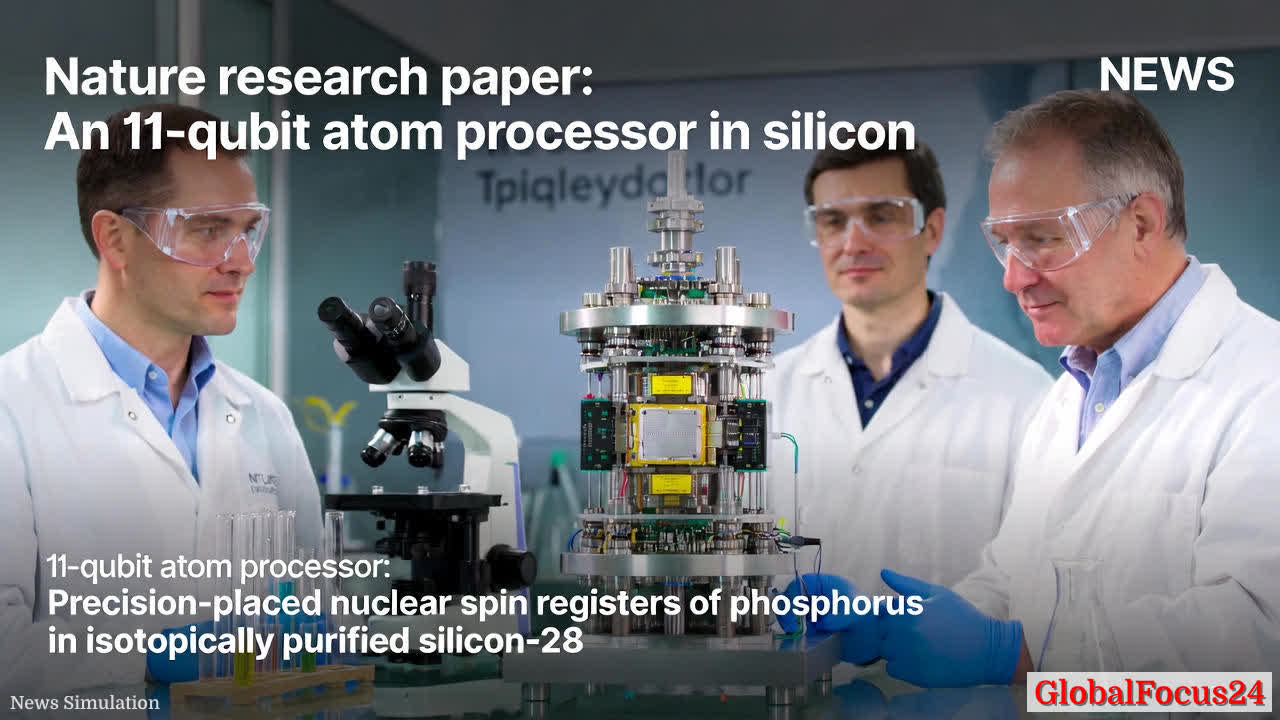
Breakthrough in Quantum Computing: Silicon-Based 11-Qubit Atom Processor Demonstrates High Fidelity
In a landmark development for quantum technology, researchers have unveiled an 11-qubit atom processor built within silicon, marking a notable stride toward scalable and fault-tolerant quantum computing. The processor leverages two precisely arranged nuclear spin registers of phosphorus atoms embedded in isotopically purified silicon-28, delivering exceptional Bell-state fidelities of up to 99.5% and two-qubit gate fidelities approaching 99.9%. This combination of high fidelity and silicon compatibility positions the work as a meaningful bridge between experimental quantum physics and practical, scalable quantum architectures.
Historical context and scientific lineage
Quantum computing has long pursued a path from theoretical possibility to tangible hardware. Early milestones centered on superconducting qubits and trapped-ion systems, each with distinct strengths and challenges. Silicon-based approaches, by contrast, draw from decades of established semiconductor manufacturing know-how. The use of phosphorus dopants in silicon—often described as “spin qubits in silicon”—traces its roots to proposals from the late 1990s and early 2000s, which envisioned long-lived electron and nuclear spins as carriers of quantum information. Over the years, advances in isotopic purification of silicon, precise dopant placement, and laser- or radiofrequency-based control methods have converged to enable increasingly coherent and controllable qubits.
The current work builds on a lineage of carefully engineered quantum devices that emphasize nuclear spins’ stability and electron-nuclear coupling. Phosphorus nuclei possess intrinsically long coherence times, especially when the silicon lattice is isotopically purified to minimize magnetic noise. By relegating the quantum operations to a well-protected nuclear-spin register and employing phosphorus donors arranged with nanometer precision, the researchers address two core obstacles in quantum computing: maintaining coherence through longer computations and achieving reliable two-qubit interactions essential for universal quantum logic.
Technical highlights and architectural choices
The 11-qubit atom processor centers on two separate, precisely positioned nuclear spin registers—each dominated by phosphorus donor atoms in silicon-28. The strategy emphasizes a clean separation of qubit registers to reduce cross-talk while preserving the ability to perform entangling operations across the registers. Achieving high Bell-state fidelity up to 99.5% indicates that entangled states, a fundamental resource for quantum advantage, can be prepared with exceptional reliability. The reported two-qubit gate fidelities near 99.9% are particularly meaningful, as two-qubit gates are the primary bottleneck in many quantum computing platforms.
A crucial aspect of the design is the use of isotopically purified silicon-28. Natural silicon contains multiple isotopes with nuclear spins, which can act as a source of decoherence for quantum data. By enriching silicon-28 and employing careful material growth techniques, the researchers reduce magnetic noise that otherwise degrades qubit performance. The precise placement of phosphorus atoms—often achieved through techniques like single-atom lithography or ion implantation followed by annealing—allows the construction of well-defined interaction pathways between qubits. Calibrations tailored to the specific atomic configuration further optimize gate operations, maximizing fidelity while minimizing error rates.
From a hardware perspective, the silicon platform offers several potential advantages. It leverages existing CMOS-compatible fabrication processes, which could, in the long run, lower manufacturing costs and facilitate scaling. The ability to integrate quantum components with classical control electronics on the same substrate is another compelling advantage, potentially enabling tighter qubit control, faster feedback, and more compact system architectures. Moreover, the silicon-based approach benefits from long research-driven roadmaps, aiming to translate laboratory demonstrations into industrial-scale production.
Economic implications and industry impact
As quantum computing moves from niche experiments to commercial relevance, high-fidelity silicon qubits may influence the economic landscape by aligning quantum hardware development with established semiconductor ecosystems. Firms exploring fault-tolerant quantum computation rely heavily on error-correcting codes, which demand robust physical qubits and reliable two-qubit gates. Fidelities approaching 99.9% for gate operations represent a meaningful elevation in hardware performance, potentially reducing the overhead required for quantum error correction and shortening the path to practical quantum advantage for certain workloads.
The demonstrable compatibility with silicon-based manufacturing also opens opportunities for co-development with the broader chip industry. Engineers may leverage existing fabrication facilities, supply chains, and design flows to prototype quantum cores that can be integrated with classical processors and control systems. While challenges remain—such as scaling beyond tens or hundreds of qubits, managing heat dissipation, and ensuring uniform qubit performance across large arrays—the current results contribute to a broader, more tangible roadmap for commercially viable quantum devices.
Regional comparisons and global context
In the race to build scalable quantum computers, several regional ecosystems are pursuing complementary approaches. North American research centers have made substantial progress across superconducting qubits, trapped ions, and spin-based platforms, with ongoing investments in quantum hardware, software, and education. Europe has been advancing quantum technologies through a mix of academic collaborations and industrial partnerships, emphasizing open hardware initiatives and standardization efforts. Asia-Pacific research communities are rapidly expanding capabilities in materials science, cryogenics, and system integration, often linking quantum devices to nearby manufacturing hubs.
Within this broader landscape, silicon-based quantum processors occupy a unique niche that pairs quantum information storage with a material platform entrenched in electronics. The demonstrated 11-qubit atom processor contributes to a comparative narrative where silicon qubits may offer advantages in terms of scalability and integration with classical computing infrastructure. Regional efforts to build quantum campuses or national initiatives could benefit from cross-pollination of techniques, such as advanced donor-placement methods or refined calibration regimes, further accelerating progress toward fault-tolerant architectures.
Public reception, risk, and ethical considerations
Public interest in quantum technology remains high, driven by the promise of dramatically accelerating certain classes of computation, such as material simulation, optimization, and cryptographic analysis. While thecapabilities of this silicon-based processor are impressive, experts caution that translating laboratory fidelity into real-world, scalable quantum advantage requires overcoming substantial engineering challenges. The field continues to emphasize a long horizon for deployment, with realistic timelines anchored in the development of error-corrected qubits, robust control electronics, and reliable system maintenance in non-laboratory environments.
Ethical considerations in quantum development touch on security implications, data privacy, and the responsible release of information about fragile quantum hardware. As processors grow more powerful, policymakers and researchers increasingly collaborate to establish frameworks for secure use, responsible disclosure of vulnerabilities, and transparent communication about capabilities and limitations. In the context of silicon-based qubits, the convergence with existing semiconductor security practices offers both practical benefits and new areas for policy dialogue.
Technical challenges and future directions
Despite the notable fidelity achievements, several technical hurdles remain. Scaling from 11 qubits to the hundreds or thousands required for meaningful quantum advantage demands precise dopant placement across larger substrates, robust error mitigation techniques, and efficient qubit readout schemes. Cross-talk, spectral crowding, and thermal management become more pronounced as qubit counts rise, necessitating innovations in device design, materials engineering, and control electronics. Furthermore, integrating quantum coherence with real-time classical processing to enable feedback-based quantum computation will be a pivotal area of development.
Researchers are likely to explore several avenues to sustain momentum. Enhancements in isotopic purification, improved phosphorus placement accuracy, and refined calibration protocols can contribute to higher overall fidelity across larger qubit registers. Parallel efforts may focus on hybrid architectures that combine silicon-based qubits with other quantum systems to capitalize on complementary strengths. The ongoing refinement of error-correcting codes, such as surface codes tailored to silicon qubits, will shape how quickly practical fault-tolerant operation becomes feasible.
Comparative performance metrics and benchmarks
The reported Bell-state fidelities and two-qubit gate fidelities are among the most compelling metrics in contemporary silicon-based quantum devices. Bell-state fidelity measures the quality of entanglement generation, a fundamental resource for quantum communication and computation. High two-qubit gate fidelity is a critical factor in determining the resource overhead for quantum error correction and the overall viability of a quantum processor for complex tasks. While gate fidelity alone does not capture the full picture of a processor’s performance, its steady improvement is directly correlated with the scalability prospects of silicon-based approaches.
In context, other leading quantum platforms demonstrate their own strengths. Superconducting qubits often boast rapid gate times and mature control hardware, while trapped ions excel in fidelity and connectivity for certain regimes. Silicon-based systems, with their potential for seamless integration and long-term stability, occupy an increasingly important position in this multidimensional landscape. The current breakthrough underscores that silicon hardware can rival or complement other platforms in critical fidelity metrics, reinforcing the argument for a diversified ecosystem of quantum technologies.
Case for near-term applications and workloads
While the field remains in a stage where broad, real-world quantum advantage is still on the horizon, near-term applications may benefit from silicon-based processors in constrained settings. Material science simulations, quantum chemistry problems, and optimization tasks that map well to small-to-medium-scale quantum networks could see measurable gains. The ability to integrate quantum cores with conventional computing subsystems may accelerate prototyping and experimentation, enabling researchers and industry partners to iterate designs rapidly and explore practical use cases in fields such as drug discovery, energy research, and advanced manufacturing.
Educational and workforce implications
As quantum hardware becomes more sophisticated, the demand for talent with cross-disciplinary expertise grows. Engineers and physicists who can navigate both quantum information science and semiconductor fabrication stand to play pivotal roles in translating laboratory breakthroughs into commercial systems. Universities and industry partnerships are likely to expand programs that blend materials science, cryogenics, quantum control, and electrical engineering. This multidisciplinary training is essential to sustaining momentum as silicon-based quantum technology moves toward higher qubit counts and more complex architectures.
Conclusion and outlook
The unveiling of an 11-qubit atom processor in silicon represents a meaningful milestone in the quest for scalable, fault-tolerant quantum computing. By exploiting two precisely arranged phosphorus spin registers in isotopically purified silicon-28, researchers achieve near-perfect entanglement fidelities and exceptionally high two-qubit gate performance. The silicon platform’s compatibility with established semiconductor manufacturing and its potential for integration with classical control systems position it as a promising path toward scalable quantum processors.
As the field continues to evolve, the momentum generated by this achievement will likely influence ongoing research agendas, industrial investments, and policy conversations. The road to practical quantum computing remains long and complex, but each advancement—especially one that aligns quantum capabilities with the fabric of modern electronics—brings the prospect of transformative computational power a step closer to reality. Public interest and industry excitement are likely to intensify as researchers translate laboratory success into scalable, real-world solutions that could reshape fields from cryptography to materials science, unlocking new possibilities for innovation across sectors.