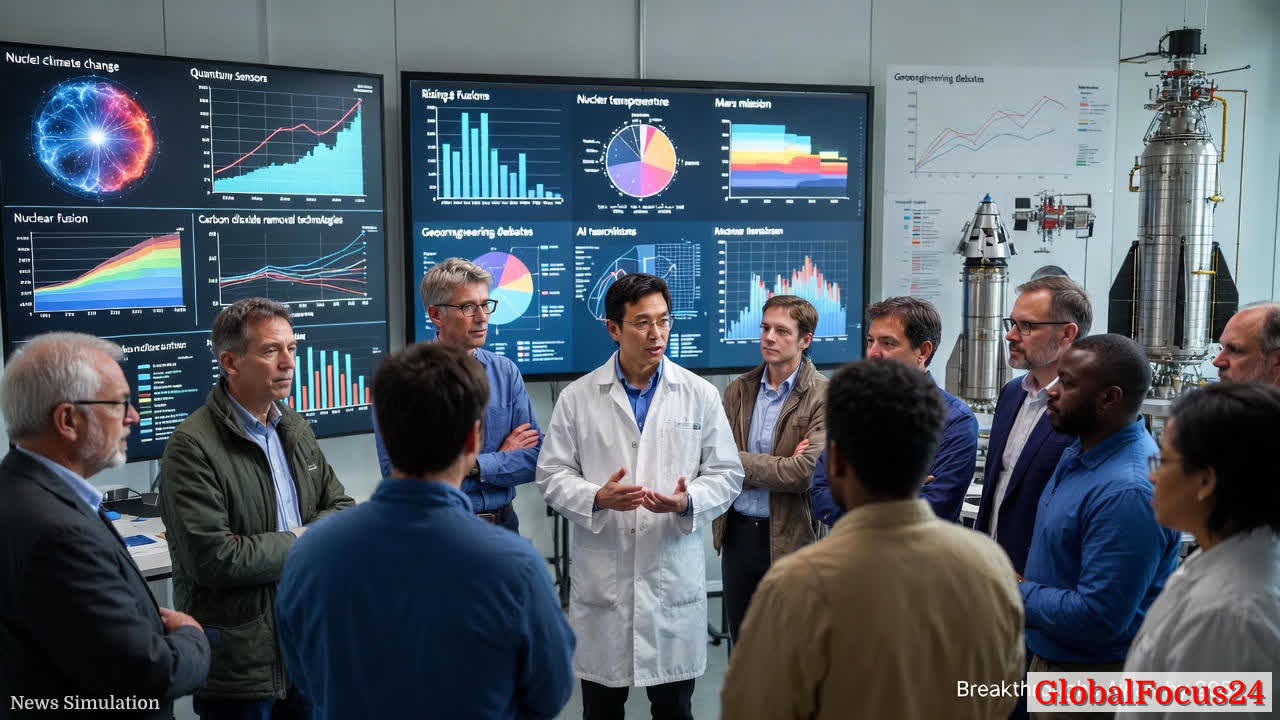
Breakthroughs Await by 2050: Fusion, Mars Missions, and AI Revolution
A wave of scientific milestones is anticipated to redefine the middle of the 21st century, with nuclear fusion powering grids around the world, humans venturing to Mars, and artificial general intelligence accelerating discoveries across disciplines. The trajectory outlined by researchers and industry leaders blends extraordinary potential with persistent uncertainties, demanding careful attention to economics, regional dynamics, and the societal context in which these breakthroughs unfold.
Historical context: the arc from incremental gains to transformative leaps
To understand the predicted breakthroughs by 2050, it helps to trace the arc of modern science from the mid-20th century to today. Nuclear fusion, once a distant dream born from early plasma physics, has progressed through stages of tokamak and stellarator designs, materials research, and increasingly sophisticated simulations. Space exploration has shifted from single-domain expeditions to multinational, multi-vehicle programs that combine robotics and human missions to extend reach into the solar system. Artificial intelligence has evolved from rule-based systems to probabilistic learning, with growing capabilities in perception, decision-making, and autonomous operation. Taken together, these threads illustrate a pattern: sustained investment, international collaboration, and evolving computational power transform speculative science into practical capability.
Fusion energy: a clean power cornerstone or a contested promise?
Fusion is widely envisioned as a long-elusive but potentially game-changing source of carbon-free electricity. The core advantage is clear: abundant fuel availability (deuterium from seawater and lithium from common minerals), a high energy density, and inherently low long-lived radioactive waste compared with fission. Technological hurdles remain formidable—achieving net energy gain, sustaining stable plasma confinement, and developing materials that can withstand extreme neutron bombardment over long lifetimes. Yet, proponents argue that progress is accelerating as superconducting magnets improve, fusion confinement devices become more robust, and international collaborations pool expertise and capital.
Economic implications extend beyond electricity pricing. If fusion proves commercially viable, it could reshape energy markets by reducing fuel price volatility, lowering reliance on imported energy, and enabling new industries that require continuous, high-density power. Regions with strong manufacturing ecosystems and deep capital markets may lead early deployment, while grid operators would need to adapt to high-penetration, baseload fusion generation or complementary hybrid systems with renewable sources. Critics caution that the cost curve remains steep and that regulatory, safety, and supply-chain questions will influence timing. Nevertheless, many analysts see a realistic pathway to demonstrator plants in the 2030s and pilot commercial plants by the 2040s, with broader adoption by 2050 in many regions.
Regional and global comparisons illuminate uneven progress and varying strategies. East Asia has pursued large-scale fusion research through ambitious national programs and private ventures, leveraging advanced manufacturing and electronics ecosystems. Europe emphasizes international cooperation, fusion as part of its broader green-transition strategy, and the development of a diversified energy portfolio. North America combines federal-backed research with a thriving private sector, aiming to harmonize safety, permitting, and project finance. In all regions, policy stability, access to capital, and the ability to recruit specialized talent will be decisive in whether fusion becomes a staple of electricity markets by mid-century.
Mars missions: from robotic scouts to human presence
The vision of sending humans to Mars has deep historical roots in science fiction, later shaped by robotic prelude missions that tested landing techniques, life-support systems, and surface operations. By 2050, many planners expect a layered approach: precursor robotic missions mapping resources, testing in-situ resource utilization (ISRU) to harvest local materials, and demonstrating reliable ascent and descent systems for crewed landers. Uncrewed tests could begin in the late 2020s, with crewed missions potentially unfolding in the 2030s, depending on safety, funding, and the ability to solve radiation exposure challenges.
The economic impact of Mars exploration is multifaceted. On one hand, mission budgets drive aerospace suppliers, propulsion technology, and habitat engineering firms, stimulating regional jobs and advanced manufacturing ecosystems. On the other hand, the lofty costs and long time horizons raise questions about opportunity costs—how investable are these programs relative to terrestrial challenges like climate adaptation, public health, and basic science? Regions with robust spaceports, experienced aerospace bases, and strong private sector participation may capture a disproportionate share of commercial and research activity connected to Mars exploration. Partnerships between space agencies, private companies, and international coalitions could help distribute risk and unlock capabilities that a single entity could not achieve alone.
Scientific and geopolitical considerations accompany the push toward Mars. Radiation protection, microgravity effects on human physiology, life-support reliability, and planetary protection protocols will be central to mission planning. Public interest and engagement play roles as well; Mars missions can stimulate STEM education, inspire long-duration teamwork in isolation, and drive public imagination about humanity’s place in the solar system. Yet the scale of the enterprise invites careful risk management, transparent governance, and clear milestones to maintain social license and budgetary sustainability.
Artificial intelligence and the lab of the future
The anticipated AI revolution by 2050 centers on the emergence of highly capable systems that can automate and accelerate laboratory research, medical discovery, and industrial innovation. Proponents envision machines that can design experiments, run simulations, and interpret data at scales far beyond human capacity. In biotechnology, automated laboratories could shorten discovery cycles, test hypotheses in silico and in vitro, and enable rapid responses to emerging health threats. In materials science, AI-guided synthesis and screening could yield new polymers, catalysts, and energy storage technologies with unprecedented speed.
The implications for research culture are profound. Automation could increase throughput and reduce human tedium, but it also raises questions about the workforce—how researchers adapt to more supervisory roles over autonomous labs, how skills shift toward data literacy and system integration, and how institutions balance safety, ethics, and accountability when AI conducts critical experiments. Economically, AI-enabled acceleration could compress development timelines, attract investment in early-stage ventures, and alter the competitive landscape across biotechnology, pharmaceuticals, and advanced manufacturing.
Regional dynamics in AI adoption depend on data access, computational infrastructure, and regulatory environments. Countries with robust digital ecosystems, large markets, and generous R&D incentives may lead in AI-driven science, while others may focus on complementary strengths such as clinical trials, public health infrastructure, or niche manufacturing. The governance of AI research—privacy, safety, transparency, and reproducibility—will be essential to maintain public trust and ensure that rapid innovation translates into broad societal benefit.
Interconnected challenges: climate, policy, and public sentiment
Climate change remains a backdrop to all these trajectories. Even as breakthroughs promise transformative advances, rising temperatures and extreme weather stress economies, infrastructure, and public health systems. Some scenarios envision carbon dioxide removal technologies achieving profitability and enabling materials and fuels production directly from atmospheric CO2. Others warn of the geoengineering debate, including the potential risks of solar radiation management and the geopolitical frictions that could arise from unilateral deployment or misalignment of international governance.
Policy choices and funding priorities will influence the pace and direction of discovery. Populist movements and budget constraints can erode sustained investment in basic science, inadvertently slowing progress on foundational technologies like fusion or AI alignment. Conversely, stable funding, clear regulatory pathways, and public-private partnerships can accelerate development, attract talent, and maintain momentum across multiple frontiers.
Public reaction and societal impact
Public sentiment toward science and technology will shape how breakthroughs are absorbed into daily life. A culture that values scientific literacy, safety, and ethical considerations will better navigate the transformative implications of fusion energy, Mars exploration, and AI-driven research. Conversely, misinformation, anxiety about automation, and perceived inequities in who benefits from breakthroughs can generate resistance. Effective science communication, transparent risk assessment, and inclusive policy design will be critical to translating technical potential into tangible improvements in health, energy access, and economic opportunity.
The pace of change will also influence labor markets. As automation expands in laboratories, clinics, and manufacturing, new training pathways—retraining programs, interdisciplinary curricula, and lifelong learning—will be essential to help workers adapt. Regions that invest in education and transition support will likely experience smoother transitions and broader participation in the gains from technological advancement.
Looking ahead: integrated trends to watch
- Fusion energy pilots: Expect incremental milestones toward net energy gain demonstrations, followed by regulatory and supply-chain developments that determine the timing of first commercial plants.
- Martian program milestones: Track the cadence of robotic precursor missions, ISRU validation, habitat testing, and eventual crewed missions, with international collaboration shaping mission architectures.
- AI-enabled discovery: Monitor advances in generalizable AI systems, lab automation, and reproducibility standards, alongside robust governance to address safety and ethical concerns.
- Climate-resilient technology: Observe the deployment and economics of CO2 removal and climate adaptation technologies, including how they interact with industrial chemistry, plastics, and pharmaceuticals.
- Regional leadership: Compare how Asia, Europe, North America, and other regions deploy policy incentives, capital markets support, and talent pipelines to compete in the global science economy.
Conclusion: a future rich with possibility and responsibility
The prospect of fusion becoming a reliable power source, humans reaching Mars, and AI driving a new era of scientific discovery paints a portrait of a world poised for profound change by 2050. Yet this future is not predetermined. It will be shaped by the interplay of technical breakthroughs, economic viability, public policy, international collaboration, and the societal choices that accompany rapid innovation. As researchers push the boundaries of what is knowable, regions that cultivate stable funding, prioritize safety and ethics, and invest in people will likely translate breakthroughs into durable improvements for living standards and planetary stewardship.
In sum, the next few decades could redefine humanity’s relationship with energy, the cosmos, and intelligence itself. The path forward will demand disciplined investment, thoughtful governance, and a shared commitment to ensuring that the benefits of breakthrough science accrue broadly, begetting a future that is not only technologically advanced but socially resilient as well.