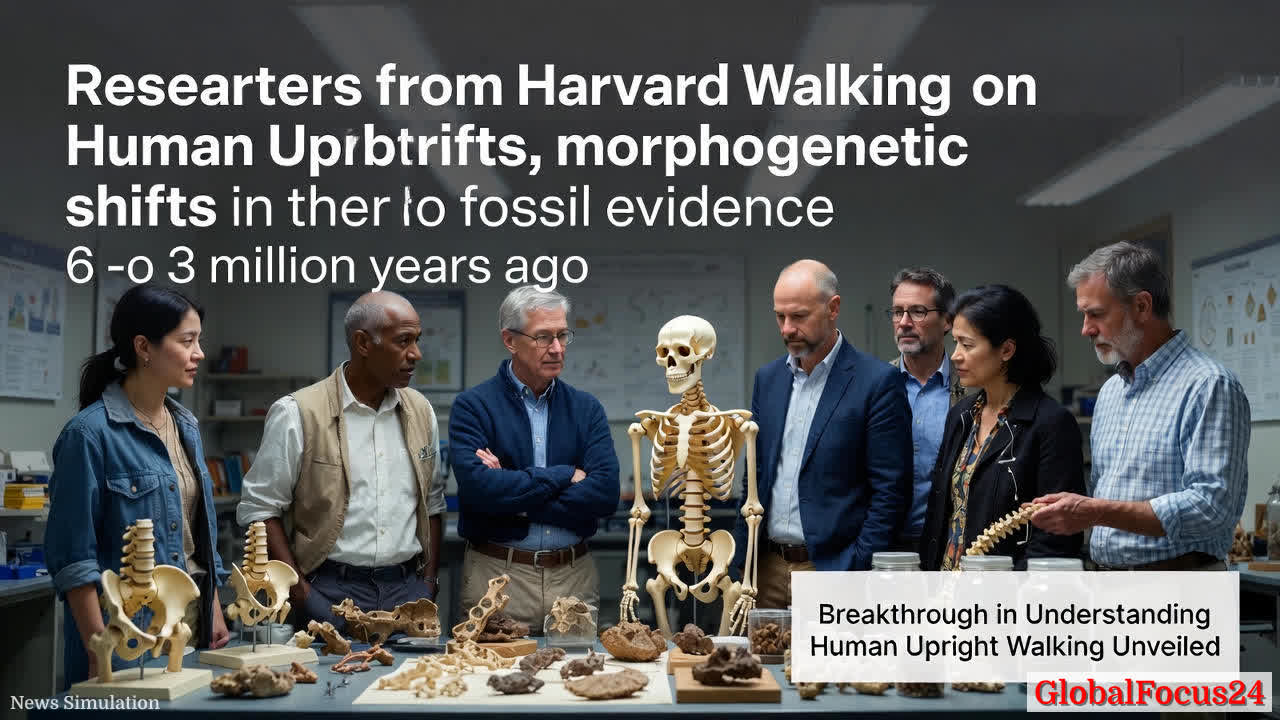
Breakthrough in Understanding Human Upright Walking Unveiled
A new study published on December 30, 2025, reframes the long-standing question of how humans came to walk on two legs by highlighting a concerted skeletal transformation centered on the pelvis. Researchers describe a sequence of morphogenetic shifts in the growth plate and changes in the timing of bone formation that together reshaped the human pelvis, enabling efficient bipedal locomotion. The findings, anchored in fossil evidence dating from roughly 6 to 3 million years ago, illuminate how anatomical innovations accumulated gradually to support upright movement, separating human locomotion from that of our closest primate relatives.
Historical context and the evolutionary arc
The quest to understand upright walking has a storied history in paleoanthropology. Early researchers proposed a simple, linear transition from quadrupedalism to bipedalism, often emphasizing leg length, spine curvature, or foramen magnum position as the decisive factors. Subsequent decades, however, revealed a more intricate picture: a suite of anatomical adaptations spanning the pelvis, lumbar spine, feet, and neuromuscular control coalesced to support a new mode of locomotion. The pelvis has consistently stood out as a central hinge in this transition because it anchors both balance and propulsion while shaping the mechanism by which the weight of the upper body is transmitted to the legs.
The new study adds a critical layer to this narrative by focusing on the growth plate dynamics and the timing of ossification—developmental tempo that governs how bones grow and shape mature form. Morphogenetic shifts in the hip region, coupled with revised mineralization timelines, appear to have loosened and then rebalanced the pelvic ring. In the fossils recovered from ancestral hominin sites, investigators identify pelvises that are broader, more bowl-shaped, and differently oriented than those of arboreal primates. Such structural refinements would have lowered energetic costs during walking, improved stability on varied terrains, and allowed for longer strides without compromising balance.
Economic and public-health implications
Understanding the origin of upright walking is not merely an academic pursuit; it has tangible implications for public health, biomechanical engineering, and rehabilitation medicine. The pelvis functions as a keystone in human mobility. By unpacking how pelvic morphology evolved to support bipedalism, researchers can inform modern clinical approaches to gait abnormalities, reduce the risk of lower-back and pelvic injuries, and guide the design of assistive devices, including exoskeletons and prosthetics, that more closely emulate natural human motion.
From an economic perspective, the study reinforces the importance of investing in multidisciplinary research that bridges paleontology, developmental biology, and biomechanics. Advances in imaging techniques, comparative anatomy, and computational modeling have enabled a more precise reconstruction of ancient growth patterns and their functional consequences. Countries and institutions that sustain cross-disciplinary collaborations stand to benefit from innovations in orthopedics, sports science, and robotics, where a deeper understanding of pelvic biomechanics translates into tangible products and therapies.
Regional comparisons and broader implications
The research adds a regional dimension to our understanding of early human locomotion. Fossil records from East Africa—particularly sites within the Rift Valley—have long provided the most complete window into early hominin evolution. The new findings corroborate a broader pattern seen in several regional records: pelvises that show a trend toward increased breadth and mass distribution around the hip joint appear in conjunction with other skeletal changes that favor efficient bipedalism. This pattern aligns with climate-driven ecological shifts of the Pliocene epoch, when habitat fragmentation and open grasslands may have favored endurance walking as an energy-efficient foraging strategy.
In comparison, early hominins from other regions show variations in pelvic morphology that likely reflect different adaptive pressures. Some regional fossils suggest steps toward upright walking but with divergent body plans that illustrate multiple experimental trajectories before a stable, efficient form emerged. The study’s emphasis on growth plate dynamics offers a unifying lens to interpret these regional offsets: similar developmental mechanisms could yield different adult pelvic shapes depending on genetic background, nutrition, and environmental context.
Biomechanics and functional interpretation
The pelvis serves as the central conduit for converting leg-driven propulsion into forward motion while maintaining balance. The new research points to two intertwined developments: a reshaped pelvis that better distributes forces across the hip joint, and a timing shift in bone formation that allows the pelvis to attain its weight-bearing configuration earlier in development. This combination would have reduced energetic costs during walking and running and supported longer travel distances—a decisive advantage in expanding hominin ranges and resource networks.
These insights dovetail with broader biomechanics findings that emphasize the synergy between skeletal architecture and neuromuscular control. Efficient bipedal walking requires coordinated hip extension, trunk stabilization, and foot-ground contact patterns that collectively minimize energy expenditure. By illuminating how developmental biology influenced pelvic shape, the study adds a crucial piece to the puzzle of how early humans achieved gait stability on diverse landscapes, from woodland margins to open savannas.
Public reaction and scientific discourse
The unveiling of a developmental mechanism behind pelvic evolution has generated strong interest across scientific communities and public-facing science outlets. Experts emphasize that while fossil evidence establishes the morphological end state, understanding the ontogenetic processes—that is, how bones grow and mature—provides essential context for interpreting functional capabilities. The narrative of an incremental, developmentally driven transition challenges views that emphasize a single “prime mover” for bipedalism, instead supporting a pluralistic model in which multiple factors converged over millions of years.
In the broader public sphere, the findings have sparked renewed attention to how our ancient past shapes contemporary health considerations. Medical researchers note that modern humans still contend with pelvic and lower-back disorders rooted in developmental pathways and structural constraints that originated long ago. By extending the timeline of pelvic evolution and linking it to growth dynamics, the study invites reflection on how early biology informs today’s medical challenges and rehabilitation strategies.
Methodology and evidence
The study integrates fossil morphology with comparative developmental biology and advanced imaging. Researchers examined pelvises from a range of early hominins and related taxa, applying high-resolution imaging technologies to infer growth trajectories and ossification sequences. They correlated these inferences with wear patterns, articulation angles, and estimated muscle leverage to reconstruct functional implications for gait. The convergence of fossil data with developmental models strengthens the case that pelvic evolution in early humans was not a single mutation but a cascade of changes in growth dynamics that translated into a robust, upright walking pattern.
Limitations and future directions
As with any long-span evolutionary narrative, uncertainties remain. The fossil record is inherently fragmentary, and inferring growth dynamics from static bones requires careful interpretation and corroboration across multiple lines of evidence. Future research aims to refine the timing estimates of ossification in various pelvic regions, expand the regional sample to include underrepresented sites, and integrate biomechanical simulations with ancient climate data to reconstruct the selective pressures that favored different pelvic configurations. Additionally, researchers anticipate exploring how pelvic evolution interacted with adaptations in the spine, pelvis, and lower limbs to produce the integrated system we rely on today.
Impact on education and public knowledge
The breakthrough enriches science education by providing a clear example of how developmental biology intersects with evolution to shape human capabilities. It offers educators a tangible story about why the pelvis matters not only for movement but for understanding the broader arc of human ancestry. Museums, outreach programs, and science communicators can leverage these findings to illustrate the complex, gradual nature of evolutionary change and to dispel lingering myths of instantaneous leaps in human history.
Policy implications and societal relevance
While the topic is scientific, the implications ripple into policy domains concerned with science literacy, education funding, and public health planning. A nuanced appreciation of human physiology and evolution can inform curricula that emphasize evidence-based reasoning and critical thinking about science. As population health continues to grapple with gait-related ailments, the research underscores the value of investing in interdisciplinary studies that translate basic science into practical health outcomes and technology development.
Conclusion
The study’s emphasis on growth plate dynamics and ossification timing offers a fresh, evidence-based perspective on one of humanity’s defining traits: upright walking. By connecting developmental biology to functional anatomy, the research provides a coherent narrative that explains how incremental changes in pelvic structure contributed to efficient bipedal locomotion. This integrated view—rooted in fossil evidence, developmental science, and biomechanical analysis—advances our understanding of human evolution and its enduring relevance to health, technology, and education.