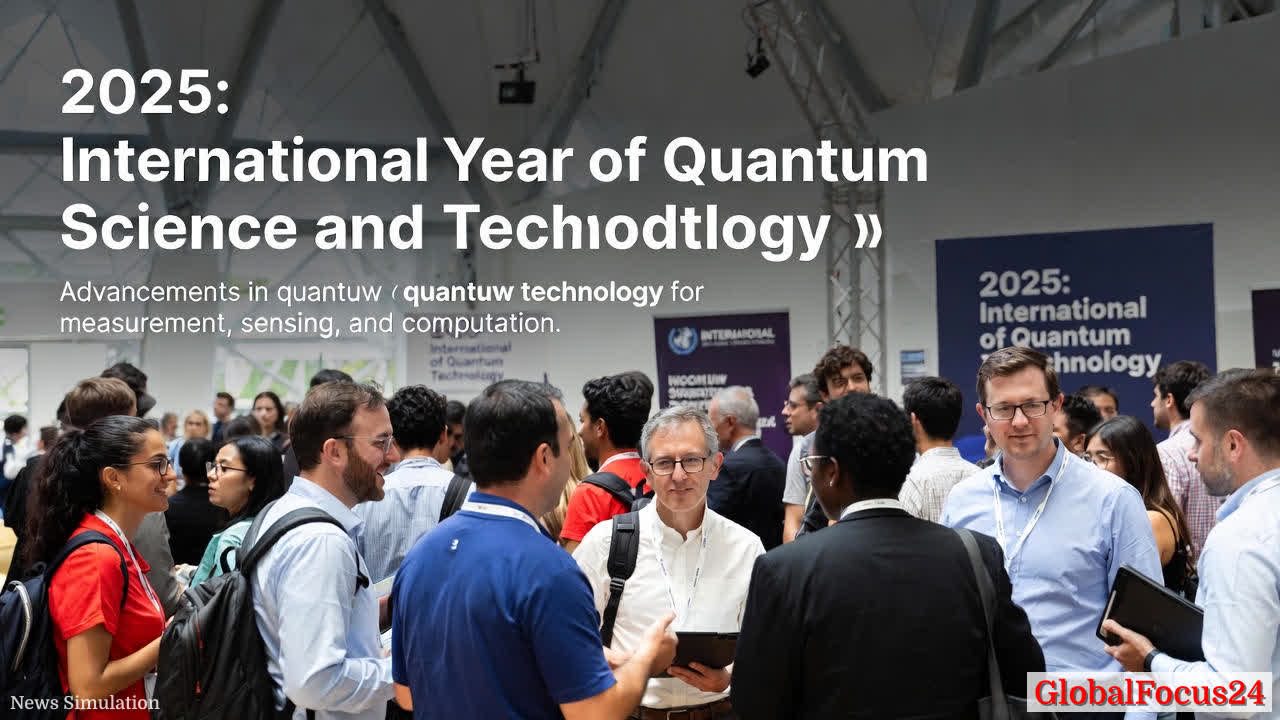
International Year of Quantum Science and Technology Celebrated in 2025
In 2025, the world marks the International Year of Quantum Science and Technology, a milestone that commemorates a century since the foundational developments of quantum mechanics. This year-long celebration brings together researchers, policymakers, industry leaders, and the public to reflect on the evolution of quantum science, its present-day applications, and the trajectory of its influence on technology, economy, and global collaboration. While the roots of quantum theory were established in the early 20th century, its implications have rippled across disciplines—from fundamental physics to practical devices that reshape how we measure, compute, and communicate.
Historical Context: From Theory to Technology
The century-long arc of quantum science begins with a handful of paradigm-shifting ideas that challenged classical intuition. Early pioneers introduced concepts such as quantization of energy, wave-particle duality, and the probabilistic nature of physical systems. These ideas, once considered abstract and esoteric, gradually found concrete expression through experimental validation and engineering ingenuity. The mid-to-late 20th century witnessed the emergence of technologies that harnessed quantum principles in tangible ways: lasers with precise coherence properties, semiconductors that form the backbone of modern electronics, and magnetic resonance techniques that underpin medical imaging.
By the turn of the millennium, quantum research evolved from isolated laboratories into a collaborative, international enterprise. Universities, national laboratories, and industry spurred a landscape where theoretical insights intersected with manufacturing capabilities. This convergence accelerated the development of quantum sensing, quantum communication, and early quantum information processing concepts. The year 2025 serves as both a scholarly anniversary and a practical inflection point, highlighting how deep scientific understanding translates into tools with real-world impact.
Economic Impact: Quantum Technologies as Engines of Growth
The economic implications of quantum science and technology are multifaceted and gradually amplifying. Quantum sensing and metrology have begun to redefine measurement standards in areas such as navigation, timing, and imaging, enabling greater precision with broad commercial and defense-related implications. In manufacturing and logistics, quantum-enhanced sensors improve reliability and efficiency, translating into cost savings and new service offerings. The potential ripple effects extend to sectors such as finance, where quantum-inspired algorithms promise to accelerate optimization tasks and risk analysis, and energy, where quantum materials research aims to yield higher-efficiency devices and improved battery technologies.
While broad consumer-facing quantum products remain in earlier stages of commercialization, the ecosystem surrounding quantum startups, venture funding, and cross-border collaboration has matured. Public-private partnerships, research consortia, and national strategies have become more common, reflecting a recognition that quantum technology requires long horizons, substantial investment, and multidisciplinary talent. Regions investing in talent pipelines, infrastructure, and regulatory clarity stand to benefit from early leadership in high-value domains such as quantum communication networks, quantum computing research, and precision measurement devices.
Regional Comparisons: Global Centers of Quantum Development
Several regions have emerged as influential hubs for quantum science and technology, each with distinct strengths and strategic emphases. In North America, collaboration between universities, national laboratories, and industry has fostered an environment where fundamental research can transition quickly to prototype hardware and software ecosystems. Investment in education, talent retention, and scalable infrastructure supports ongoing progress in quantum information science, error correction techniques, and cryogenic systems essential for many quantum devices.
Europe has prioritized a coordinated approach through European Union funding streams, cross-border research centers, and standardization efforts that facilitate interoperability among quantum components. This regional approach accelerates joint experiments, shared fabrication facilities, and the development of regulatory frameworks that balance innovation with security and privacy considerations. The United Kingdom and continental Europe, in particular, have cultivated strengths in quantum sensing, photonics, and hybrid quantum systems, contributing to robust academic-industry collaborations.
Asia–Pacific presents a dynamic landscape of rapid growth, manufacturing capability, and ambitious national programs. Countries in this region emphasize scalable production of quantum components, such as superconducting qubits and photonic platforms, alongside investment in quantum education pipelines. Public policy often intertwines with industrial strategy, aiming to translate laboratory breakthroughs into deployable applications—ranging from secure communications to advanced timing systems and environmental sensing networks.
Other notable centers include Israel’s startup ecosystem that blends academic research with venture-backed ventures, and emerging programs in parts of Latin America and the Middle East that are expanding access to quantum research infrastructure. Across these regions, talent mobility, intellectual property regimes, and international collaboration agreements shape how quickly discoveries flow from the lab to real-world deployments.
Technological Milestones and Applications
Quantum technologies today are defined by a spectrum of capabilities that address different use cases and markets. Quantum sensing and metrology provide ultra-sensitive measurements that improve navigation, resource discovery, and medical diagnostics. Quantum communication aims to enable secure information transfer through quantum key distribution and related protocols, with ongoing demonstrations of metropolitan-area and long-haul networks. Quantum computing research, while not yet delivering broad, fault-tolerant systems for general-purpose tasks, continues to push forward with demonstrations of quantum advantage in specific problems and with progress in error correction and hardware scalability.
In practical terms, the momentum around quantum technologies translates into improved timing devices, navigation systems in GPS-denied environments, and enhanced imaging modalities for medical and industrial applications. Researchers are also pursuing hybrid systems that combine quantum components with classical architectures to deliver near-term benefits while keeping a clear line of sight toward more ambitious quantum computational capabilities.
Public Perception and Societal Impacts
As quantum science enters more households through specialized devices and industry-enabled services, public perception of the field blends curiosity with cautious optimism. Educators and science communicators emphasize the difference between laboratory breakthroughs and the pace of commercialization, helping to manage expectations about when quantum technologies will achieve transformative or ubiquitous status. Public reaction to new demonstrations—whether a secure communication link or a high-precision sensor—often centers on themes of national competitiveness, data security, and the potential for scientific literacy to empower individuals.
Policy considerations surrounding quantum technologies focus on safeguarding critical infrastructure, ensuring talent development, and promoting ethical standards in data privacy and security. The International Year of Quantum Science and Technology catalyzes dialogues that connect researchers, policymakers, and industry to map roadmaps that balance innovation with risk management. By highlighting historical context and ongoing progress, the year-long observance fosters informed decision-making that underpins durable economic and social benefits.
Global Collaboration: A Cooperative Path Forward
Quantum science thrives on collaboration that transcends borders. International consortia, joint experiments, and shared facilities enable researchers to tackle complex challenges that are difficult to address within a single institution or country. Intellectual property frameworks, funding mechanisms, and standardization efforts are central to accelerating the transfer of knowledge and the commercialization of quantum-enabled products. The International Year of Quantum Science and Technology underscores the value of open science and geopolitical pragmatism, encouraging partners to align on common goals such as securing supply chains for critical materials, expanding quantum-ready infrastructure, and cultivating a diverse, multilingual talent pool capable of advancing the field.
Looking Ahead: What 2025 Signals for the Next Decade
The momentum surrounding quantum science in 2025 signals a decade of continued experimentation, investment, and systemic integration of quantum technologies into traditional industries. As laboratories transition toward more scalable manufacturing and as educational institutions adapt curricula to produce a workforce adept at spanning physics, engineering, and software, the pace of progress is likely to accelerate. With progress comes challenges: ensuring robust cybersecurity for quantum-enabled systems, managing the environmental footprint of cryogenic and fabrication facilities, and maintaining an inclusive, globally accessible research landscape.
Nevertheless, the narrative around quantum science remains one of cautious optimism and pragmatic pursuit. The century-spanning arc—from theoretical foundations to real-world instruments—serves as a blueprint for how transformative science evolves: not through isolated breakthroughs alone, but through coordinated effort, sustained investment, and a culture that values both curiosity and the application of knowledge to everyday life.
Public Engagement: Education, Outreach, and Workforce Development
Educators, museums, science centers, and media outlets play a crucial role in translating quantum concepts into accessible knowledge for diverse audiences. Hands-on demonstrations, citizen science projects, and explanation-based programming help demystify quantum phenomena and lower barriers to entry for students considering careers in STEM fields. Workforce development initiatives, including scholarships, apprenticeships, and industry-sponsored internships, help ensure a steady pipeline of talent equipped to design, fabricate, test, and maintain quantum devices. As quantum technologies begin to influence sectors such as manufacturing, healthcare, and communications, broad-based literacy around the basics of quantum science will support informed public discourse and responsible adoption.
Synthesis: A Century of Quantum Progress
The International Year of Quantum Science and Technology in 2025 stands as a milestone that encapsulates a century of scientific inquiry turning into tangible capability. It celebrates not only the elegance of quantum theory but also the practical networks—academic, industrial, and policy-driven—that translate theory into devices, standards, and services that touch everyday life. The year’s activities underscore that quantum science is more than a collection of experiments; it is a living ecosystem where discoveries mature into technologies with the potential to redefine precision, security, and computation for generations to come. As regions around the world continue to invest in quantum research and as collaborations deepen, the global community moves toward a future where quantum-enabled capabilities become progressively integrated into infrastructure, industry, and daily decision-making.