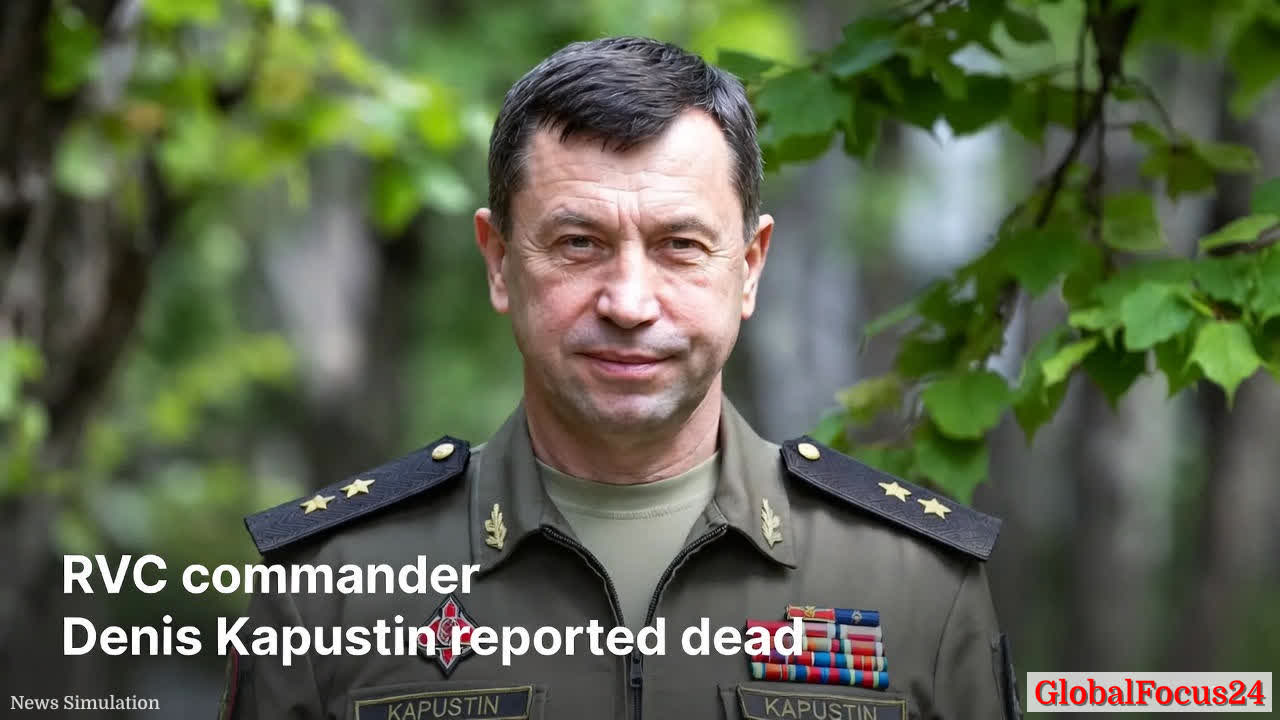
Death of Russian Volunteer Corps Commander Denis Kapustin Reported on Zaporizhzhia Front
Reports of a High-Profile Battlefield Death
Denis Kapustin, the commander of the Russian Volunteer Corps and one of the most recognizable paramilitary figures linked to the war in Ukraine, has reportedly been killed on the Zaporizhzhia front following a strike by a first-person-view (FPV) drone. Preliminary reports circulating on Friday suggest that Kapustin died during fighting in a contested sector of the frontline in southern Ukraine, though official confirmation from all parties remained limited at the time of reporting.
Kapustin’s reported death marks a significant development in a conflict where non-state armed groups, volunteer formations, and irregular units have increasingly shaped both the narrative and the realities on the ground. As information continues to emerge, military analysts and observers are closely watching for corroboration, potential battlefield consequences, and possible retaliatory actions.
Background: From Ultras Scene to Paramilitary Command
Denis Kapustin, often known by various aliases, built his reputation long before the full-scale invasion of Ukraine in 2022. He first gained prominence in far-right and football hooligan circles before transitioning into the world of paramilitary organizing and security work. His trajectory reflected a broader trend in parts of Eastern Europe and Russia, where fringe political activism and street movements sometimes evolved into militarized structures.
The Russian Volunteer Corps, which he later came to lead, emerged as one of several formations composed primarily of Russian citizens fighting against the Kremlin’s forces on Ukrainian soil. The group’s activities focused not only on frontline engagements but also on high-profile cross-border actions, which drew significant attention from both Russian and international media.
Bryansk Incursion and Life Sentence in Absentia
Kapustin’s name gained global attention in March 2023, when the Russian Volunteer Corps claimed responsibility for a cross-border raid into Russia’s Bryansk region. Russian authorities described the operation as a terrorist attack and a violation of the country’s territorial integrity. The incident triggered a wave of state media coverage, emergency responses in the affected region, and heightened security along parts of the border.
In 2024, a Russian court sentenced Kapustin to life imprisonment in absentia, citing his role in organizing the Bryansk incursion and other alleged activities against the Russian state. The sentence underscored Moscow’s intent to portray him as a leading enemy of the state, while also signaling that individuals behind such cross-border actions would face the harshest possible penalties if captured.
The legal proceedings took place against the backdrop of intensifying hostilities, growing use of drones and long-range weapons, and a propaganda battle over how to frame such cross-border operations—either as acts of resistance or as terrorist attacks, depending on the perspective of the audience.
The Zaporizhzhia Front: Strategic and Symbolic Importance
The Zaporizhzhia region has been one of the focal points of the war in Ukraine, serving as a critical axis connecting the eastern Donbas front with the southern corridor toward Crimea. Control over this area influences logistics, supply routes, and the security of key infrastructure, including the Zaporizhzhia nuclear power plant, which has been the subject of sustained international concern.
Fighting in the region has involved conventional Russian units, Ukrainian brigades, and a variety of volunteer formations and territorial defense units. The reported death of Kapustin in this sector highlights the continuing intensity of the conflict there, even as frontline lines have often shifted only modestly over months of combat.
The use of FPV drones, which allow operators to guide explosive-laden unmanned aircraft with precision in real time, has become a defining feature of the Zaporizhzhia battlescape. These relatively low-cost devices can target vehicles, personnel, and fortifications with high accuracy. Their widespread deployment has created a battlefield where even high-ranking commanders are at constant risk, far from the traditional frontlines of industrial-age warfare.
Rise of FPV Drones as a Decisive Weapon
Kapustin’s reported death in an FPV-drone strike underscores the transformative role of drones in modern warfare. Both Russian and Ukrainian forces, as well as aligned paramilitary units, now deploy FPV systems extensively for reconnaissance and strike missions. Compared with earlier generations of unmanned systems, FPV drones are cheaper, easier to assemble, and more accessible to smaller units and volunteer formations.
The proliferation of these drones has:
- Expanded the reach of small units capable of conducting precision strikes.
- Reduced the relative safety of command posts and rear-area movements.
- Increased the importance of electronic warfare, camouflage, and decoys.
- Amplified the psychological impact on troops who know they can be targeted at any moment.
In this environment, the death of a commander via FPV drone is not an anomaly but a manifestation of evolving combat doctrine. Commanders increasingly must move closer to the front to maintain control and morale, yet doing so dramatically heightens their exposure to surveillance and drone attacks.
Historical Context of Cross-Border Volunteer Formations
The emergence of groups like the Russian Volunteer Corps fits into a broader historical pattern in Eastern Europe and Eurasia, where volunteer units, foreign legions, and ideologically motivated fighters have periodically supplemented or challenged state militaries. During the conflicts in the Balkans in the 1990s, volunteers from outside the immediate war zones joined armed groups on all sides, contributing to both battlefield outcomes and propaganda narratives.
In the post-Soviet space, volunteer battalions and irregular formations gained prominence during the early stages of the conflict in eastern Ukraine in 2014–2015. Some of these units were later integrated into official structures, while others remained semi-autonomous. The presence of Russian citizens fighting against Moscow’s forces inside Ukraine, as in the case of the Russian Volunteer Corps, adds another layer to this history by blurring the lines between internal opposition, diaspora fighters, and foreign volunteers.
Kapustin’s role within this ecosystem was distinctive because he commanded a unit composed primarily of Russian nationals that directly carried out operations on Russian soil. This elevated him from a battlefield figure to a symbol of transnational opposition in the context of the war.
Economic and Strategic Implications of Command Losses
From an economic and strategic standpoint, the reported death of a commander like Kapustin can have several layered effects, even if his unit was relatively small compared with conventional brigades.
First, experienced commanders represent a substantial investment in training, logistics, and networks. Their loss can disrupt command chains, slow decision-making, and reduce a unit’s operational effectiveness. Replacing such figures involves not only finding a suitable successor but also reestablishing relationships with local communities, contacts abroad, and potential donors or supporters.
Second, the presence of volunteer formations influences the broader war economy. These groups often rely on crowdfunding, diaspora support, and private donations for equipment and supplies, including vehicles, optics, protective gear, and drones. High-profile casualties can have mixed effects: they can galvanize supporters and spur fresh donations, or they can diminish confidence in the unit’s prospects and divert support to other groups perceived as more stable or promising.
Third, cross-border operations like the Bryansk incursion have indirect economic effects by compelling states to invest in border fortifications, surveillance systems, and internal security forces. These expenditures draw resources away from civilian sectors such as infrastructure, healthcare, and education. If the reported death of Kapustin reduces the capacity or willingness of his unit to stage such operations, it could subtly alter how resources are allocated on the Russian side over time.
Regional Comparisons: Irregular Forces in Modern Conflicts
The presence and impact of irregular formations like the Russian Volunteer Corps can be compared to similar groups in other contemporary and recent conflicts.
In Syria and Iraq, a mix of local militias, foreign volunteer units, and ideological brigades fought alongside or against state militaries. These groups sometimes acted as force multipliers, sometimes as destabilizing elements. Their influence depended heavily on their leadership, external backing, and ability to coordinate with national armed forces or coalitions.
In the South Caucasus, particularly during renewed fighting over Nagorno-Karabakh, volunteer units and paramilitaries also played roles on the battlefield, though the conflict was dominated by state-led militaries employing advanced drones and artillery. The effectiveness of those irregular groups varied considerably and often reflected the coherence of their leadership structures.
Compared with these examples, the Russian Volunteer Corps stands out because it is composed mainly of citizens of the very state it opposes, operating from territory controlled by that state’s adversary. Kapustin’s leadership combined ideological messaging, media outreach, and military operations—a combination that amplified the group’s visibility beyond its numerical size.
Potential Impact on Morale and Propaganda
Information warfare remains a central feature of the conflict in Ukraine. Figures like Kapustin function as symbols as much as military leaders, featured in videos, social media channels, and messaging campaigns aimed at domestic and international audiences.
The reported drone strike killing him could influence several dimensions of the information landscape:
- For supporters of the Russian Volunteer Corps, he may be framed as a martyr whose death demands renewed efforts and recruitment.
- For Russian state media, his reported death could be presented as evidence of the effectiveness of Russian forces and the futility of armed opposition.
- For broader international audiences, the event may underscore the human cost of the war and the vulnerability of high-profile commanders.
These narratives can shape morale among fighters and civilians alike, influencing recruitment, public support for continued combat operations, and the overall perception of momentum on the battlefield.
Ongoing Verification and Unanswered Questions
As with many reports emerging from active war zones, details surrounding Kapustin’s reported death remain subject to verification. Conflicting claims, limited access to the frontline, and the tactical use of information all complicate efforts to establish a definitive account of what happened.
Key questions include:
- Whether independent sources can corroborate the time and location of the FPV-drone strike.
- How the Russian Volunteer Corps will adjust its leadership structure and public communications.
- Whether the incident will trigger additional operations, retaliatory attacks, or shifts in tactics.
Until more evidence emerges, observers are treating early reports with caution while acknowledging the potential significance of the event if confirmed.
A Symbolic Moment in a Protracted War
The reported killing of Denis Kapustin highlights several defining features of the war in Ukraine: the prominence of irregular formations, the central role of advanced yet accessible technologies like FPV drones, and the growing importance of symbolism and narrative in a conflict that has dragged on for years with high casualties on all sides.
Regardless of the final confirmed details, the incident underscores how even high-level paramilitary commanders are vulnerable in a densely surveilled battlespace where drones, artillery, and long-range precision weapons constantly seek targets. It also illustrates how cross-border incursions, life sentences in absentia, and high-profile battlefield deaths have become interconnected elements of a conflict with far-reaching regional and global implications.
As the Zaporizhzhia front continues to see sustained combat and as non-state formations remain active along multiple axes, the fate of figures like Kapustin will likely continue to influence both the military situation and the wider debate over how this war is fought—and how it may eventually be resolved.