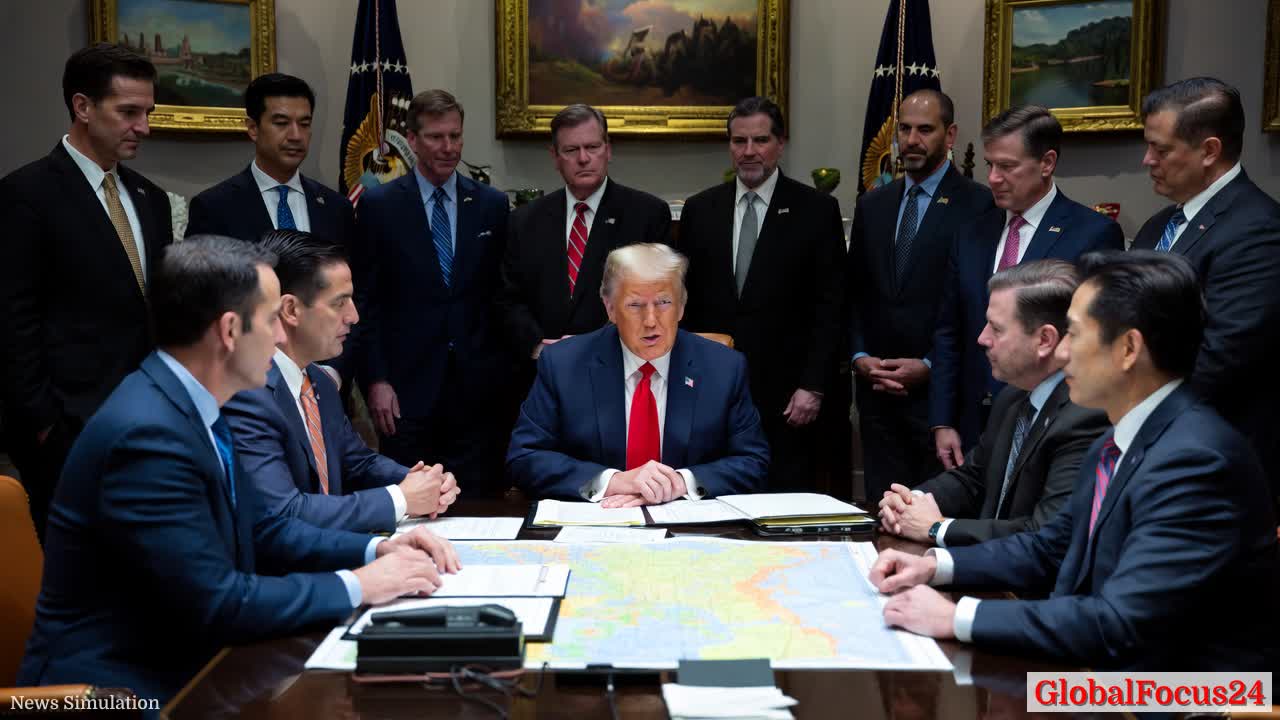
Trump Advised That Strike on Iran Unlikely to Guarantee Regime Collapse
Military Advisers Warn of Limited Strategic Gains
President Donald Trump has been cautioned by senior national security advisers that a large-scale military strike against Iran would not guarantee the collapse of Tehran’s ruling regime and could instead ignite a prolonged regional conflict, according to U.S. officials familiar with recent briefings. The assessment, described by multiple defense and intelligence sources, underscored that even a sustained bombing campaign might fail to achieve the administration’s hoped-for political outcome — dismantling the deeply entrenched Islamic Republic structure that has dominated Iran since 1979.
Military planners reportedly emphasized that such an operation would demand significant reinforcement of U.S. assets across the Middle East to shield bases and personnel from potential retaliation. They warned that Iran’s layered defense networks, dispersed command structure, and influence across proxy groups could make a decisive strike nearly impossible without escalation.
Strategic Calculations Behind the Scenes
According to U.S. officials, advisers briefed the president that Iran’s military and political systems are designed to withstand heavy external pressure. Even if key installations or leadership targets were neutralized, analysts judged that the regime’s core institutions — bolstered by the Islamic Revolutionary Guard Corps (IRGC) and state intelligence apparatus — would likely sustain control through coercive countermeasures and loyalist militias.
While some officials acknowledged that a large-scale assault could temporarily weaken Iran’s economic infrastructure, energy exports, and regional reach, the consensus reportedly held that such results would be transient. Military officials warned that attempting to “decapitate” Iran’s leadership could catalyze widespread instability across the Persian Gulf, disrupt global oil markets, and prompt retaliatory attacks against U.S. allies such as Israel and Saudi Arabia.
The briefings reflect a broader recalibration within U.S. strategic circles about the effectiveness of military intervention in achieving political transformation, lessons drawn from two decades of conflict in Iraq and Afghanistan.
Protests in Iran Add Pressure
The deliberations occur against the backdrop of nationwide demonstrations in Iran sparked by economic grievances and anger over tightening political repression. Over recent months, the Iranian government has deployed security forces to disperse gatherings, leading to clashes in multiple cities. Rights organizations have reported dozens of arrests and casualties, though official figures remain disputed.
The Trump administration has vocalized strong support for the demonstrators, framing the unrest as evidence of mounting public dissatisfaction with the regime. Publicly, the president has urged Iranians to “stand up to their government,” while pledging that the United States would continue to impose economic and diplomatic pressure. Yet privately, advisers have warned that military action might strengthen hardliners in Tehran who could use external threats to justify intensified domestic crackdowns.
Historical Context of U.S.-Iran Tensions
Tensions between Washington and Tehran have followed a fluctuating trajectory for decades, characterized by cycles of confrontation and cautious de-escalation. The 1979 Iranian Revolution, which overturned U.S.-backed Shah Mohammad Reza Pahlavi, marked the beginning of a deep political estrangement. The hostage crisis that followed severed diplomatic ties, and relations have remained strained through succeeding administrations.
Periodic flashpoints — such as the U.S. Navy’s downing of Iran Air Flight 655 in 1988, the 2003 Iraq invasion, and the 2020 killing of Iranian General Qassem Soleimani — have repeatedly raised the risk of direct confrontation. Each episode reinforced Tehran’s resolve to invest in asymmetric warfare, cyber capabilities, and regional influence operations as deterrence measures against potential U.S. or allied attacks.
For American policymakers, Iran represents a persistent challenge: a nation driven by ideological opposition to Western influence yet central to the region’s energy supply and geopolitical stability. Consecutive U.S. presidents have wrestled with balancing punitive sanctions with engagement strategies designed to contain Tehran without committing to another Middle Eastern war.
Economic and Energy Market Consequences
Analysts warn that any military escalation involving Iran could send shockwaves through the global economy. Iran borders the Strait of Hormuz, a strategic chokepoint through which roughly one-fifth of the world’s oil supply transits daily. Even limited hostilities could halt tanker traffic or trigger attacks on critical shipping lanes, driving up energy prices worldwide.
During previous flare-ups, such as the 2019 tanker attacks and the missile exchange that followed Soleimani’s death, crude oil prices spiked amid investor fears of supply disruption. Economists suggest similar market volatility would occur if military operations resumed on a larger scale, potentially undermining growth forecasts in major economies already managing inflationary pressures.
Energy experts also caution that Iran’s retaliatory capacity extends beyond its borders. Proxy forces aligned with Tehran — including Hezbollah in Lebanon, Shiite militias in Iraq, and the Houthi movement in Yemen — could target infrastructure or shipping interests linked to the United States and its partners. Such a scenario, officials say, could entangle multiple regions simultaneously, with unpredictable economic consequences.
Regional Repercussions and Alliance Concerns
Any U.S. strike against Iran would reverberate across the Middle East, reshaping regional alliances and strategic priorities. Gulf states, particularly Saudi Arabia and the United Arab Emirates, might welcome a weakened Iran but remain wary of the chaos that a full-scale war could unleash. Israel, which views Iran’s nuclear and missile ambitions as existential threats, would likely support measures curbing Tehran’s capabilities but faces its own vulnerability to retaliation.
Neighboring Iraq, already contending with domestic instability and a contested political environment, could again become a battleground for proxy hostilities. Baghdad’s delicate balance between Washington and Tehran might collapse if U.S. forces launched operations from Iraqi territory, potentially triggering parliamentary demands for a reduction of the American military footprint.
European governments, meanwhile, have urged restraint, warning that renewed hostilities could derail diplomatic efforts aimed at limiting Iran’s nuclear program. Previous rounds of negotiations, despite setbacks, demonstrated that sustained engagement — though slow and fraught — remains one of the few mechanisms capable of curbing Iran’s nuclear progress through verifiable oversight.
Inside the White House Deliberations
Within the administration, divisions reportedly persist over how to approach the Iranian challenge. Some senior officials advocate a robust demonstration of military power to deter further provocations, citing Iran’s support for regional militias and its recent missile tests. Others counsel a more incremental strategy focused on diplomatic isolation and expanded sanctions rather than direct confrontation.
Sources familiar with the matter say President Trump has directed the Pentagon to ensure that appropriate military assets are positioned for potential use, even as he withholds a final decision. Carrier strike groups and long-range bomber deployments are reportedly under review as contingency measures.
Officials stress that the ultimate course of action will depend on multiple variables, including the scale of Iran’s crackdown on protesters and its military posture in the weeks ahead. “The president wants options,” one official summarized. “But he also wants clarity about what those options can and cannot accomplish.”
Broader Policy Implications
The debate over Iran reprises a longstanding dilemma in U.S. foreign policy: whether coercive force can truly produce political change in adversarial states. Analysts note that similar hopes of regime collapse through external pressure have repeatedly fallen short, from Saddam Hussein’s Iraq to Bashar al-Assad’s Syria. In each case, deeply entrenched power structures, combined with nationalistic resistance to foreign intervention, limited the effectiveness of direct military campaigns.
As Washington weighs its next steps, allies and adversaries alike are closely monitoring signals from the White House and Pentagon. The region remains a tinderbox of overlapping conflicts, economic tensions, and ideological divisions — conditions that magnify the consequences of any miscalculated move.
For now, U.S. officials continue to characterize the administration’s approach as “measured but ready.” Yet as protests swell in Iran and diplomatic channels narrow, the risk of escalation lingers — a reminder that in the volatile calculus of Middle Eastern politics, even measured decisions can carry far-reaching and unpredictable costs.