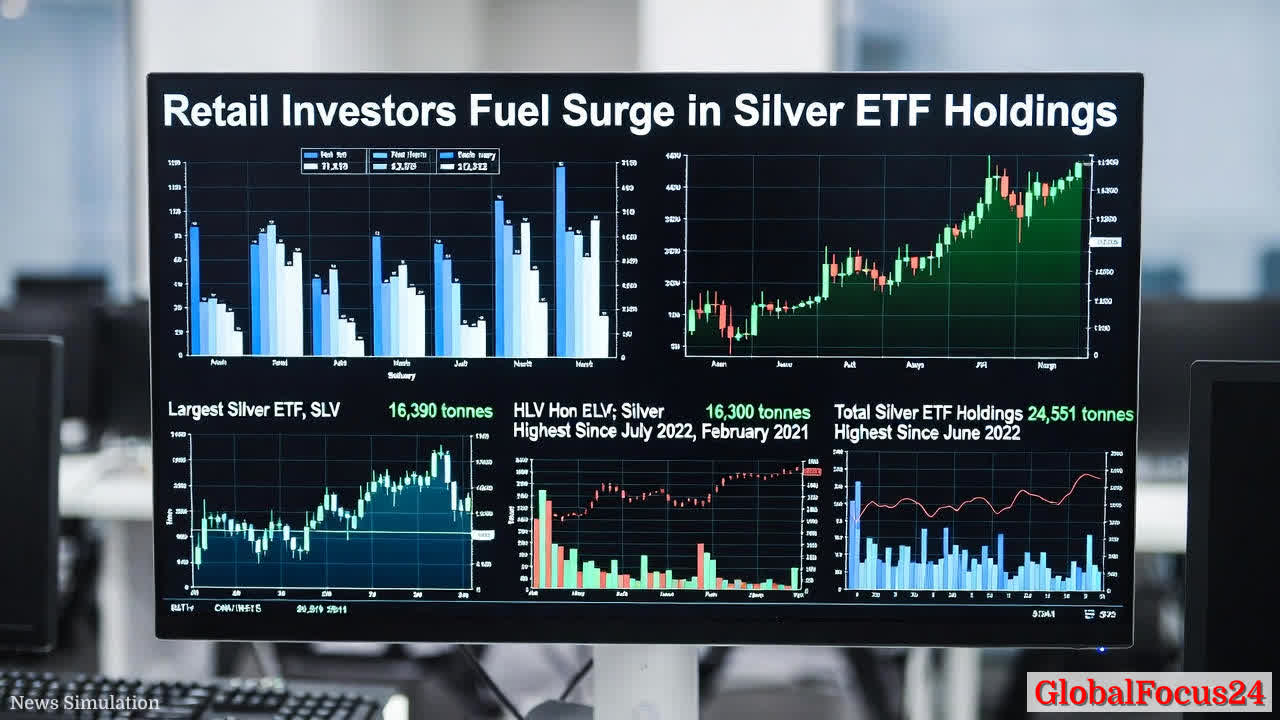
Retail Investors Drive Fresh Surge in Silver ETF Holdings
A marked shift in investor sentiment over the past year has positioned silver ETFs at the center of a high-profile retail demand wave. As ordinary savers and amateur traders increasingly seek exposure to precious metals, exchange-traded funds backed by physical silver have recorded sustained inflows, elevating holdings to levels not seen since mid-2022. Market observers are watching closely, noting that the momentum mirrors broader trends in alternative assets, inflation hedging strategies, and the evolving dynamics of retail participation in global commodities markets.
Historical backdrop and context Silver has long held a dual identity in financial markets: a monetary metal with a storied history and a industrial metal integral to manufacturing, electronics, and solar energy. The metal’s price behavior often reflects a combination of precious-metal demand for wealth preservation and broader cyclical demand from manufacturing and technology sectors. In the 2010s, silver ETFs gained popularity as investors sought diversification beyond traditional equities and bonds. The February 2021 surge in holdings—driven in part by active online communities and retail enthusiasm—illustrates how digital forums and social trading platforms can catalyze demand for physical-backed vehicles. Since then, the market has experienced fluctuations, but the latest data indicate a renewed appetite among retail participants.
Current holdings and momentum The flagship fund, a widely traded silver ETF with physical backing, has reported holdings of about 16,390 tonnes, the highest since July 2022. This level marks a notable increase of roughly 3,000 tonnes since February of the same year. In a broader context, total holdings across all known silver ETFs have climbed to roughly 24,551 tonnes, the most since June 2022, representing a rise of nearly 4,933 tonnes since February. These figures underscore a broad-based retail interest that has persisted through varying market conditions.
Investors are traditionally drawn to silver ETFs for several reasons. First, silver’s price has historically demonstrated sensitivity to inflation expectations and macroeconomic uncertainty, making it a potential hedge when inflation remains elevated or volatile. Second, physical-backed ETFs offer a convenient, transparent way to gain exposure to silver without the logistical challenges of setting up a storage facility, while still retaining a claim on physical metal. Third, these vehicles can be accessed within traditional brokerage accounts, lowering barriers for individual investors who wish to diversify beyond equities and bonds.
Regional and global comparisons The growth in silver ETF holdings is not uniform across all regions, but several markets have contributed disproportionately to inflows. North American retail investors have shown sustained interest, supported by a robust ecosystem of brokers, advisory services, and financial literacy initiatives. In Europe, curious savers have increasingly turned to precious metals as part of diversified portfolios, while Asia-Pacific markets have seen ongoing participation from a mix of retail and professional investors seeking one or more of the hedging properties associated with silver.
In comparison to other precious metals, silver’s price and ETF activity often move with a wider set of industrial demand drivers. This distinguishes silver from gold, which is frequently viewed more as a store of value and crisis hedge. The current cycle reflects a convergence of factors: a renewed emphasis on cost-effective hedges amid inflationary pressures, a desire for tangible assets in volatile markets, and a willingness to deploy capital into physically backed vehicles as a form of diversification.
Economic impact and market implications The rise in silver ETF holdings has several practical implications for markets and industries connected to precious metals. For one, larger ETF inventories can influence price discovery dynamics, providing a visible gauge of demand among retail participants. While ETFs themselves do not directly control the metal’s price, their aggregate demand can contribute to tighter supply conditions on the market, particularly if inflows persist over extended periods and are accompanied by limited new mine supply or divestment elsewhere.
Manufacturing sectors that rely on silver—including electronics, solar panels, medical devices, and automotive components—may feel nuanced effects as demand for silver comes from both speculators and industrial users. If inflows sustain at current levels, some downstream suppliers could adjust their procurement strategies to reflect evolving demand signals. Conversely, a broader investor interest in physical assets could help stabilize silver prices during times of market stress, as investors seek non-traditional hedges beyond equities and bonds.
Public sentiment and investor behavior Retail investor enthusiasm for silver ETFs often coincides with heightened public awareness of macroeconomic uncertainties. Economic indicators such as inflation readings, currency fluctuations, and geopolitical tensions can intensify appetite for tangible assets perceived as having intrinsic value. The social dimension—driven by online communities sharing analysis, charts, and investment theses—adds a participatory layer to market activity. This dynamic can accelerate inflows during periods when retail confidence is particularly buoyant, even if underlying fundamentals remain complex and multifaceted.
In this cycle, observers note that the surge in ETF holdings aligns with a broader trend of retail penetration into diversified asset classes. As more individuals gain access to financial markets through fractional purchases, robo-advisors, and streamlined trading platforms, the allocation to alternative assets like physical-backed silver becomes a practical option for those seeking to balance risk and return across a broader spectrum.
Supply considerations and future outlook Silver supply remains influenced by mining production, recycling input, and industrial demand. While ETF inflows reflect confidence in silver’s role as a hedge and diversification tool, the direction of future price trajectories will depend on a mix of supply resilience and demand dynamics across both investment and industrial segments. Analysts also watch for shifts in central bank behavior, currency strategies, and global growth trends, all of which can affect liquidity and the attractiveness of precious metals.
From an investment strategy perspective, several scenarios could unfold. If retail demand strengthens further, ETF inflows could continue to support a higher floor for silver prices, particularly if physical supply tightens or mining output struggles to keep pace with demand. If macro conditions ease or inflation expectations moderate, ETF inflows might wane or reallocate toward other asset classes. In either case, silver ETFs provide a transparent barometer of retail sentiment and a vehicle for accessible exposure to the metal.
Policy and regulatory considerations Regulatory frameworks governing ETFs and commodity markets influence how easily retail investors can participate in these vehicles. Transparency requirements, custody standards, and reporting obligations are designed to protect investors while ensuring market integrity. As the market evolves, regulators may monitor for concentrations of holdings, liquidity risk, and the potential for rapid inflows or outflows to impact market stability. Well-structured products with clear disclosures and robust risk management practices remain essential for maintaining confidence among individual investors and institutions alike.
Historical comparisons and long-term trends Looking back over a multi-year horizon, silver’s role in investment portfolios has fluctuated with macroeconomic cycles. The post-pandemic period, inflation shocks, and changing macro narratives have periodically boosted demand for tangible assets, including silver. The February 2021 surge in holdings remains a reference point for how quickly retail interest can escalate when coordinated online communities or resonance with market themes align. The current trajectory, while distinct in context, echoes the enduring appeal of silver as both a practical metal for industry and a hedge against uncertainty.
Conclusion The renewed vigor in silver ETF holdings signals a robust wave of retail interest in tangible assets. As investors diversify beyond traditional stocks and bonds, physical-backed silver ETFs emerge as a practical conduit for exposure to a metal with both industrial utility and monetary heritage. The data point to a market where retail participants are shaping demand patterns, influencing price discovery, and contributing to a broader narrative about how households allocate risk in a changing economic landscape. Amid ongoing global economic shifts, silver ETFs stand as a barometer of retail sentiment, balancing the allure of potential inflation hedging with the realities of supply, manufacturing demand, and the evolving toolkit available to individual investors.