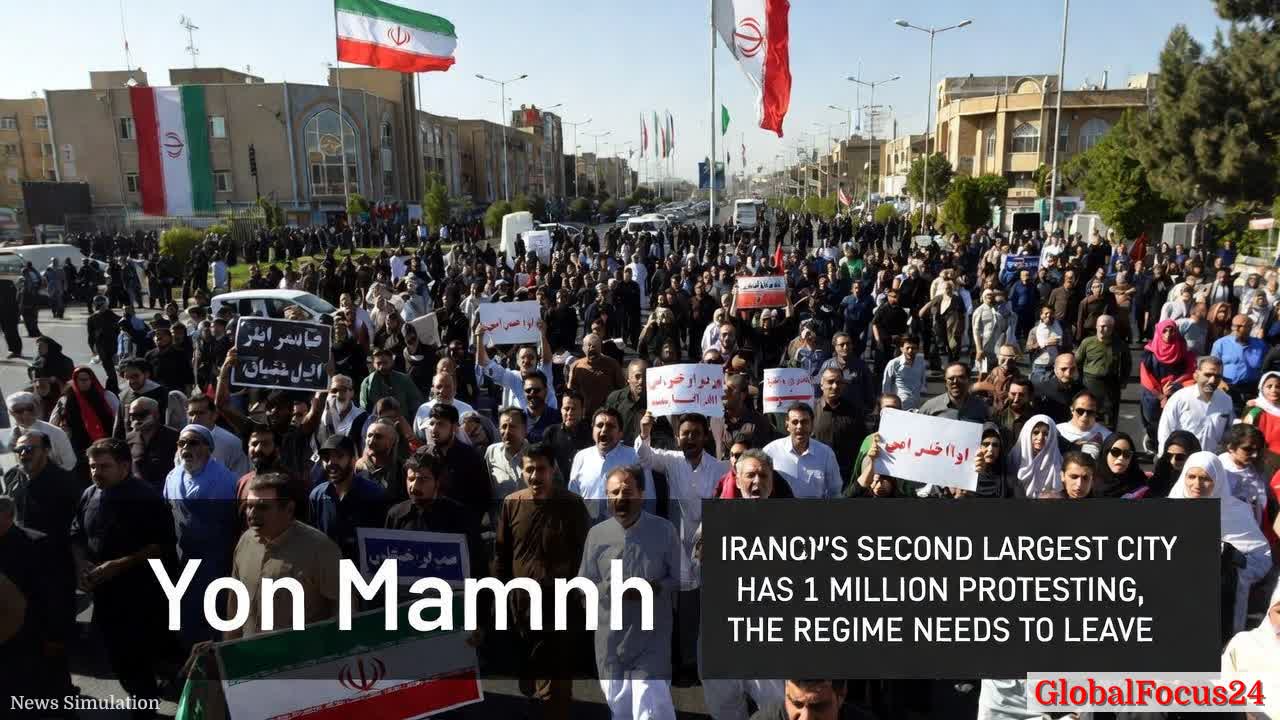
Over One Million Protesters Rally in Mashhad as Economic Crisis Deepens Across Iran
Massive Crowds Take Over Iran’s Second-Largest City
Over one million protesters have poured into the streets of Mashhad, Iran’s second-largest city, in what observers describe as one of the largest demonstrations in the country’s modern history. Reports and footage from the city show a sea of people filling major squares and avenues, chanting against the government as security forces appear to have withdrawn from key areas.
Mashhad, known as a conservative bastion and home to the revered Imam Reza shrine, has become the unexpected epicenter of an unprecedented wave of unrest. Demonstrators reportedly took control of several districts after local security personnel retreated, marking a highly symbolic shift in a city historically aligned with the state’s religious leadership.
The protests, now spreading to more than 100 cities across Iran, were initially sparked by an accelerating economic crisis. The national currency has collapsed, inflation has soared to triple digits, and shortages of basic goods have left many Iranians struggling to survive. The unrest has quickly evolved into a broader movement calling for systemic change.
Economic Collapse Fuels Nationwide Unrest
At the heart of the demonstrations lies a deepening economic emergency. The Iranian rial has lost most of its value over the past year, leaving salaries worthless and imports prohibitively expensive. Hyperinflation has rippled through every sector, from food and energy to healthcare and housing.
By early January, inflation rates had reportedly surged to levels exceeding 110 percent, with essential goods such as bread, rice, and cooking oil becoming unaffordable for millions of families. Small businesses have shuttered across provincial towns, and major industries — particularly petrochemicals and steel — are facing severe slowdowns due to foreign currency shortages and declining export revenue.
For many Iranians, these economic pressures have reached a breaking point. “People can no longer live under these conditions,” said one Mashhad shopkeeper via phone, declining to give his name for security reasons. “This is not only about politics; it’s about survival.”
A City Steeped in History and Symbolism
The choice of Mashhad as the focal point of the protests carries powerful symbolism. As the country’s most important pilgrimage center and the seat of key religious institutions, the city has long been viewed as a conservative anchor — one that traditionally supports the Islamic Republic’s ruling ideology.
Mass demonstrations in such a city indicate a significant shift in public sentiment. Historically, Iran’s largest protest movements began in Tehran, the capital, or other urban centers with more diverse populations. Mashhad’s participation — and apparent leading role — signals that discontent has spread even among communities once considered loyal to the establishment.
The city also bears historical resonance. Mashhad has occasionally acted as a spark for major political developments in Iran. In the late 1970s, before the 1979 revolution, smaller protests there foreshadowed the nationwide uprising that eventually changed the course of Iranian history. For many, today’s scenes echo that pivotal period, though the outcome remains uncertain.
Clashes, Strikes, and Acts of Defiance Nationwide
Across the country, demonstrations have grown increasingly bold. In over 100 cities, crowds have gathered in main squares, industrial zones, and university campuses. Protesters have blocked roads, staged general strikes, and refused to work in state-run sectors.
In some regions, symbolic acts of defiance have emerged. Videos circulating on social media show demonstrators lowering national flags, tearing them apart, or replacing them with banners carrying anti-government slogans. While internet restrictions have slowed the flow of verified information, eyewitness accounts suggest a level of coordination larger than seen in previous protest waves.
Strikes among oil workers, teachers, and transport employees have intensified pressure on the government, disrupting vital sectors that fuel Iran’s economic lifeline. Analysts say these labor movements, particularly if sustained, could limit the state’s ability to restore control through conventional means.
Security Forces Pull Back in Mashhad
Perhaps the most striking development has been the reported pullback of security forces in Mashhad. Footage shared by demonstrators shows emptied police posts, abandoned vehicles, and protesters freely moving through major intersections once tightly controlled.
Local sources claim that some police and paramilitary units were overwhelmed by the magnitude of the crowd, while others may have intentionally withdrawn to avoid confrontation in the country’s second-holiest city. While these reports remain difficult to verify independently, they have fueled perceptions of authority breakdown.
Authorities have so far refrained from declaring martial law, though there are unconfirmed reports of troop reinforcements heading toward the city from neighboring provinces. Analysts warn that if unrest continues at this scale, the government may be forced to make a critical decision — whether to negotiate with protesters or reassert power through force.
Historical Parallels and Unanswered Questions
Iran has faced waves of unrest before, but the current one stands out for its scale, social breadth, and geographic spread. In 2009, the “Green Movement” protests challenged election results but were largely confined to urban middle-class constituencies. In contrast, today’s demonstrations include workers, merchants, students, and religious pilgrims alike.
The comparison to the late 2017 protests — which also began in Mashhad — is striking. Back then, discontent centered on economic grievances that were quickly suppressed by a coordinated security response. What makes this situation distinct is the intensity of participation and the apparent erosion of fear among the population.
Political analysts note that widespread fatigue from years of sanctions, mismanagement, and corruption has eroded the social contract that once held parts of the population in check. With no quick economic relief in sight, and with key institutions losing credibility, the country faces its most serious internal challenge in decades.
Regional and Global Ripples
The unrest in Iran is already reverberating across the Middle East. Neighboring countries are watching closely, mindful that prolonged instability could impact regional trade routes and energy exports. Iran remains one of the world’s major oil producers, and any sustained disruption could influence global markets already strained by geopolitical tensions.
In Iraq and Afghanistan, border trade has slowed as transport routes tighten amid reports of increased inspections and security closures. Gulf states, which rely on energy stability, are monitoring developments for potential effects on global crude supplies. If the Iranian government diverts resources to suppress domestic unrest, it could further curtail export volumes, adding pressure to already-volatile oil prices.
Economic and Social Fallout
On the domestic front, the impact of the protests on Iran’s economy is already visible. Markets in Tehran and other major cities have seen sharp drops in business activity. The rial has continued to fall in unofficial markets, trading at record lows. Food prices have surged daily, pushing millions closer to poverty.
In addition to economic shock, many Iranians are facing social strain. Reports of factory closures, unpaid wages, and bank withdrawals have multiplied. Families are stockpiling essentials, fearing long-term shortages. For those living on fixed incomes — particularly retirees and public employees — the crisis has become existential.
While the government has called for calm, there is no sign that economic stability will return quickly. International sanctions remain in place, limiting foreign investment and trade options, while domestic production struggles with inefficiency and dwindling confidence.
The Path Ahead
For now, Mashhad stands as both the symbol and the center of Iran’s growing unrest. The images of vast crowds filling its streets, chanting for change beneath the golden dome of Imam Reza’s shrine, encapsulate the magnitude of the national moment.
Whether the protests evolve into a sustained movement or fade under renewed security measures remains to be seen. But the scale of participation — and the breadth of discontent — suggests that the grievances run far deeper than temporary economic pain.
For millions of Iranians, the demonstrations represent more than dissent; they mark a collective plea for dignity amid a collapsing economy and an uncertain future. The coming days will determine whether that plea becomes a turning point for the nation — or another chapter in its long struggle between hope and hardship.