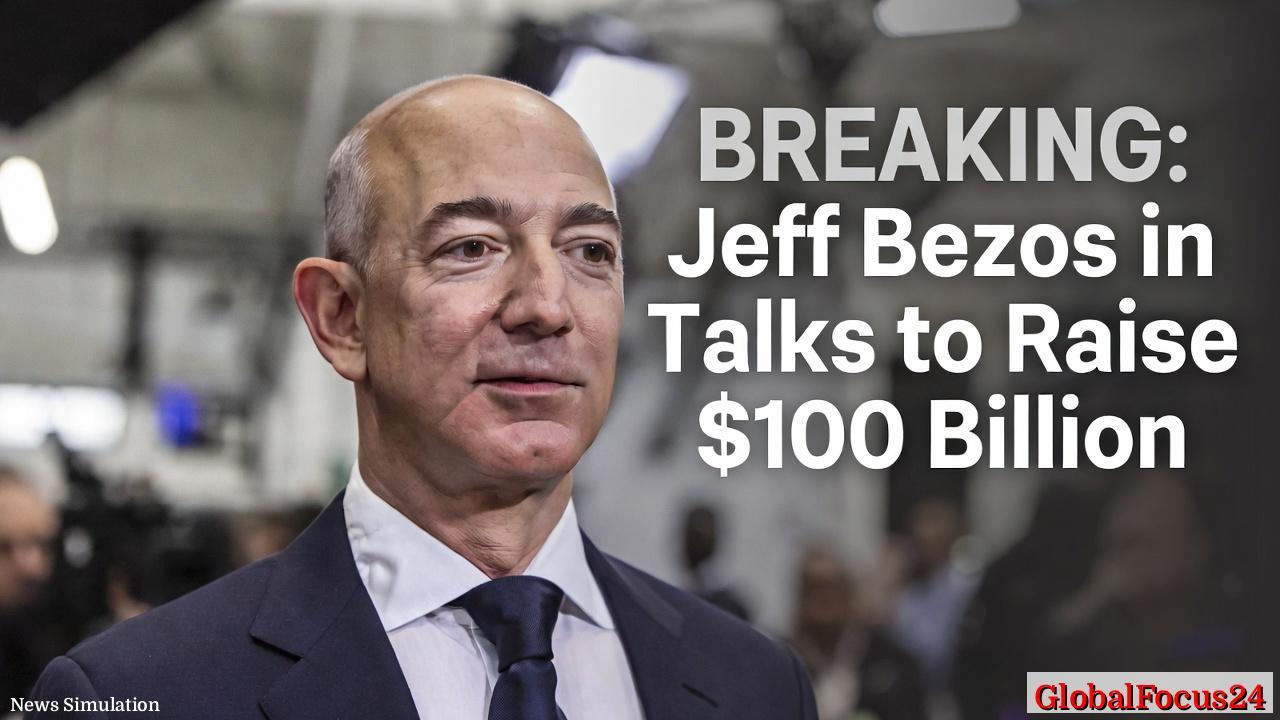
Jeff Bezos Pursues $100 Billion Fund to Revolutionize Global Manufacturing with Artificial Intelligence
Jeff Bezos, founder of Amazon.com and one of the world’s most influential entrepreneurs, is in early talks to raise an ambitious $100 billion investment fund designed to transform the manufacturing sector through artificial intelligence. The potential fund — one of the largest private investment vehicles ever conceived — aims to acquire established industrial and manufacturing companies and accelerate their automation using advanced AI and robotics technologies.
According to investor documents and accounts from individuals familiar with the effort, Bezos envisions the initiative as a comprehensive “manufacturing transformation” designed to modernize foundational industries such as chipmaking, defense, and aerospace — all sectors critical to global competitiveness in an era increasingly defined by automation and geopolitics.
A New Industrial Project from One of Tech’s Biggest Builders
Bezos, who stepped down as Amazon’s CEO in 2021 but remains executive chair, has spent recent months quietly meeting with sovereign wealth funds and institutional investors in the Middle East and Singapore. His travels are reportedly part of a global fundraising campaign designed to secure commitments for the massive new fund, which could rank among the largest in history if successful.
Sources close to the discussions say Bezos’s pitch draws upon his three decades of experience in scaling technology-driven enterprises and logistics systems. Amazon’s transformation of retail — powered by algorithmic optimization, cloud computing, and robotics — serves as a proof point, but this time his sights are set on the physical backbone of the world economy: the factories, machines, and supply chains that still depend heavily on manual processes and aging infrastructure.
The proposed fund would function more like an industrial holding company than a traditional venture capital vehicle. Rather than backing small startups, it would acquire mid- to large-scale manufacturing firms and retrofit them with AI systems to improve productivity, safety, and efficiency. Executives involved in early planning have described the effort as “a new model for industrial revitalization,” with a focus on technology integration rather than cost-cutting.
The Global Manufacturing Race Enters a New Phase
The timing of Bezos’s initiative underscores growing awareness among governments and investors that manufacturing capability is once again a strategic priority. Over the past decade, global supply chain disruptions — from the U.S.–China trade tensions to pandemic-era shortages of semiconductors and pharmaceuticals — have exposed vulnerabilities in the industrial base of advanced economies.
National strategies from Washington to Brussels to Tokyo now emphasize “reshoring” production and deploying automation to close labor gaps. Meanwhile, emerging markets across the Middle East and Asia are positioning themselves as hubs for precision manufacturing and AI research. Against this backdrop, Bezos’s proposed fund seeks to ride the convergence of capital, advanced computing, and industrial modernization.
If executed successfully, such a fund could redraw the competitive landscape of global production. The integration of AI into manufacturing — already underway in automotive, semiconductor, and aerospace sectors — promises exponential efficiency gains. Predictive maintenance powered by machine learning, automated quality control systems, and AI-driven design optimization can all boost output while reducing error rates and energy consumption.
Historical Context: The Long Arc of Industrial Reinvention
Industrial transformation has long been intertwined with technological revolutions. The first industrial revolution mechanized textile production in the 18th century; the second introduced electricity and assembly lines; the third digitalized manufacturing with computers and robotics. What Bezos now proposes could represent the dawn of a “fourth industrial age” — one defined by intelligent automation that combines machine learning, advanced robotics, and global-scale infrastructure.
In recent years, nations like Germany with its “Industry 4.0” program have championed digital manufacturing as a national strategy. The United States has followed with initiatives focused on semiconductor fabrication, battery production, and advanced materials. Yet progress remains uneven, often limited by the high cost and slow pace of AI integration across legacy plants.
By targeting entire companies rather than investing piecemeal in vendors and startups, Bezos’s plan appears tailored to overcome that inertia. His model borrows from the playbook of private equity — acquire established industrial enterprises and rebuild them around a data-centric architecture capable of adapting in real time to market demands.
Economic and Strategic Implications
If the $100 billion fund reaches its goal, its impact could ripple through both the private and public sectors. Tens of thousands of manufacturing jobs may be redefined rather than replaced, with an emphasis on human–AI collaboration. Regions that attract investment — particularly those in the Middle East, Asia, and North America — could see substantial infrastructure upgrades and a reinvigorated supply of skilled engineering work.
From an economic standpoint, the scale of the fund could act as both a stimulus and a technological accelerator. Global manufacturing output, which accounts for roughly 16 percent of world GDP, has struggled to regain momentum amid rising labor costs and post-pandemic inflationary pressures. Injecting hundreds of billions into modernization could help reignite productivity growth that has stagnated across most advanced economies since the late 2000s financial crisis.
The proposed fund also aligns with shifting geopolitical dynamics. AI-infused manufacturing has become a pillar of national security policy, particularly within defense and semiconductor supply chains. The United States has launched multibillion-dollar initiatives to bolster domestic chip fabrication, while China continues to invest heavily in automated production systems as part of its "Made in China 2025" strategy. A Bezos-backed industrial fund would add a powerful private-sector engine to that global competition.
Potential Investors and Financial Architecture
Early reports suggest Bezos is courting some of the world’s largest sovereign wealth funds — notably those based in Saudi Arabia, the United Arab Emirates, and Singapore. These investment entities, many of which hold trillions in assets, have been increasing allocations to technology and infrastructure in recent years as they seek to diversify away from oil revenue or traditional equity markets.
By leveraging his reputation and proven record of scaling technology companies, Bezos may command access to capital pools typically reserved for mega-infrastructure projects. Analysts note that a $100 billion target would require multilateral participation across continents — possibly blending sovereign capital with pension funds, insurance firms, and select private investors.
Structurally, the fund could resemble Berkshire Hathaway’s acquisition model more than a typical private equity fund. Rather than flipping companies for short-term returns, it might emphasize long-term stewardship, reinvesting profits into modernization and R&D to sustain growth over decades.
Regional Comparisons and Global Positioning
The vision also highlights a new wave of industrial ambition emerging outside traditional Western manufacturing centers. In Saudi Arabia, the government’s Vision 2030 plan has prioritized advanced manufacturing through public–private partnerships. In Singapore, the government has fostered automation and robotics startups through its Smart Nation initiative. Both regions — where Bezos has made recent visits — offer incentives and logistics infrastructure that could anchor key components of the new fund’s operations.
Meanwhile, in the United States, renewed federal emphasis on domestic manufacturing resilience has opened opportunities for large-scale private investment. Legislation such as the CHIPS and Science Act has already catalyzed tens of billions in semiconductor and electronics investments. A Bezos-led fund could serve as a complementary force — infusing capital at a scale capable of transforming industrial capacity rather than merely supporting incremental upgrades.
The Promise and Limits of AI-Driven Automation
While investors are drawn by the potential returns of such broad automation, experts caution that the transition poses significant challenges. Deploying AI across complex manufacturing systems requires vast datasets, domain-specific expertise, and careful oversight to ensure safety and reliability. Moreover, widespread automation raises questions about workforce displacement, data governance, and cyber resilience.
Proponents argue that automation will not eliminate human work but change its nature. Tasks once performed by hand will shift to oversight, system maintenance, and real-time optimization. Similar transitions occurred during earlier industrial revolutions, though with periods of social adjustment and retraining. Education and workforce programs will likely play a central role in ensuring that the new generation of “AI factories” benefits broader economies.
Bezos’s Broader Legacy and Long-Term Vision
For Bezos, the project represents both a return to form and a continuation of his lifelong fascination with transformative infrastructure. His ventures already stretch across the technological and industrial spectrum — from Amazon’s cloud computing networks to Blue Origin’s private rocketry projects. The proposed fund would bridge these pursuits, applying lessons from logistics, automation, and data analytics to reimagine how physical products are made.
Observers say the scale of this manufacturing transformation effort could define a new phase of Bezos’s post-Amazon career: less focused on consumption and more on creation. In that sense, his ambition recalls the 20th-century industrialists who merged technology, capital, and manufacturing prowess to shape the modern global economy.
If realized, the $100 billion fund could become not just the largest private manufacturing initiative in modern history but also a defining experiment in how artificial intelligence reshapes the real-world economies that still rely on machines, materials, and human ingenuity.