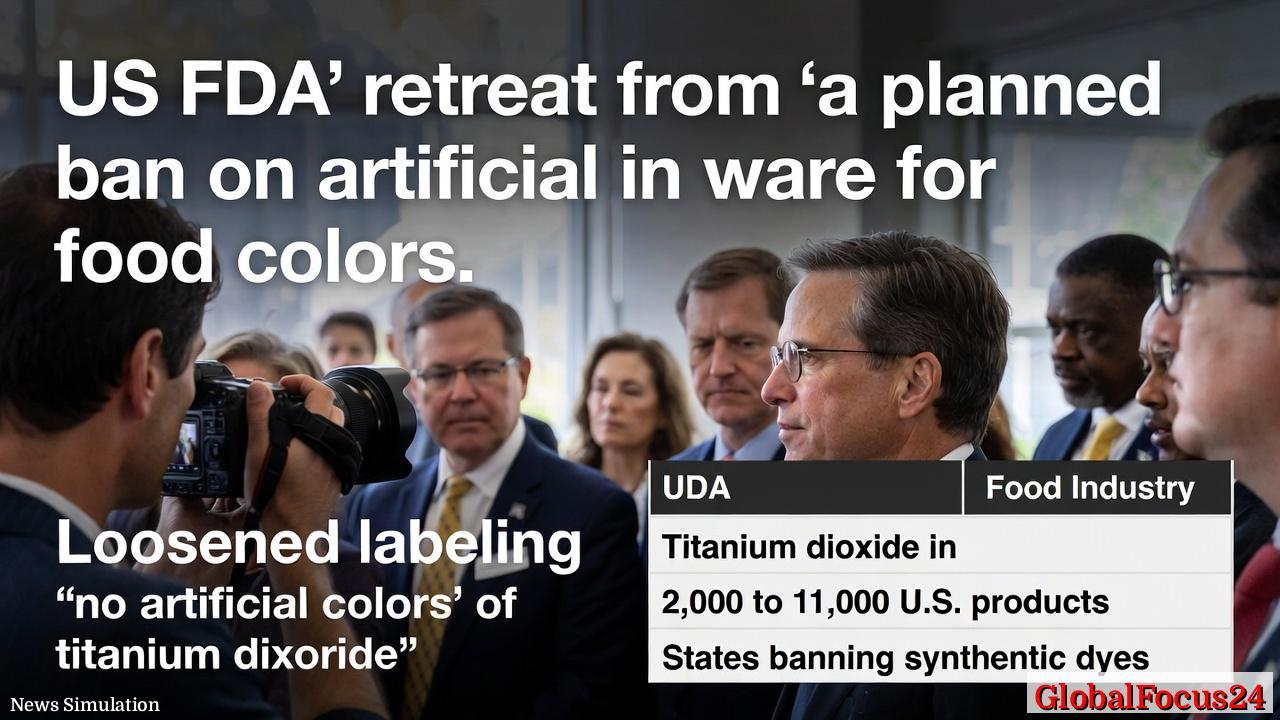
FDA Retreats from Plan to Ban Artificial Colors in Food
Regulatory Rollback Sparks Debate on Food Label Transparency
The U.S. Food and Drug Administration (FDA) has reversed course on a plan to fully ban artificial colors in food, opting instead to relax labeling rules that allow manufacturers to claim “no artificial colors” even when their products contain certain additives such as titanium dioxide. The decision, announced in mid-February 2026, has ignited a heated debate among consumer advocates, health researchers, and the food industry over what constitutes honest labeling and consumer protection.
Under the new guidelines, food companies can make “no artificial color” claims as long as the dyes used are not petroleum-based. The FDA describes the change as part of an effort to encourage a transition away from synthetic, petroleum-derived colorants—long scrutinized for their possible health impacts—toward naturally derived alternatives. The shift represents a retreat from 2025 proposals that would have phased out several artificial dyes entirely.
A Controversial Compromise
This compromise was welcomed by major U.S. food manufacturers and trade groups that had expressed concern about the financial and logistical burden of reformulating products. At the same time, public health advocates criticized the policy as a step backward, arguing it opens a loophole that could mislead consumers seeking to avoid all artificial or potentially harmful colorants.
Thomas Galligan, a principal scientist with the Center for Science in the Public Interest, warned that the rule “is going to cause confusion and allow some companies to mislead folks about the colors that are present in their foods.” Galligan and other consumer advocates argue that a clear, enforceable ban on harmful substances would have better served public health goals.
The FDA defended its decision by emphasizing the need for realistic, incremental progress. Health and Human Services Secretary Kennedy described the rule change as “real progress,” stating that the goal is to promote the use of safer, plant-based pigments without jeopardizing supply chains or raising consumer prices.
Industry Relief, Consumer Unease
For the food industry, the decision provides much-needed clarity and breathing room. The trade group Consumer Brands called the new rule a “positive step toward greater ingredient safety and transparency,” emphasizing that it gives companies flexibility to innovate with new natural pigments, including turmeric, beet extract, and spirulina.
However, many consumer advocates view it differently. Kelly Ryerson, a clean-label campaigner, praised earlier FDA efforts to pressure companies to move away from synthetic dyes but noted that the latest rule stops short of meaningful reform. "Consumers want truth in labeling," she said. "Saying ‘no artificial colors’ while still using ingredients like titanium dioxide is deeply misleading."
Health Risks and Scientific Concerns
Concerns over food colorants are not new. For decades, researchers have examined the neurological and carcinogenic impacts of synthetic dyes such as Red No. 3 and Yellow No. 5, which are still used in a variety of candies, drinks, and processed foods. Numerous studies have linked certain artificial dyes to behavioral issues, including attention‑deficit/hyperactivity disorder (ADHD) and hyperactivity in children.
The FDA banned Red Dye No. 3 in January 2025 following studies demonstrating that long-term exposure caused cancer in laboratory rats. That move was hailed as a landmark victory for regulatory accountability, fueling expectations of a broader crackdown on food colorants. But the February 2026 retreat suggests a more cautious approach, balancing public health with industry feasibility.
Naturally derived dyes are generally considered safer, yet they are not immune to controversy. Titanium dioxide, a whitening agent commonly used to brighten candy coatings and baked goods, has become a flashpoint. It is widely used in the U.S. but banned in the European Union due to ongoing concerns about nanoparticle toxicity. Studies have tied chronic exposure to potential health issues including inflammation, DNA damage, and reproductive harm.
Titanium Dioxide and the Global Divide
The European Food Safety Authority (EFSA) concluded in 2021 that it could no longer consider titanium dioxide safe for consumption. France quickly enacted a ban, followed by the wider EU in 2022. Despite mounting evidence and a 2023 petition from environmental and consumer groups urging the FDA to withdraw its approval, the agency has yet to take definitive action.
Analysts estimate that titanium dioxide appears in between 2,000 and 11,000 U.S. food products, ranging from candies and chewing gum to dressings, cookies, and yogurt. Unlike the EU, the FDA has maintained that current evidence does not conclusively prove harm in humans, though it continues to monitor emerging data.
Ken Cook, co-founder of the Environmental Working Group, expressed frustration with the FDA’s stance, calling it “another broken promise.” He contended that voluntary industry shifts, without enforceable limits, risk leaving consumers exposed. “We’ve seen this play out before,” Cook said. “Dialogue without accountability does not protect anyone.”
State and Regional Action Increasing
As federal policy remains cautious, several U.S. states are taking matters into their own hands. West Virginia has enacted bans on select synthetic food dyes, while Texas has mandated warning labels for products containing certain chemical colorants. California, New York, and more than two dozen other states are now considering similar measures—an echo of regional movements that often precede national policy changes in food safety regulation.
These state-led efforts illustrate how uneven the regulatory landscape has become. Companies must now navigate a patchwork of standards, balancing consumer expectations in jurisdictions with stricter laws against looser national requirements. Some manufacturers have preemptively reformulated products to avoid having multiple regional variations, while others have chosen to adjust labeling only in states that require it.
The Economic Impact on Food Production
Economically, the FDA’s reversal highlights a tension between public health objectives and industry stability. Reformulating packaged foods to remove artificial dyes can be costly, particularly when natural alternatives are more expensive or less stable under high temperatures. For large manufacturers, those costs can reach millions of dollars across national product lines.
By loosening its labeling restrictions, the FDA has effectively reduced short-term financial strain. Analysts say this move could protect smaller companies from regulatory shocks and supply shortages, especially given the challenges of sourcing plant-based colorants at scale. However, consumer trust may be the real cost. Surveys consistently show that shoppers are willing to pay more for products with clean, transparent ingredient lists—and backlash could erode sales if the public perceives the new labels as deceptive.
Historical Context: From Synthetic Revolution to Natural Return
Artificial food coloring became popular in the early 20th century as industrial food processing expanded. Petroleum-derived dyes offered vivid colors, uniform results, and long shelf lives. The FDA’s early regulatory efforts, including the 1938 Food, Drug, and Cosmetic Act, were designed in part to control unsafe or deceptive use of colorants. Red Dye No. 2 was banned in 1976 after being linked to cancer, setting a precedent that continues to shape the debate today.
In the past two decades, the rise of organic and “clean label” trends has reignited public demand for transparency and natural ingredients. Major brands like General Mills, Kellogg’s, and Mars have gradually reduced their reliance on synthetic dyes, opting instead for natural pigments like paprika extract and beta-carotene. The FDA’s current pivot, critics argue, threatens to dilute that progress by blurring distinctions between truly natural additives and synthetic compounds that are merely non-petroleum.
Balancing Safety, Clarity, and Innovation
Supporters of the FDA’s new rule argue that it reflects a realistic balancing act. The agency’s stated goal is to encourage companies to innovate responsibly without imposing abrupt bans that could disrupt supply chains or turn consumers toward unregulated imports. Proponents also note that the safety profile of many naturally derived dyes is still under review, and some—such as caramel coloring produced with ammonia—carry their own risks due to by-products like 4‑MEI, a compound linked to cancer in animal studies.
Critics counter that transparency should take precedence over industrial convenience. They warn that ambiguous labels could undermine consumers’ ability to make informed choices, particularly as interest in food safety surges in the wake of new research into additives, allergens, and nanomaterials.
The Road Ahead
The FDA has indicated it will continue studying the safety of titanium dioxide and related compounds and may revisit the issue in the future. For now, the agency’s latest move signals a pause rather than a full pivot—an attempt to maintain regulatory flexibility in a politically and economically sensitive space.
Meanwhile, consumer pressure is likely to intensify. Advocacy organizations are urging brands to voluntarily eliminate both synthetic and questionable natural additives to stay ahead of shifting public expectations. The tug-of-war between transparency, safety, and practicality is reshaping how American food is made and marketed, one ingredient at a time.
As the debate continues, the FDA’s decision underscores a central tension in modern food regulation: whether gradual, industry‑friendly adaptation can genuinely safeguard public health—or simply delay the reckoning over what’s really in our food.