U.S. White-Collar Hiring Slumps to 11-Year Low Amid Growing Economic Strain
Professional and Business Services Face Deep Hiring Freeze
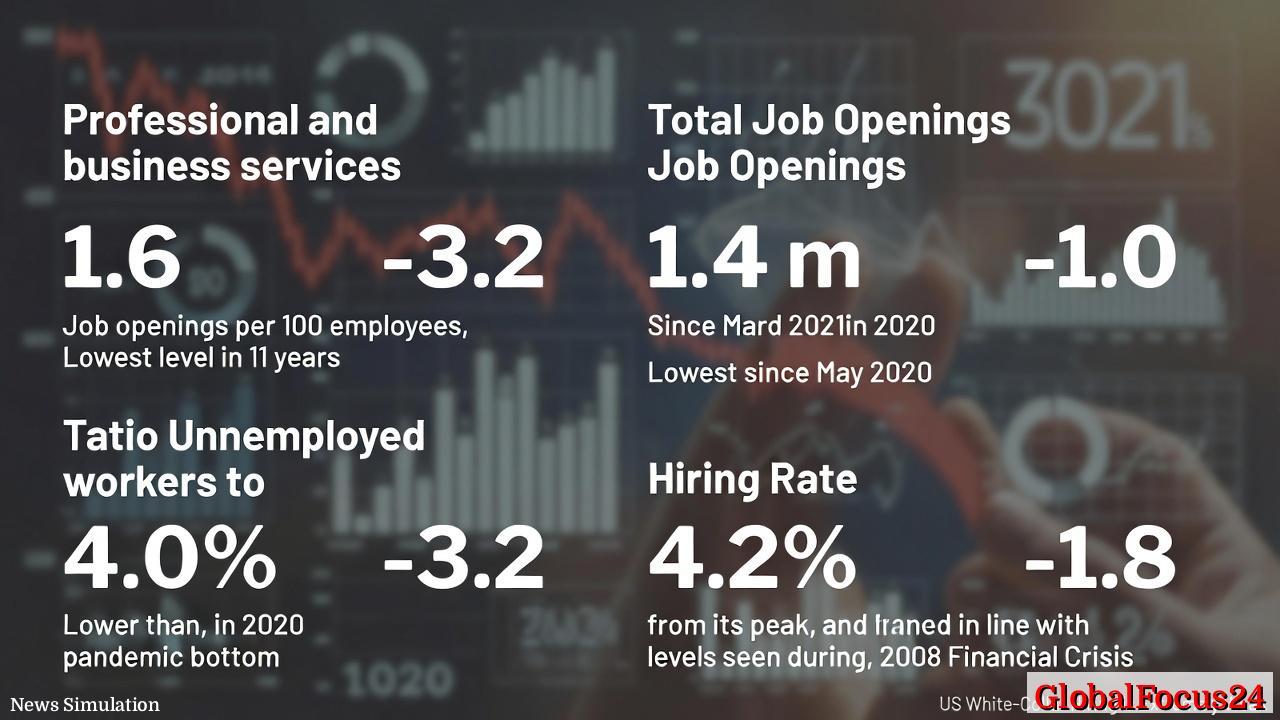
America’s white-collar job market has entered one of its weakest stretches in more than a decade, as employers in professional and business services sharply curtail hiring. According to the latest federal data, there are now just 1.6 job openings per 100 employees across the sector—the lowest level in at least 11 years and even weaker than at the depths of the 2020 pandemic downturn.
The ratio has more than halved from its 2021 peak, when companies were scrambling to attract staff in a labor market defined by remote work expansion, aggressive corporate growth, and unprecedented stimulus. What began as a gradual cooling through 2023 has now tipped into a full-blown contraction, signaling a white-collar recession that many economists warn could deepen through 2026.
A Sharp Reversal from the Pandemic Hiring Boom
During the pandemic recovery, professional and business services led the rebound. From software development and consulting to accounting and management, firms raced to fill vacancies as demand surged for digital transformation and strategic planning. At its March 2022 peak, the sector boasted around 2.4 million job openings, double pre-pandemic levels.
Today, that number has fallen by 1.4 million, leaving just 1.0 million openings—the lowest since May 2020. The collapse has been swift and sustained, reflecting a combination of softer demand, cost-cutting pressures, and widespread corporate restructuring.
“The market has swung from over-heating to over-correction,” said one labor economist based in Boston. “Employers over-hired in 2021 and 2022, and now they’re pausing—some even reversing course.”
Hiring Rate Falls to Financial Crisis Levels
The hiring rate within the professional and business services sector has dropped 1.8 percentage points since early 2022, resting at 4.2%—a level last seen during the 2008 Financial Crisis. This figure underscores the depth of the slowdown, as even firms with open positions appear to be hiring at a slower pace, or in many cases, not at all.
Many companies that expanded headcount rapidly during the pandemic now find themselves overstaffed. Corporate giants in technology, finance, and consulting have all carried out rounds of restructuring, with many rolling hiring freezes into 2026. Startups and mid-size firms, once aggressive recruiters, have largely stepped back amid tighter credit conditions and subdued venture funding.
The downturn has also hit recruitment agencies and staffing firms, which serve as bellwethers for the broader employment landscape. Many report weakened demand for both permanent placement and temporary contract roles—two traditionally resilient areas during economic cycles.
Job Seekers Confront Mounting Competition
The slowdown means professionals looking for new roles are encountering one of the toughest markets in years. For every available position, roughly 4.0% of unemployed workers in the sector are now vying for it, a ratio that nearly mirrors the pandemic-era lows.
Candidates report drawn-out recruitment timelines, fewer callbacks, and rescinded offers—a stark contrast to the employee-driven market of just three years ago. In some industries, competition for roles has intensified even further, particularly in marketing, project management, and finance.
“Openings exist, but they’re narrower and more specialized,” observed a San Francisco-based recruiter. “Employers know they have the leverage again, and they’re using this period to raise qualification thresholds.”
Broader Economic Ripples and Confidence Impact
The weakness in white-collar hiring mirrors a broader cooling across the U.S. economy. Professional and business services account for roughly 13% of total U.S. employment, making it one of the most influential sectors in shaping wage dynamics and consumer confidence.
When white-collar workers face job insecurity, the effects quickly spill into housing, retail spending, and services. Economists note that discretionary categories—such as travel and home improvement—tend to soften when salaried professionals pull back.
Recent earnings data suggest that higher-income households have begun tightening budgets. Retailers and service providers that cater to professional demographics, such as office equipment suppliers and upscale restaurants, are reporting softer demand as clients curb expenses and business travel remains uneven.
Tech and Finance Lead the Downturn
The decline is most pronounced in technology, financial services, and consulting—industries that had previously dominated the hiring landscape. Tech firms, after years of double-digit growth, are scaling back amid elevated borrowing costs and slowing revenue expansion.
Finance and accounting roles, which typically follow economic cycles, have also contracted as firms focus on efficiency and automation. Consulting firms, meanwhile, have postponed new projects and deferred hiring as clients cut discretionary budgets.
The pullback in white-collar employment contrasts sharply with ongoing resilience in blue-collar fields. Sectors such as construction, healthcare, and logistics continue to post relatively stable demand for skilled labor, highlighting a divided labor market: strong at the base, fragile at the top.
Regional Patterns Show Growing Divergence
Regional differences across the U.S. further illustrate the imbalance. Sun Belt metros such as Dallas, Atlanta, and Miami—once magnets for corporate growth—are reporting noticeable declines in job postings for business and professional services roles.
In contrast, cities with diverse economic bases such as Chicago, Denver, and Raleigh have shown slightly better resilience, supported by a mix of manufacturing, education, and healthcare expansion. The coastal tech hubs of San Francisco, Seattle, and New York, however, remain at the epicenter of white-collar cutbacks, with job listings down more than 40% year-over-year in some areas.
Remote work, initially seen as a buffer against regional downturns, has not provided much relief. Companies appear equally cautious regardless of location, signaling that the weakness is structural rather than geographic.
Historical Context: A Cycle with Parallels
The current slump draws close parallels to past downturns. During both the 2001 tech collapse and the 2008–2009 financial crisis, professional and business services were among the first sectors to contract and the last to rebound.
Historically, white-collar recessions develop out of declining corporate confidence rather than sudden consumer shocks. Companies scale back planning, consulting, and administrative spending months before cutting frontline operations, often foreshadowing broader slowdowns across the economy.
In this cycle, the abrupt correction follows three years of overheating—a pattern that economists say is typical after large-scale stimulus and rapid digital expansion. If history repeats, recovery may not begin until sustained corporate profitability returns, likely late in 2026 or 2027.
Businesses Turn to Automation and Efficiency
Behind the numbers lies a long-term shift in the nature of white-collar work. Many firms are replacing or consolidating administrative functions with automation and artificial intelligence tools. From entry-level analysts to customer support staff, software platforms are taking over routine tasks once performed by humans.
Executives increasingly frame these investments as both a cost-saving measure and a productivity strategy. While such transitions can elevate efficiency, they also reduce headcount needs, dampening demand for generalist roles and mid-tier professionals.
Training initiatives and reskilling programs have emerged as a potential counterbalance, but progress has been uneven. Experts warn that without sustained upskilling, the professional labor market may remain structurally weaker than before the pandemic.
The Outlook: Prolonged Weakness Ahead
Most forecasts suggest that the white-collar recession will persist into late 2026, with significant improvement unlikely until interest rates decline and corporate confidence stabilizes. Major professional-services employers continue to emphasize “discipline” and “headcount optimization” in earnings calls, signaling that caution remains the prevailing mood.
If the broader U.S. economy avoids a deeper recession, gradual improvement could emerge next year. But for now, the hiring environment remains chilled, reshaping expectations for workers and businesses alike.
The professional-class employment engine that once powered America’s post-pandemic boom is now idling—one of the clearest signs that corporate America’s once-boundless appetite for white-collar talent has hit its coldest point in more than a decade.