US Labor Market Swings Sharply as Hiring Data Signals Uncertainty
Volatile Hiring Patterns Mark Early 2026 Labor Market
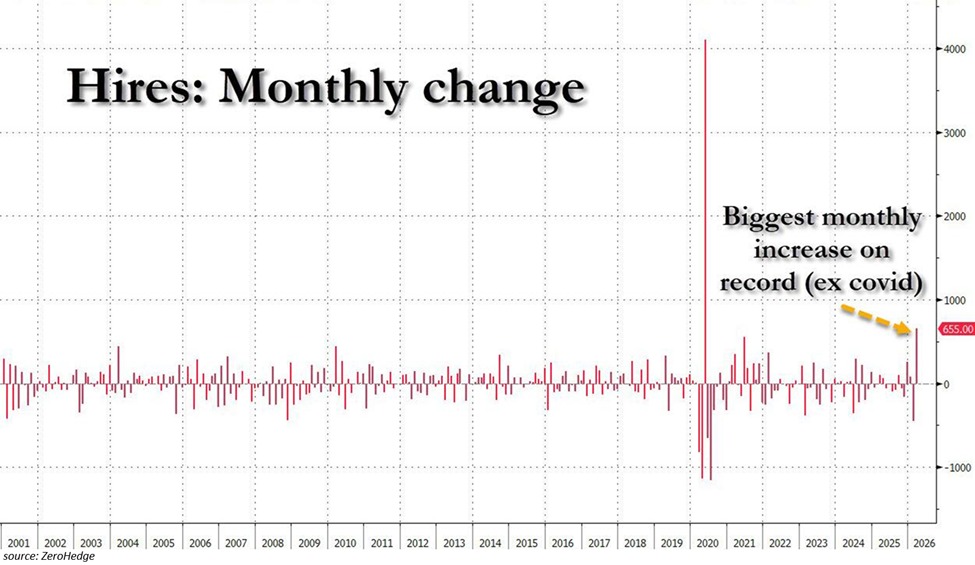
The United States labor market is showing unusually sharp swings in hiring activity, underscoring a period of heightened uncertainty for employers and workers alike. After a steep contraction of 448,000 jobs in February—the largest monthly decline since the early months of the COVID-19 pandemic—March brought a dramatic reversal, with hiring surging by 655,000 jobs. This marks the strongest monthly increase outside of the pandemic rebound period in 2020.
The abrupt shift pushed total hiring to 5.55 million in March, the highest level recorded since February 2024. At the same time, the national hiring rate rose by 0.4 percentage points to 3.5%, its highest level since May 2024. Despite this improvement, hiring activity remains below the pre-pandemic average of 3.8% seen between 2017 and 2019, highlighting the uneven nature of the current recovery.
Conflicting Signals: Layoffs vs Hiring Surges
The dramatic fluctuations in hiring data stand in contrast to ongoing reports of large-scale layoffs across multiple sectors. Technology firms, financial institutions, and some manufacturing companies have announced workforce reductions in the first months of 2026, creating a complex picture of the labor market.
This divergence reflects a broader structural shift rather than a uniform slowdown. While some industries are trimming headcount due to cost pressures, automation, or changing consumer demand, others—particularly in healthcare, hospitality, and certain service sectors—continue to add workers at a steady pace.
Economists note that such conflicting signals are not uncommon during transitional economic periods. Hiring and layoffs often occur simultaneously as businesses reallocate resources, adjust to new technologies, or respond to shifting market conditions. However, the scale of the recent swings has drawn particular attention.
Historical Context: Echoes of Pandemic-Era Volatility
The magnitude of February’s job decline and March’s rebound evokes comparisons to the labor market turbulence seen during 2020. At that time, sudden shutdowns followed by rapid reopenings produced record-breaking job losses and gains within short periods.
Outside of that extraordinary period, labor market data in the United States has typically been more stable. Monthly hiring changes rarely exceed a few hundred thousand jobs, making the recent swing of more than one million jobs across two months especially notable.
Historically, such volatility has often coincided with periods of economic recalibration. For example:
- During the early 2000s recession, hiring slowed unevenly as industries adjusted to the collapse of the dot-com bubble.
- Following the 2008 financial crisis, the labor market experienced prolonged weakness but relatively fewer abrupt monthly swings.
- The post-pandemic recovery in 2021 and 2022 saw strong hiring but gradually stabilized as labor demand normalized.
The current pattern appears distinct, combining elements of rapid adjustment with ongoing structural change.
Sector-Level Shifts Driving the Numbers
The recent volatility in hiring is partly driven by uneven performance across sectors. Industries tied to consumer services, including travel, dining, and healthcare, have continued to expand hiring in response to sustained demand and labor shortages.
At the same time, sectors more sensitive to interest rates and global economic conditions—such as technology, real estate, and manufacturing—have shown signs of contraction or cautious hiring. Companies in these industries are reassessing workforce needs amid higher borrowing costs and evolving business models.
Temporary employment, often seen as a leading indicator of labor market trends, has also shown fluctuations. Employers frequently adjust temporary staffing levels before making longer-term hiring decisions, contributing to short-term volatility in overall job figures.
Regional Differences Highlight Uneven Recovery
Labor market conditions vary significantly across regions, further complicating the national picture. States with strong service-based economies, such as Florida and Nevada, have experienced more consistent hiring growth, supported by tourism and population inflows.
In contrast, regions with higher concentrations of technology and manufacturing jobs, including parts of California and the Midwest, have faced more pronounced layoffs and hiring slowdowns. This regional divergence reflects broader economic shifts, including changes in consumer behavior, remote work patterns, and industrial demand.
Urban areas, particularly large metropolitan centers, continue to recover from pandemic-era disruptions but face challenges related to office occupancy rates and shifts in commuting patterns. Meanwhile, smaller cities and suburban regions have benefited from population growth and business relocation trends.
Economic Implications of Labor Market Instability
The recent swings in hiring data carry significant implications for the broader economy. A stable labor market is typically a key driver of consumer confidence and spending, which in turn supports economic growth.
Volatility, however, can create uncertainty for both workers and businesses. For workers, sudden changes in hiring conditions may affect job security and wage expectations. For employers, unpredictable labor market conditions can complicate workforce planning and investment decisions.
Key economic impacts include:
- Consumer spending: Fluctuating employment conditions may lead to cautious spending behavior, particularly for discretionary goods and services.
- Wage dynamics: Labor shortages in some sectors continue to push wages higher, while layoffs in others may exert downward pressure.
- Productivity trends: Ongoing workforce adjustments may influence productivity as companies reorganize operations and adopt new technologies.
Despite these challenges, the overall level of hiring remains relatively strong by historical standards, suggesting that underlying demand for labor persists.
Comparison with Other Advanced Economies
The United States is not alone in experiencing labor market fluctuations, but the scale and speed of recent changes appear more pronounced compared to other advanced economies.
In Europe, labor markets have generally shown slower, more stable adjustments, partly due to stronger employment protections and different economic structures. Countries such as Germany and France have maintained relatively steady employment levels, though growth has been modest.
In contrast, the U.S. labor market is known for its flexibility, allowing for quicker hiring and layoffs. This flexibility can lead to faster recoveries but also contributes to greater short-term volatility.
Japan, with its aging population and longstanding labor shortages, has experienced relatively stable employment conditions, with less dramatic monthly swings. However, its slower economic growth presents a different set of challenges.
These international comparisons highlight how structural factors—such as labor laws, demographic trends, and industry composition—shape labor market behavior.
Labor Force Participation and Hiring Trends
Another key factor influencing hiring data is labor force participation, which has yet to fully return to pre-pandemic levels. While participation has improved in recent years, demographic changes, including retirements and shifts in work preferences, continue to affect labor supply.
The mismatch between available jobs and worker skills also plays a role. Many employers report difficulty filling positions that require specialized training or experience, even as layoffs occur in other areas.
This imbalance contributes to the seemingly contradictory data: high levels of hiring alongside ongoing job cuts. It reflects a labor market in transition rather than one in clear decline or expansion.
Outlook for the Coming Months
Looking ahead, economists expect continued variability in labor market data, though the extreme swings seen in February and March may moderate. Several factors will influence the trajectory:
- Interest rates and monetary policy, which affect business investment and hiring decisions.
- Global economic conditions, including trade dynamics and supply chain stability.
- Technological advancements, particularly in automation and artificial intelligence, which may reshape workforce needs.
- Consumer demand, a key driver of employment in service-oriented sectors.
While the recent rebound in hiring is a positive signal, it does not fully offset concerns raised by earlier declines and ongoing layoffs. Instead, it underscores the complexity of the current economic environment.
A Labor Market in Transition
The sharp contrast between February’s job losses and March’s hiring surge reflects a labor market undergoing significant transformation. Rather than indicating a clear direction, the data points to a period of adjustment as businesses and workers navigate changing economic conditions.
Despite the volatility, the overall level of hiring remains relatively robust, suggesting resilience in the face of uncertainty. However, the coexistence of strong hiring and notable layoffs highlights the uneven nature of the recovery.
As the year progresses, the labor market’s ability to stabilize will be closely watched, not only as an indicator of economic health but also as a measure of how effectively the economy adapts to ongoing structural changes.