Federal Reserve Expands Treasury Holdings to Peak Levels Not Seen Since Mid-2024
Federal Reserve Balance Sheet Swells as Treasury Purchases Accelerate
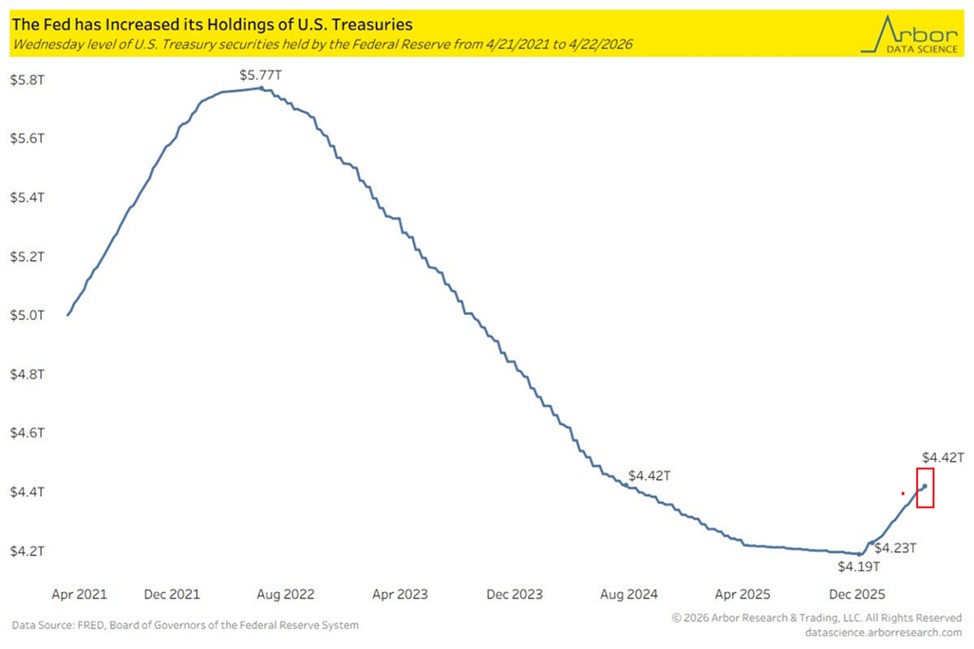
The Federal Reserve has sharply increased its holdings of U.S. Treasury securities, pushing its total to approximately $4.4 trillion, the highest level recorded since July 2024. The move marks a notable shift in the central bank’s balance sheet strategy and reflects evolving dynamics within the U.S. government debt market.
Since December, the Fed has added roughly $237 billion in Treasury securities to its portfolio. This surge has elevated Treasuries to 65.9% of total Federal Reserve assets, a proportion not seen since March 2008, during the early stages of the global financial crisis. The central bank’s total balance sheet has expanded to $6.7 trillion, its largest size since May 2025.
The scale and speed of these purchases are drawing attention from market participants, economists, and policymakers, as they signal potential changes in liquidity management, monetary conditions, and financial stability considerations.
Historical Context: From Crisis Response to Balance Sheet Normalization
The Federal Reserve’s relationship with U.S. Treasuries has long been central to its monetary policy toolkit. During periods of economic stress—most notably the 2008 financial crisis and the COVID-19 pandemic—the Fed dramatically increased its Treasury holdings through large-scale asset purchases, commonly known as quantitative easing.
At its peak during the pandemic response in 2022, the Fed’s balance sheet exceeded $8 trillion, driven by aggressive buying of Treasuries and mortgage-backed securities. These purchases were designed to stabilize financial markets, lower borrowing costs, and support economic recovery.
Beginning in 2022, however, the Fed initiated a process known as quantitative tightening, gradually reducing its holdings to normalize monetary conditions and combat inflation. Treasury securities were allowed to mature without reinvestment, shrinking the balance sheet over time.
The recent reversal—marked by renewed Treasury accumulation—suggests a shift away from strict balance sheet reduction, even if temporary. While not officially labeled as a new easing program, the scale of purchases has drawn comparisons to earlier interventions.
Drivers Behind the Surge in Treasury Holdings
Several factors appear to be contributing to the Federal Reserve’s increased Treasury purchases:
- Market liquidity concerns: Volatility in the U.S. Treasury market has raised concerns about liquidity, particularly in longer-dated securities. Increased Fed participation can help stabilize trading conditions.
- Elevated Treasury issuance: The U.S. government has significantly increased debt issuance to finance ongoing fiscal obligations, creating a larger supply of securities that must be absorbed by the market.
- Interest rate environment: Higher interest rates have changed investor demand patterns, with some traditional buyers reducing exposure to longer-term Treasuries.
- Financial system stability: Maintaining orderly market functioning remains a core Fed priority, particularly in the world’s largest sovereign debt market.
These dynamics have combined to create conditions in which the central bank’s presence acts as a stabilizing force, even without explicit policy shifts.
Economic Implications of a Growing Balance Sheet
The expansion of the Federal Reserve’s balance sheet carries broad implications for the U.S. economy and global financial markets.
One immediate effect is increased liquidity within the financial system. As the Fed purchases Treasuries, it injects reserves into the banking system, which can influence lending conditions and overall financial stability. While not equivalent to traditional stimulus measures, this process can ease certain funding pressures.
The rise in Treasury holdings also affects yields. Increased demand from the Fed can place downward pressure on interest rates, particularly at the long end of the yield curve. This, in turn, influences borrowing costs for businesses, consumers, and the federal government.
However, the long-term implications are more complex. A sustained expansion of the balance sheet may complicate future monetary policy decisions, especially if inflationary pressures persist. Managing the balance between supporting market stability and maintaining price stability remains a central challenge.
Comparison with Global Central Banks
The Federal Reserve is not alone in navigating these dynamics. Central banks across major economies have faced similar challenges in managing sovereign debt markets while maintaining monetary policy objectives.
In Japan, the Bank of Japan continues to hold a substantial portion of government bonds as part of its yield curve control policy. Its balance sheet, relative to the size of its economy, remains significantly larger than that of the United States.
The European Central Bank has also engaged in large-scale bond purchases through various asset purchase programs. However, in recent years, it has moved more cautiously toward balance sheet reduction compared to earlier aggressive expansions.
In contrast, some emerging market central banks have limited capacity to intervene in their domestic bond markets due to concerns about currency stability and capital flows. This divergence highlights the unique position of the Federal Reserve, which operates within the world’s primary reserve currency system.
Market Reaction and Investor Sentiment
Financial markets have responded cautiously to the Fed’s increased Treasury holdings. While the purchases have provided some support to bond prices, investors remain attentive to broader signals about monetary policy direction.
Treasury yields have shown mixed movements, reflecting a balance between increased Fed demand and ongoing concerns about inflation, fiscal deficits, and global economic conditions. Equity markets have also reacted unevenly, with some sectors benefiting from lower yields while others remain sensitive to macroeconomic uncertainty.
Market participants are particularly focused on whether the current trend represents a temporary adjustment or a more sustained shift in policy approach. Clarity from the Federal Reserve in upcoming communications will be closely scrutinized.
The Role of Treasury Markets in the Global Financial System
The U.S. Treasury market plays a foundational role in the global financial system, serving as a benchmark for interest rates, a safe-haven asset during times of uncertainty, and a key component of central bank reserves worldwide.
Disruptions in this market can have far-reaching consequences, affecting everything from mortgage rates to international capital flows. As such, the Federal Reserve’s involvement is often viewed not only through a domestic lens but also as a stabilizing force for global finance.
The recent increase in Treasury holdings underscores the importance of maintaining smooth functioning in this critical market. Even modest dislocations can amplify volatility across asset classes, making proactive measures a priority.
Fiscal Context and Debt Dynamics
The expansion of Federal Reserve holdings comes against a backdrop of rising U.S. government debt. Increased fiscal spending, coupled with higher interest costs, has led to larger Treasury issuance volumes.
As the supply of government debt grows, the need for consistent demand becomes more pronounced. While private investors, foreign governments, and institutional buyers continue to play major roles, the Federal Reserve’s participation can help bridge gaps during periods of uneven demand.
This interaction between fiscal policy and monetary operations highlights the interconnected nature of modern economic management. While the Fed operates independently, its actions inevitably intersect with broader fiscal developments.
Outlook for Federal Reserve Policy
Looking ahead, the trajectory of the Federal Reserve’s balance sheet will depend on several key factors:
- Inflation trends and the broader economic outlook.
- Stability and liquidity conditions in the Treasury market.
- Global financial developments and cross-border capital flows.
- Domestic financial system resilience.
If market conditions stabilize and inflation remains controlled, the Fed may resume balance sheet reduction over time. Alternatively, persistent market stress could justify continued or expanded interventions.
The current increase in Treasury holdings does not necessarily signal a return to large-scale quantitative easing, but it does indicate a flexible approach to managing evolving risks.
A Turning Point or Tactical Adjustment?
The Federal Reserve’s growing Treasury portfolio marks a significant development in the ongoing evolution of U.S. monetary policy. Whether it represents a turning point or a tactical adjustment remains uncertain.
What is clear is that the central bank continues to play a pivotal role in ensuring the stability and functionality of one of the world’s most important financial markets. As economic conditions shift, its actions will remain a focal point for investors, policymakers, and analysts alike.
The coming months are likely to provide further insight into the durability of this trend and its implications for interest rates, financial markets, and the broader economy.