US Stocks Plunge as Tariff Uncertainty Reignites Trade War Fears February 23, 2026
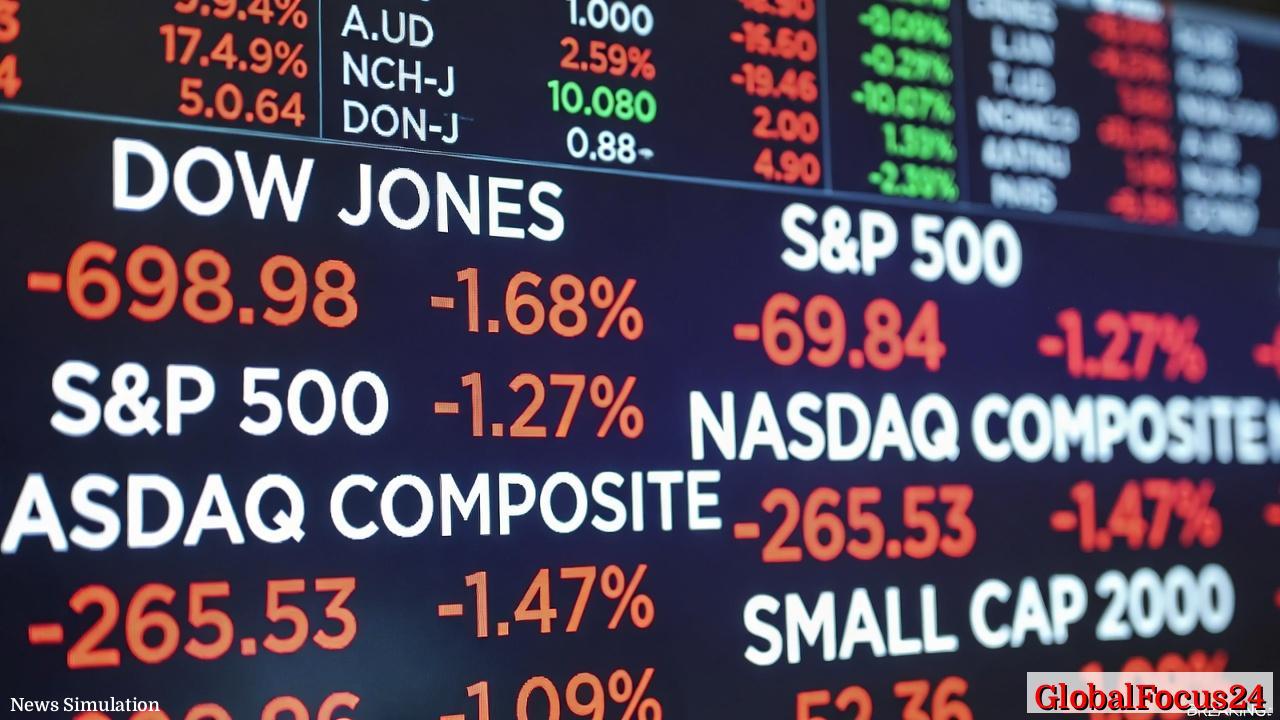
Major U.S. stock indices sank sharply on Monday as renewed uncertainty over President Donald Trump’s latest tariff announcements rattled Wall Street and revived fears of a prolonged trade dispute. The Dow Jones Industrial Average fell 698.98 points, or 1.41%, to 48,926.99, while the S&P 500 lost 69.84 points, or 1.01%, closing at 6,833.67. The Nasdaq Composite plunged 265.53 points, or 1.16%, to 22,620.54, and the Small Cap 2000 index declined 52.36 points, or 1.97%, to 2,611.42.
Investors reacted sharply to news of a new 15% tariff on key U.S. trading partners, which followed a Supreme Court decision last week limiting the administration’s use of emergency trade powers. The move reignited concerns about global supply chains, inflation, and the stability of international trade relations—issues that have loomed large since the first trade war erupted nearly a decade ago.
Market Sell-Off Accelerates as Trade Uncertainty Deepens
The sell-off accelerated through the morning session, with every major U.S. benchmark falling more than 1%. Technology, industrials, and consumer discretionary sectors led losses, while defensive plays—such as utilities, energy, and healthcare—showed relative resilience. The Volatility Index, often viewed as Wall Street’s “fear gauge,” surged 15%, its steepest one-day rise since late 2020.
Traders moved quickly into safe-haven assets. Treasury yields dropped as demand surged, and the yield on the 10-year note fell below 3.2%, marking a two-week low. Gold prices climbed more than 2% as investors sought protection from market turbulence and policy unpredictability.
A Flashback to the Trade Wars of 2018–2020
The return of tariff battles has revived memories of the 2018–2020 trade wars, when sweeping levies on steel, aluminum, and billions of dollars’ worth of imports from China disrupted global supply networks and triggered steep market losses. At the time, retaliatory measures from trading partners led to higher consumer prices and months of economic uncertainty.
Although the global economy has since diversified its manufacturing centers, many corporations remain exposed to shifts in U.S. trade policy. Companies that rely heavily on imported components—from microchips to auto parts—could see profit margins compressed in the coming quarters if tariffs expand further.
Corporate and Industry Reactions
Across the corporate landscape, early responses were swift. Major industrial manufacturers, including machinery and aerospace firms, warned that escalating tariffs could raise input costs and delay international contracts. Retailers and technology providers faced similar concerns, given their dependence on overseas components and assembly lines.
Logistics firms reported a spike in calls from clients seeking advice on rerouting shipments or renegotiating import terms. “There’s growing confusion among exporters and importers,” said one San Francisco trade consultant. “Businesses had just adjusted after years of volatility, and now we’re back to uncertainty that makes long-term planning extremely difficult.”
Investor Sentiment Turns Cautious
Financial analysts noted that market psychology is shifting back toward caution. Equity markets, which had surged through late 2025 on optimism over cooling inflation and solid earnings, are now grappling with fresh geopolitical and trade-related risks.
“The market hates uncertainty more than bad news,” said one New York-based portfolio strategist. “If traders can’t predict tariff timelines or scope, they’ll de-risk portfolios first and ask questions later. This is exactly what we’re seeing now.”
The current pullback marks the S&P 500’s worst single-day drop since June 2020, when pandemic-related volatility last hammered U.S. indices. Although analysts caution against reading this as the start of a prolonged bear market, many agree the episode underscores the market’s sensitivity to shifting policy signals.
Treasury Markets and Safe-Haven Flows
The bond market reflected a classic risk-off trade. The 10-year Treasury yield slipped as investors sought safety, while the 2-year yield declined even more sharply, narrowing the yield curve. Treasury futures rose as expectations mounted that the Federal Reserve may delay further rate increases to cushion the economy against external shocks.
Meanwhile, gold surpassed $2,200 an ounce—its highest level since summer 2025—adding to signs that investors are hedging against renewed volatility. The U.S. dollar initially rallied against emerging market currencies but softened later in the session as traders weighed the long-term implications of trade disruption on overall growth.
Global Ripple Effects
The reverberations of the U.S. tariff measures extended across the Atlantic and Pacific. European indices finished lower, led by declines in Frankfurt and Paris, while London’s FTSE 100 dropped close to 1%. In Asia, markets closed mixed, with Japan’s Nikkei 225 holding its ground as exporters benefited from a weaker yen, but South Korea’s KOSPI and Hong Kong’s Hang Seng fell sharply on concerns about diminished U.S. demand.
Economists noted that renewed U.S. trade tensions could slow global recovery efforts that gained traction only recently after the inflationary shocks of the early 2020s. While Europe and the United Kingdom have managed to stabilize manufacturing output, both remain sensitive to fluctuations in U.S.-led trade policy, especially in technology and energy sectors.
Historical Context: Tariffs as a Recurring Economic Weapon
Tariffs have long been a potent political and economic tool in U.S. history. From the 1930 Smoot-Hawley Tariff, which deepened the Great Depression by stifling trade, to the retaliatory tariffs of 2018–2020, protective measures have often produced unintended economic consequences.
Over the past decade, global trade systems have evolved toward selective decoupling. Many nations have invested in reshoring or “friend-shoring” strategies—bringing production closer to allied economies to reduce vulnerability to sanctions or tariffs. Yet, for globally integrated industries like semiconductors and automobiles, complete insulation remains elusive.
Analysts note that each new tariff announcement tends to ripple through complex supply chains in unpredictable ways, affecting both producers and consumers. Higher duties on raw materials can lift costs for domestic manufacturers, while retaliatory tariffs abroad can hurt exporters in agriculture, aerospace, and heavy machinery.
Economic Outlook and Policy Debate
Economists are divided on the potential long-term effects of the latest tariffs. Some argue that targeted measures could protect strategic industries and encourage domestic production, especially in critical areas such as steel, defense, and semiconductors. Others warn that tit-for-tat trade actions risk stalling investment, slowing job growth, and reigniting inflationary pressures.
Consumer prices, which began to stabilize in late 2025, could again rise if importers pass on higher costs. Retail chains and auto manufacturers are particularly vulnerable to new tariffs, given their reliance on global suppliers. Any sustained increase in prices could complicate monetary policy decisions for the Federal Reserve, which has spent the past year balancing inflation control with maintaining employment gains.
Regional and Sector Comparisons
Some sectors are better positioned to adapt than others. Energy producers and domestic construction suppliers may benefit from reduced foreign competition, while technology hardware producers, automakers, and retailers could face headwinds. In California’s Silicon Valley, many firms rely on components sourced from Asia, raising concerns about potential supply bottlenecks.
Meanwhile, the Midwest—home to a concentration of agricultural and industrial exporters—faces renewed anxiety about foreign retaliation. Farmers have faced similar situations before: U.S. soybean exports to China plummeted nearly 75% during the height of the 2019 trade dispute, prompting billions in federal subsidies to offset losses.
Internationally, Canada and Mexico are monitoring developments closely. Both nations depend heavily on the integrated North American supply chain created under the USMCA trade agreement. Industry leaders warn that expanding tariffs risk undermining years of progress toward regional trade stability.
Looking Ahead
Market participants will be watching for signals from the White House and trade negotiators in the coming days to gauge whether the new tariffs mark the beginning of a broader trade confrontation or a short-term policy maneuver. Congressional leaders have called for greater transparency on how the duties were calculated and which sectors might face future increases.
Until clarity emerges, investors and businesses alike are expected to remain defensive, prioritizing liquidity and hedging exposure to global markets. Despite solid corporate earnings and moderating inflation earlier this year, trade policy turbulence once again underscores how quickly sentiment can shift on Wall Street.
The renewed tariff uncertainty has shattered a period of relative calm, reintroducing a familiar question to global markets: how much economic turbulence can the world’s largest economy risk before the cost outweighs the leverage? For now, investors are preparing for rougher waters ahead.