Wall Street Voices Rising Over Big Tech’s Soaring Capital Spending
Growing Unease Over Corporate Investment Levels
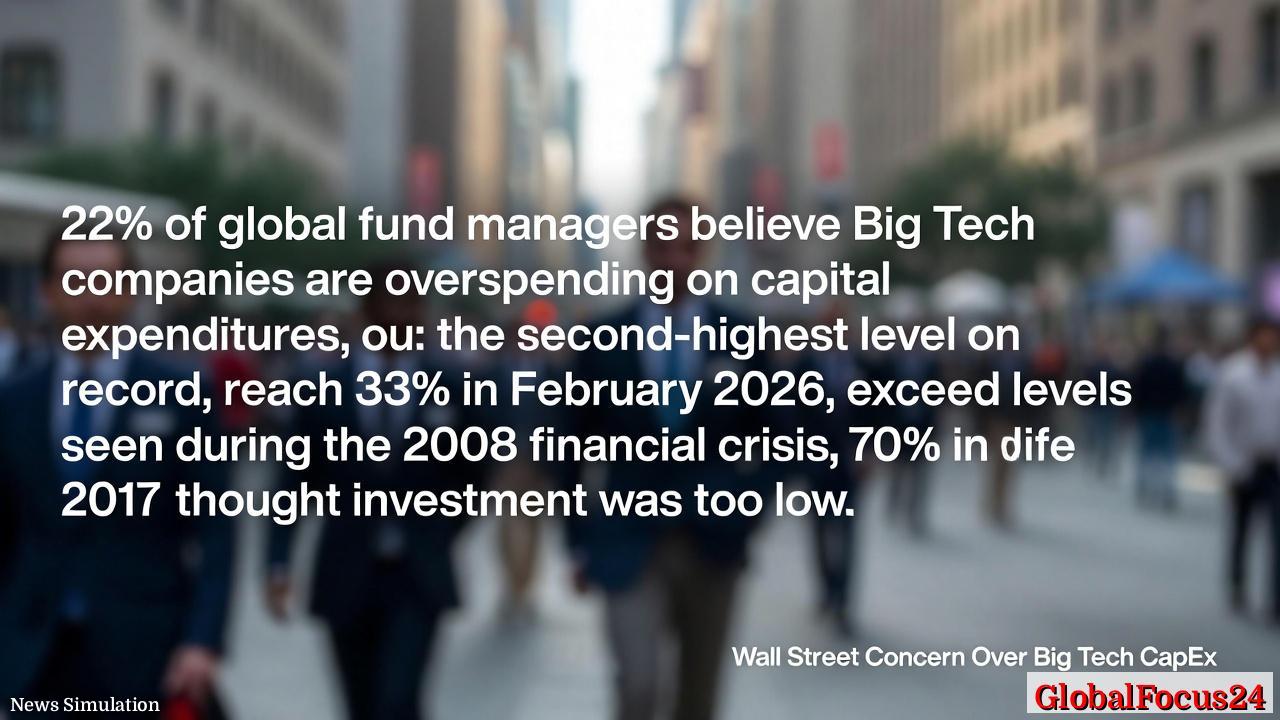
Wall Street is showing new signs of unease over the scale of Big Tech’s capital expenditures, as a growing number of investors question whether some of the world’s most valuable companies are overspending on infrastructure, data centers, and artificial intelligence projects. According to a global fund manager survey released this month, 22 percent of respondents believe companies are spending too heavily on capital expenditures—the second-highest level ever recorded, trailing only February 2026’s record 33 percent.
This shift marks a striking reversal in sentiment compared to just a few years ago. For much of the past decade, investors encouraged businesses to deploy their massive cash reserves into long-term growth, especially in technology and innovation. In 2017, by contrast, 70 percent of fund managers said firms were investing too little. The pendulum has now swung dramatically in the opposite direction, fueling concerns about sustainability, profitability, and returns on capital in sectors that once seemed unstoppable engines of wealth creation.
Context: From Underspending to Overdrive
For two decades following the dot-com bust of the early 2000s, corporate America—particularly large-cap technology firms—pursued a disciplined approach to spending. The trauma of that period, combined with shareholder pressure to favor buybacks and dividends, restricted major capital expenditure projects. Companies built leaner balance sheets, favoring asset-light business models that prioritized software and services over physical expansion.
That pattern began to change around the mid-2010s. The explosive rise of cloud computing, streaming, and mobile services created an insatiable demand for server capacity, global data center networks, and broadband infrastructure. What had once been regarded as excessive spending on hardware and network assets became essential investment to keep pace with digitalization. The pandemic years accelerated this trend further: as remote work, e-commerce, and digital entertainment surged, Big Tech rapidly scaled infrastructure to support global usage levels unprecedented in scope and speed.
Yet as the global economy normalizes and users’ growth plateaus, analysts say the current pace of investment may be running ahead of actual cash flow potential. The same corporate sector that once led efficiency-driven growth is now stretching its budgets to maintain technological supremacy.
The Big Tech Spending Boom
The scale of current Big Tech investment dwarfs anything seen in earlier business cycles. Industry estimates suggest that the five largest U.S. technology firms collectively spent more than $200 billion on capital projects in 2025—an increase of nearly 40 percent from 2023 levels. A significant share of that total went into artificial intelligence infrastructure, high-performance computing clusters, and the construction of next-generation data centers designed to host increasingly complex machine learning models.
AI research and deployment are particularly expensive endeavors. Companies are competing fiercely to secure advanced chips, build proprietary language models, and establish dominance in AI-powered services. Each of these initiatives demands vast physical and financial resources: advanced semiconductor purchases, renewable energy agreements to power facilities, and new real estate commitments across North America and Europe.
Investment analysts note that, while these projects may drive technological leadership, they also introduce longer-term risk. A data center that once took three years to repay its cost might now face a seven- or eight-year horizon given escalating energy prices and falling unit margins on cloud services. The result is a growing gap between technological ambition and financial prudence.
Wall Street’s Changing Mood
Investor sentiment toward corporate investment tends to shift slowly, but the latest survey results suggest a meaningful change in how the financial community perceives Big Tech’s strategy. The 22 percent figure—representing those who now see “overinvestment” as a major concern—exceeds even the skepticism seen during the 2008 financial crisis, when just 10 percent regarded corporate CapEx levels as excessive.
Several factors explain this newfound caution. First, the cost of capital has risen sharply after years of near-zero interest rates. As central banks tightened policy through 2024 and 2025 to contain inflation, the cheap financing that once fueled tech expansion lost its appeal. Many firms now fund projects directly from cash flow, a move that, while financially sound, erodes corporate flexibility and lowers free cash available for buybacks or dividends.
Second, the early productivity gains promised by AI investment have yet to fully materialize in earnings. While some companies report efficiency improvements, the broader economic impact remains muted. The so-called “AI premium” baked into stock valuations may therefore be vulnerable if profits take longer to catch up to spending trends.
Finally, Wall Street’s emphasis on shareholder returns, expressed through performance metrics such as return on invested capital (ROIC) and operating cash flow, is now clashing with the long-term vision guiding Big Tech’s strategic investments. For portfolio managers under pressure to deliver quarterly results, even necessary investments can appear excessive when viewed through a short-term lens.
Historical Echoes and Differences
Similar cycles of overinvestment have punctuated financial history. The 1980s saw a wave of spending on mainframe computing that outpaced commercial demand. The late 1990s dot-com era generated billions in speculative network buildouts that went unused after the crash. Yet there are also important differences today. Analysts point out that today’s leading technology firms—unlike their dot-com predecessors—are generating substantial cash flows and own critical infrastructure underpinning the digital economy. This makes them far better equipped to weather downturns than companies that rode earlier speculative waves.
Still, the parallels raise questions about timing. During both the 1980s and 1990s bubbles, Wall Street concerns intensified only after years of expansion, signaling a late-stage complacency in certain segments of the market. Some economists fear that a similar dynamic is emerging now: massive investment justified in the name of innovation, without sufficient discipline to measure returns.
Global Comparisons and Regional Trends
The anxiety over capital expenditure is not confined to the United States. In Europe and Asia, similar trends are emerging as large technology firms, telecom operators, and semiconductor manufacturers engage in large-scale expansion.
In Europe, government-backed investment in AI research and semiconductor capacity has driven surges in corporate spending, but with mixed investor sentiment. Germany and the Netherlands, for instance, are experiencing a semiconductor building boom centered around advanced lithography and chip fabrication, yet investors are questioning whether the region’s market demand can absorb such capacity.
In Asia, particularly in South Korea, Japan, and Taiwan, major firms continue to plow substantial resources into chipmaking and AI server supply chains. While state support in these regions helps cushion financial risk, the competition is intensifying. Some analysts warn that the race to secure dominance in AI hardware mirrors the overcapacity concerns of past industrial cycles, such as the flat-panel display and memory markets of the 2000s.
These comparisons emphasize that the issue transcends geography. The global marketplace has become an interconnected web of supply chains and data infrastructure, with one region’s expansion often prompting another’s escalation. The result is a feedback loop of competitive spending that can outpace real-world demand.
Economic Implications
If current spending patterns continue unchecked, they could have wide-reaching effects on the broader economy. On one hand, heavy corporate investment contributes to short-term growth by creating demand for construction, engineering, and high-tech manufacturing. The buildout of data centers stimulates regional economies, from rural communities hosting energy facilities to cities supplying construction labor and materials.
On the other hand, prolonged overinvestment can distort markets. A glut of server capacity or AI infrastructure could push prices down, hurting profitability. Companies might scale back future projects abruptly, creating ripples that hit contractors, suppliers, and local governments reliant on corporate capital flows. Economists remember the post-dot-com hangover, when thousands of fiber optic miles lay dormant after demand fell short of projections.
Financially, excess spending could also weaken balance sheets, increase debt burdens where borrowing persists, and invite regulatory scrutiny if firms attempt to consolidate or raise prices to preserve margins. These secondary effects are precisely what investors aim to avoid when they warn about “too much CapEx.”
Balancing Innovation and Discipline
The challenge for Big Tech executives is to balance the imperative to innovate with the need to maintain fiscal discipline. Technological revolutions, from electrification to the Internet, have always required massive upfront investment. Yet history shows that timing and execution matter more than sheer scale. Overbuilding too early can be as damaging as underinvesting when opportunity strikes.
Some companies are already signaling a more cautious stance. Recent earnings calls suggest management teams are reevaluating project timelines, prioritizing investments with clearer near-term revenue paths, and deferring more experimental initiatives. If this prudence spreads, it could relieve pressure on valuations and reassure investors that growth is sustainable.
Still, optimism remains. Many analysts see the current spending cycle as part of a broader transition toward AI-driven productivity. If the technology delivers as promised—transforming industries, boosting efficiency, and reshaping global commerce—the outlays of 2025 and 2026 may, in hindsight, appear prescient rather than reckless.
Outlook: A Market Watching Its Nerves
For now, Wall Street remains divided. Some fund managers view the latest CapEx surge as a necessary investment in the foundation of the next digital era, while others fear it risks inflating a costly bubble. With nearly a quarter of global investors expressing concern—and sentiment trending upward—the debate is far from settled.
The next year may prove decisive. Earnings results in late 2026 and early 2027 will test whether companies can turn their monumental investments into measurable profits. Until then, the tension between innovation and restraint will define not just the fate of Big Tech, but the balance of optimism and caution that moves markets worldwide.