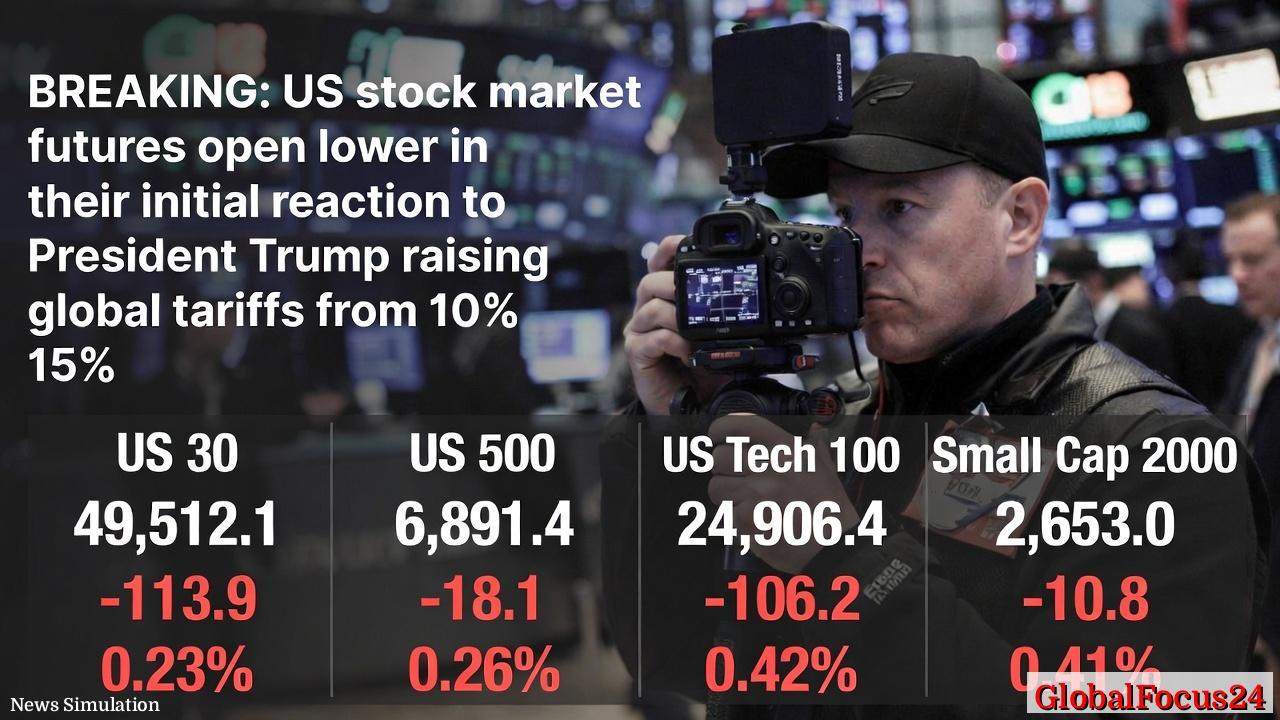
US Stock Futures Fall as Markets React to Trump’s Surprise Global Tariff Hike to 15%
US stock index futures slipped in early trading after President Donald Trump announced an abrupt increase in global tariffs, raising the rate on imports from 10% to 15% under a rarely used legal provision. The move, unveiled over the weekend, comes just days after the Supreme Court curtailed much of the administration’s earlier emergency tariff program, injecting fresh uncertainty into global trade policy and financial markets.
Futures Slide as Investors Reprice Risk
By 18:40 local time, US 30 futures were down 113.9 points, or 0.23%, at 49,512.1, signaling modest weakness in blue-chip industrial and financial names that are heavily exposed to global supply chains. Contracts tied to the broader US 500 index fell 18.1 points, or 0.26%, to 6,891.4, while US Tech 100 futures dropped 106.2 points, or 0.42%, to 24,906.4 as investors braced for potential pressure on high‑growth technology and semiconductor shares. Small Cap 2000 futures, often seen as a barometer of domestic economic prospects, slipped 10.8 points, or 0.41%, to 2,653.0, reflecting concerns that smaller US companies may struggle to absorb higher input costs.
Traders described the move in futures as a classic “risk‑off” response to trade policy uncertainty, with equity markets adjusting to the prospect of more expensive imports, possible retaliation from trading partners, and renewed volatility in sectors tied to global demand. The decline also comes ahead of closely watched earnings from major technology firms, adding another layer of caution to positioning at the start of the trading week.
A New Chapter in Trump’s Tariff Strategy
The decision to increase global tariffs to 15% marks an escalation in the president’s long‑running push to reshape the terms of US trade with the rest of the world. After the Supreme Court ruled that his earlier use of emergency powers to impose sweeping “reciprocal” tariffs exceeded his authority, Trump turned to a different legal mechanism that allows temporary duties of up to 15% for a limited period.
Under this provision, the new 15% tariff is designed as a broad, time‑bound measure covering imports from virtually all countries, replacing the 10% global baseline announced just a day earlier. No previous administration has invoked this particular statute on such a scale, underscoring the unconventional nature of the current trade strategy and the legal and political scrutiny it is likely to attract in the months ahead.
For the White House, the argument is that higher tariffs can boost government revenue, encourage consumers to buy domestically produced goods, and strengthen the bargaining position of the United States in future trade negotiations. Critics, including many economists, counter that the costs are ultimately borne by domestic businesses and households through higher prices, disrupted supply chains, and retaliatory measures from partners.
Historical Parallels: Tariffs and Market Turbulence
The latest market reaction fits a familiar pattern. Historically, major tariff announcements have tended to trigger bouts of volatility in equities and futures as investors reassess growth prospects and corporate earnings. One of the most frequently cited cautionary tales is the Smoot‑Hawley Tariff Act of 1930, which sharply raised duties on thousands of imported goods and helped fuel a global collapse in trade that deepened the Great Depression.
While the current situation is far from the protectionism of the early 20th century, past episodes show how quickly trade tensions can ripple through financial markets. During Trump’s first term, successive waves of tariffs against China and other partners contributed to swings in commodity and equity futures, particularly in sectors like agriculture, metals, autos, and technology. Agricultural futures, notably soybeans, fell as China retaliated with its own import duties, while steel and aluminum tariffs initially lifted domestic prices but later fed into broader uncertainty and cost pressures for manufacturers.
For investors, the lesson from these prior episodes has been that even when the long‑term economic impact of tariffs is unclear, the short‑term effect is often heightened volatility and compressed valuation multiples in trade‑sensitive sectors. The current pullback in US 30, US 500, US Tech 100, and Small Cap 2000 futures reflects that same instinctive repricing of risk in the face of a suddenly changing policy landscape.
Economic Impact: Growth, Prices, and Corporate Profits
Economists warn that raising global tariffs from 10% to 15% could weigh on both US and international growth if the measure is sustained or expanded. Tariffs act as a tax on imports, increasing costs for businesses that rely on foreign components and materials, and potentially feeding into higher consumer prices for finished goods.
Recent analysis of earlier Trump‑era tariffs suggests that price effects, while sometimes less dramatic than initially feared, are nonetheless significant in certain categories, particularly consumer goods and intermediate inputs. Companies often face a difficult choice: absorb the higher costs and accept lower margins, or pass them on to customers and risk weaker demand. Either outcome can pressure earnings and investment plans, which is why stock markets tend to react quickly to major tariff announcements.
Global institutions have already trimmed forecasts for world economic growth in light of ongoing trade frictions. Prolonged uncertainty around tariff levels and retaliatory measures can deter cross‑border investment, complicate supply‑chain planning, and blunt the benefits of otherwise supportive monetary or fiscal policies. For the United States, a higher blanket tariff risks offsetting some of the competitive advantages of its large domestic market by raising input costs for its own exporters and manufacturers.
Sector and Regional Repercussions
The immediate impact of the new 15% global tariff is likely to be uneven across sectors.
Industries that rely heavily on imported components—such as electronics, autos, machinery, and consumer durables—could face margin pressure as costs rise and supply chains adjust. Technology firms, many of which source hardware and components from Asia and Europe, may see greater sensitivity in their share prices, helping explain the steeper drop in US Tech 100 futures relative to broader indices.
Commodity markets also tend to react sharply when tariff policies change. Higher import duties can alter the economics of agricultural, energy, and metals trade routes, influencing futures prices as traders reassess demand patterns and potential bottlenecks. During previous rounds of tariffs, agricultural exporters confronted reduced access to key markets due to retaliatory barriers, while metals producers experienced price spikes and volatility as buyers scrambled for alternative suppliers.
On the regional front, close US trading partners such as the European Union, the United Kingdom, Canada, Mexico, Australia, and key Asian economies will be watching closely. Some countries that had negotiated specific tariff arrangements with Washington now face the prospect of a higher universal rate, at least temporarily, raising questions about the durability of recent trade deals and the possibility of renegotiations.
For export‑led economies, even a modest slowdown in US demand can have an outsized effect on growth and employment, particularly in industries tied to autos, machinery, technology, and consumer goods. Any retaliatory steps, whether through targeted tariffs or regulatory measures, would add another layer of risk for global companies and investors.
Legal and Policy Uncertainty Clouds the Outlook
One of the most striking features of the latest development is the use of an untested legal route that allows tariffs up to 15% for a period of 150 days, after which further action may require congressional approval. This time limit introduces a clear policy horizon but also intensifies uncertainty over what may follow, as the administration explores additional legal avenues to sustain or expand its tariff agenda.
For businesses, the temporary nature of the measure complicates decisions on inventory, pricing, and investment. Companies may hesitate to commit to new supply arrangements or capital spending if they believe tariff rates could shift again within months, leading to a wait‑and‑see posture that can dampen growth.
Financial markets, too, are highly sensitive to these shifting signals. When policy appears unpredictable or subject to abrupt change, the risk premium demanded by investors tends to rise, pushing up volatility and sometimes widening credit spreads, particularly for firms with significant international exposure. The current pullback in futures suggests traders are factoring in both the direct economic cost of higher tariffs and the broader uncertainty around future trade policy.
Global Trade Tensions and Investor Sentiment
The new 15% global tariff comes at a time when global trade flows are still adjusting to prior rounds of US–China tariffs, regional trade disputes, and shifts in supply chains prompted by the pandemic years and geopolitical tensions. Many multinational companies have spent recent years diversifying production bases, seeking to reduce reliance on any single country or route, but remain vulnerable to sweeping measures that cut across multiple markets simultaneously.
Investor sentiment is shaped not only by immediate profit implications but also by the symbolic weight of such policies. Broad‑based tariffs signal a turn away from decades of gradual trade liberalization and toward a more interventionist, protectionist approach, raising concerns about the long‑term stability of the global trading system. Even if the current 15% levy proves temporary, repeated recourse to tariffs as a primary policy tool can leave lasting marks on business confidence and risk appetite.
In this environment, portfolio managers typically reassess exposure to trade‑sensitive sectors, rotate toward more domestically focused or defensive assets, and increase the use of hedging strategies in futures and options markets. The drop in US 30, US 500, US Tech 100, and Small Cap 2000 futures reflects those early adjustments, as investors seek to balance the prospect of continued economic expansion against the drag from escalating trade frictions.
The Road Ahead for Markets and Policy
Over the coming weeks, market attention is likely to focus on several key questions: whether major trading partners respond with retaliatory measures, whether the administration signals any flexibility on the scope or duration of the 15% tariff, and how Congress reacts as the 150‑day window progresses. Corporate earnings calls may provide an early window into how executives are recalibrating their outlook for costs, pricing, and investment under the new regime.
For now, the decline in US stock futures underscores how swiftly changes in trade policy can reverberate through financial markets. As investors digest the details of the tariff hike and its legal framework, the balance between hopes for resilient growth and fears of renewed trade conflict will help determine whether the current pullback proves a brief adjustment or the start of a more extended period of volatility.