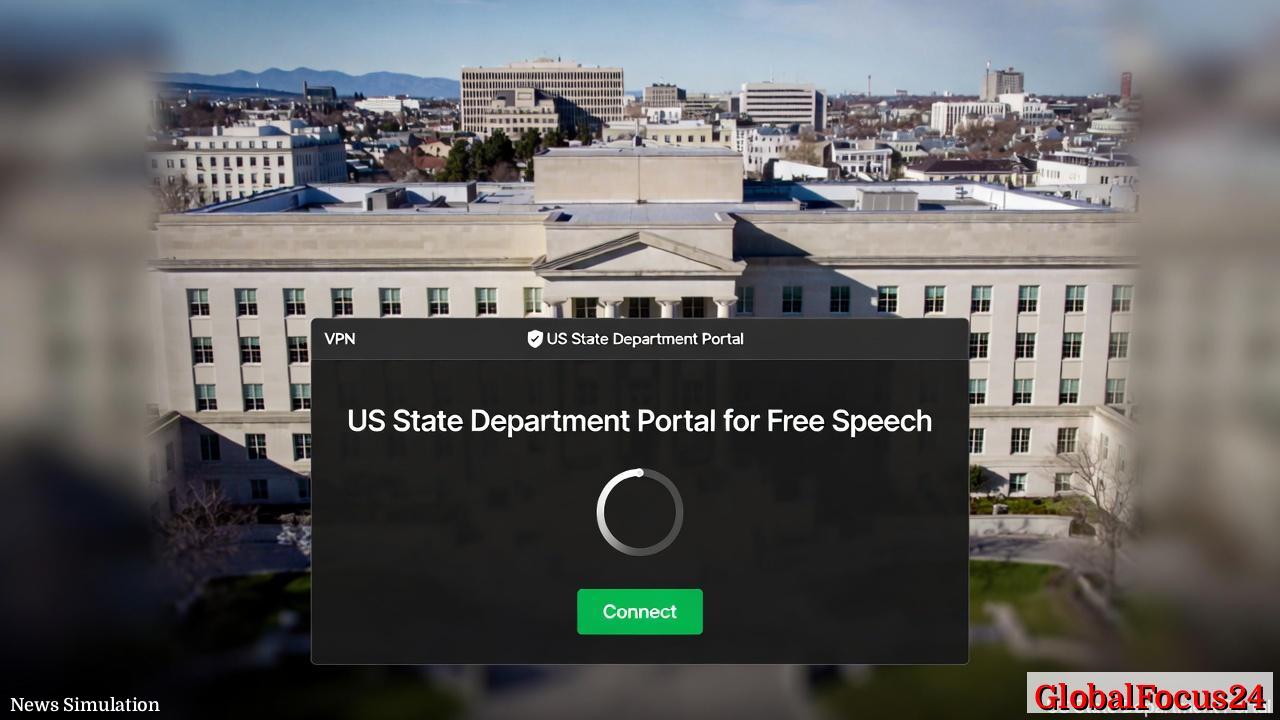
U.S. State Department to Launch Portal With Built-In VPN to Counter European Online Censorship
A New Digital Front in the Battle for Online Freedom
The United States is preparing to introduce a groundbreaking digital platform designed to give European citizens unrestricted access to information their governments have blocked. The initiative, led by the U.S. State Department, will feature a built-in virtual private network (VPN) allowing users across Europe to bypass national restrictions and access content—including posts on social media platforms like X—that have been banned or censored.
The move comes amid rising alarm over the spread of government-imposed internet restrictions across Europe, with some nations implementing stringent laws limiting what their citizens can see or share online. These measures, billed as efforts to combat disinformation or hate speech, have sparked growing concern among international observers who view them as encroachments on free expression.
The State Department’s Digital Freedom Initiative
According to early briefings from officials involved in the program, the State Department’s new portal will serve as both an information hub and a secure gateway. Users will be able to connect through an encrypted VPN built directly into the platform, enabling safe and anonymous access to websites, news, and social media content restricted by domestic regulators.
The portal, which is still in late-stage development, is set to provide curated news resources, open-source research tools, and direct access to international platforms that have faced fines or partial bans under European digital governance laws. The intention, U.S. officials suggest, is not to interfere in national politics, but to ensure that citizens have unfiltered access to the global digital commons.
Rising Tensions Between Free Speech and Regulation in Europe
Over the past five years, several European governments have intensified their oversight of digital information flows, invoking national security, hate speech prevention, and misinformation control. New rules under EU frameworks such as the Digital Services Act (DSA) have empowered regulators to demand swift removal of certain types of content.
Critics argue that these policies, while well-intentioned, have created a patchwork of censorship that varies widely between member states. A growing number of social media companies—including X—have faced heavy penalties for failing to comply with these rules. In one major case, X received fines totaling approximately €120 million for refusing to take down posts the platform deemed within the bounds of open speech, even though regulators labeled them harmful or unlawful under local standards.
This tension underscores a deeper philosophical divide: whereas the European Union has framed online governance in terms of protecting citizens from harmful content, the United States continues to emphasize the primacy of individual expression, even when that expression may be controversial or unpopular.
Historical Roots of Digital Censorship in Europe
Government involvement in media regulation has long historical roots in Europe. From print and broadcast media licensing in the 20th century to more recent digital rulesets, European institutions have consistently maintained a tradition of balancing freedom of expression against what they view as collective social responsibility.
Unlike the First Amendment protections in the United States, European law permits broader state intervention when speech intersects with racism, hate speech, or threats to public order. This approach, once largely confined to traditional media, has expanded in the digital era to encompass social media and online publications.
The rise of algorithmic amplification of extremist narratives and disinformation during political crises—such as Brexit and the Russia-Ukraine conflict—has accelerated this regulatory push. However, critics argue that these same measures now stifle legitimate dissent and public debate, forcing users to depend on anonymization and VPN tools to access basic information.
The Economic and Diplomatic Stakes
The State Department’s planned intervention introduces a new dimension to transatlantic relations. On one hand, it represents a bold declaration of America’s commitment to the free flow of information. On the other, it risks friction with European governments that view external circumvention of national laws as an intrusion on sovereignty.
Economically, the initiative could influence how technology companies approach compliance with European digital regulation. Firms that have faced costly fines and compliance challenges may see the U.S.-backed VPN portal as a signal of Washington’s willingness to defend corporate speech rights abroad. If European users shift their online activity toward tools supported by U.S. infrastructure, domestic regulators could lose leverage over platform moderation and content filtering.
The program may also have ripple effects in the global cybersecurity and VPN services market. By offering a government-sponsored secure network, the State Department could recalibrate user expectations about online privacy and national surveillance. European VPN providers—many of which operate under local data retention rules—may face increased competition from this U.S.-endorsed alternative.
Regional Reactions and Public Debate
Initial reactions across European capitals have been mixed. In countries such as Germany and France, where digital regulation frameworks are most robust, officials have suggested that an American-operated VPN could undermine local enforcement authority. Legislators have cautioned that if citizens freely access content banned under national law, it could erode the EU’s ability to maintain its unified digital standards.
At the same time, free-speech advocates and civil society organizations across Central and Eastern Europe have expressed support for the portal, describing it as a digital lifeline for journalists, researchers, and dissidents. Some advocacy groups have already begun calling it “the digital Berlin Airlift”—a reference to the Cold War-era U.S. airlift that sustained West Berlin when it was blockaded by Soviet forces.
University researchers in Poland and Hungary note that, in practice, smaller nations with fewer independent media outlets are most vulnerable when content is restricted, as domestic institutions may hesitate to challenge government narratives.
Comparing Approaches: Europe and Beyond
Europe’s evolving censorship landscape is not unique. Across the world, from Turkey’s media licensing laws to India’s platform takedown orders, governments are increasingly asserting control over digital platforms. Yet what makes Europe’s trajectory distinct is the legal sophistication underpinning its regulatory framework.
While countries such as Russia and China maintain overt information firewalls, European restrictions often emerge through complex legislative mechanisms and administrative orders. The end result, however, can resemble the same kind of limited access—albeit justified through different political and ethical reasoning.
In comparison, the United States typically resists direct intervention in platform content policies, relying instead on public pressure and congressional inquiry. The State Department’s new VPN initiative thus marks a rare instance where Washington intervenes directly in global information accessibility, leveraging technology rather than diplomacy to advance its stance on free expression.
Balancing Sovereignty and Universal Connectivity
The debate over internet censorship and access raises tough questions about sovereignty in the digital age. As governments assert their authority over national networks, the ideal of a borderless web is increasingly challenged. The State Department’s project implicitly reasserts that digital information should not be constrained by political geography—a principle rooted in the original ethos of the internet.
Economists warn, however, that this struggle between regulation and openness may escalate into digital fragmentation. If major regions begin building parallel infrastructures—some open, others controlled—the global digital economy could face dislocation similar to that seen in trade when tariffs divide markets. International coordination on transparency and privacy may become more difficult as trust erodes between regulatory blocs.
Looking Ahead: A Coming Test for Transatlantic Relations
The State Department has not announced a formal timeline for the portal’s launch, but internal briefings suggest testing phases could begin later this year. Key partnerships with U.S.-based cybersecurity firms are reportedly underway to ensure both the reliability and security of the system.
European officials will likely scrutinize the pilot closely, gauging whether the platform’s operation constitutes a violation of data protection laws or sovereignty. The European Commission has yet to issue a statement, but observers expect diplomatic discussions to intensify once the portal goes live.
In the longer term, the initiative could set a precedent for how democratic nations navigate conflicts over information access in an era of competing digital governance philosophies. Whether it becomes a flashpoint or a framework for renewed dialogue may depend on how both sides balance the principles of free speech, national jurisdiction, and user privacy.
The Broader Implications for Global Internet Freedom
The digital landscape of the 2020s has become a terrain of ideological competition over who controls information. The U.S. State Department’s VPN portal symbolizes one nation’s attempt to tilt the balance toward open access, challenging the notion that governments should decide what citizens can see online.
For many observers, the initiative represents more than a policy experiment—it embodies the continuing struggle to preserve an open internet amid growing regulation and technological fragmentation. As democratic societies confront misinformation and digital manipulation, the enduring question remains: how to uphold free expression without undermining trust or safety?
For now, Washington’s move signals that the United States intends to play an active role in shaping that answer, redefining what digital freedom means in the 21st century.