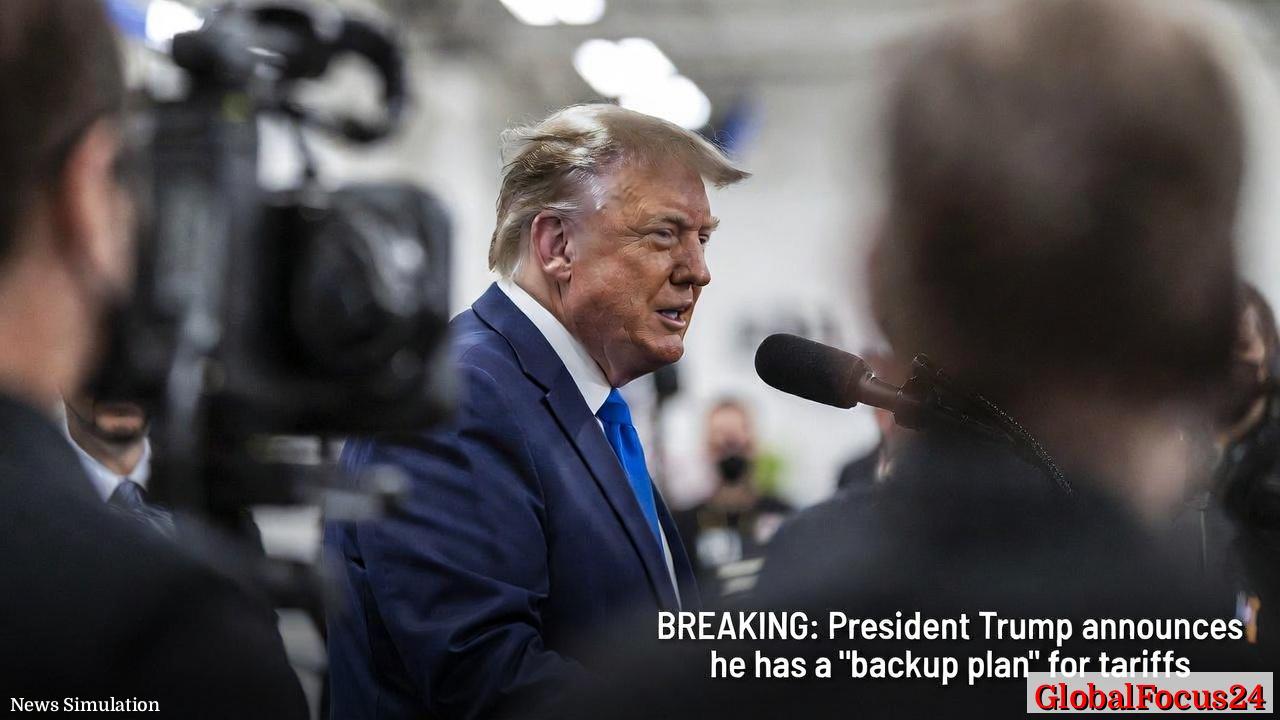
Trump Unveils ‘Backup Plan’ After Supreme Court Reversal on Tariffs: Markets Brace for Fallout
Supreme Court Rejects Longstanding Tariff Authority
President Donald Trump announced Thursday that his administration has a "backup plan" ready after the U.S. Supreme Court ruled his use of executive authority to impose sweeping tariffs on imported goods unlawful, overturning a cornerstone of his trade agenda and leaving the federal government exposed to potential refund claims exceeding $175 billion.
The landmark decision, issued in a 6–3 ruling, concluded that the executive branch had overstepped its authority under existing trade statutes, effectively invalidating several of the tariffs introduced during Trump’s first and second terms. The decision immediately sent ripples through global markets and ignited debates among economists, business leaders, and policymakers over the implications for American manufacturing, consumer prices, and international trade relations.
Speaking from the White House, Trump said the administration was “fully prepared to act,” emphasizing that an alternative framework had been under consideration “for some time.” While he did not offer details, his remarks signaled determination to continue leveraging trade restrictions as a policy tool, despite the legal setback.
Billions at Stake for Businesses and Consumers
The court’s ruling opens the door for affected importers to seek reimbursement for duties paid over the past several years, with analysts estimating the government’s potential liability could exceed $175 billion. That figure includes tariffs applied to steel, aluminum, automobiles, and a wide range of Chinese-manufactured goods since 2018.
For many U.S. businesses, particularly in manufacturing, construction, and retail sectors, refunds could provide a temporary cash boost after years of elevated input costs. “This decision could be transformative for companies that have borne the brunt of tariff-related expenses,” said one trade attorney familiar with international customs law. “But the process will likely be lengthy and riddled with administrative complexity.”
On the consumer side, the ruling raises hopes for lower prices on imported electronics, building materials, and automobiles — though economists caution that price relief may not be immediate. Supply chains reorganized under years of tariff pressure could take months, if not years, to reset, and companies may opt to retain cost gains to restore margins eroded by inflation and global disruptions.
Market Reaction and Investor Uncertainty
Financial markets reacted sharply to the news. Major stock indices dipped in early trading as investors processed the potential fiscal and trade implications. Shares of domestic steel producers and agricultural exporters were among the hardest hit, reflecting concerns that reduced trade protection could intensify global competition. Meanwhile, logistics firms, retailers, and technology companies posted modest gains on expectations of lower import costs.
Bond markets displayed a more muted reaction, but analysts warned that a wave of refund payouts could widen the federal deficit at a time when fiscal pressures are already mounting. “This ruling raises questions not only about trade policy but about how the Treasury will manage the potential payout burden,” noted a senior economist at a New York investment bank. “It injects an additional layer of uncertainty into an already complex economic environment.”
Currency markets also shifted, with the U.S. dollar weakening slightly against the euro and the yen as traders recalibrated expectations for inflation and interest rates in light of the potential economic adjustments ahead.
Historical Context: Revisiting Trade Authority Boundaries
The Supreme Court’s decision represents one of the most consequential rebukes of presidential trade authority in modern history. For decades, the executive branch has wielded broad discretion to impose tariffs under national security provisions and emergency economic powers, dating back to the Trade Expansion Act of 1962 and further reinforced by later trade acts.
Under Trump’s leadership, those powers were deployed extensively, targeting competitors and allies alike in a bid to reshape global supply chains and encourage domestic production. Supporters credited the approach with revitalizing segments of U.S. manufacturing, while critics argued it raised costs for consumers and strained diplomatic relationships.
Legal experts say the ruling could set a lasting precedent limiting unilateral trade actions by any future administration. “This is a major recalibration of executive power in trade policy,” explained an international law scholar at Georgetown University. “Congress has long allowed presidents wide leeway, but this signals the judiciary’s willingness to reassert oversight when those boundaries are stretched too far.”
Economic Impact and Policy Crossroads
The potential fiscal exposure from tariff refunds represents a significant shock to federal finances. If even a portion of the estimated $175 billion liability materializes, the impact on the federal budget could rival that of major stimulus programs. Economists warn that such an outcome might constrain other domestic initiatives, particularly as inflationary pressures, higher borrowing costs, and slowing growth test policymakers’ room for maneuver.
For businesses, the decision could reshape competitive dynamics across sectors. U.S. manufacturers that benefited from tariff protections may face renewed foreign competition, while import-heavy industries could regain access to cheaper materials and components. The ripple effects could alter investment strategies, employment trends, and regional economic performance over the next several quarters.
In particular, regions heavily reliant on steel and aluminum production — including parts of Pennsylvania, Ohio, and Michigan — could experience near-term disruptions as orders recalibrate to new pricing realities. Conversely, ports along the West Coast and major import hubs like Houston and Savannah may see an uptick in shipping volume as trade flows adjust.
Comparison to Global Trade Shifts
The legal reversal in Washington adds another twist to an already tense international trade environment. In Asia and Europe, governments have been watching U.S. tariff policy closely, crafting countermeasures and alliances designed to mitigate American protectionism. The court’s ruling could encourage renewed negotiation — or retrenchment — depending on how aggressively the administration pursues its backup plan.
In Europe, trade officials signaled openness to renewed dialogue, viewing the decision as an opportunity to reset transatlantic economic cooperation. Meanwhile, China’s Ministry of Commerce issued a measured statement emphasizing “mutual benefit and fairness,” hinting at the possibility of reopening suspended trade consultations.
Other global powers, including Canada, Japan, and Mexico, are expected to reassess their own trade arrangements with Washington, particularly those affected by retaliatory tariffs. Analysts note that if the U.S. shifts to a new tariff framework, countries may seek clarification on its legality under World Trade Organization (WTO) rules, potentially setting up fresh disputes.
The Administration’s Next Moves
Despite the setback, President Trump conveyed resolve during his remarks, insisting that the decision would not derail his broader economic goals. “We’re ahead of the curve,” he said. “Our plan is ready, and we will move forward.” While details remain scarce, observers expect the White House to rely on alternative legislative or regulatory routes to preserve elements of its trade agenda.
Options may include invoking specific national security clauses under revised statutes, negotiating bilateral tariff mechanisms, or introducing import quotas linked to domestic capacity benchmarks. Each path carries unique legal and economic risks, and the White House’s ability to navigate them could determine the tone of U.S. trade relations for years to come.
The president’s comments also hinted at ongoing internal discussions with congressional leaders. “We’re working with Congress to make sure America stays strong and competitive,” he said, suggesting potential legislative proposals aimed at restoring certain authorities curtailed by the ruling.
Businesses, Workers, and the Road Ahead
For business owners, the immediate question is procedural: how to file refund claims and recalibrate procurement strategies. The U.S. Customs and Border Protection agency, already stretched by post-pandemic trade surges, faces an unprecedented administrative task reviewing decade-old imports and verifying eligibility for compensation.
Labor leaders and industry groups have expressed concern that the shift could destabilize manufacturing jobs that benefited from tariff protections. However, others argue that the ruling may ultimately lower costs for producers reliant on imported inputs, creating new opportunities in assembly and distribution sectors.
In the short term, economists expect continued volatility as markets digest the policy uncertainty. Yet some see longer-term benefits in the restoration of clearer statutory limits on executive trade powers, which could foster more predictable and stable trade relationships.
A Turning Point in U.S. Trade Policy
The Supreme Court’s decision and the administration’s response mark a pivotal juncture in the evolution of U.S. economic policy. For decades, presidents of both parties have relied on expansive interpretations of trade law to respond swiftly to perceived threats or imbalances. Now, with the judicial branch drawing firmer lines, the balance of policymaking power appears set to return partly to Congress.
Whether Trump’s “backup plan” rejuvenates his trade agenda or faces further legal scrutiny may define the next chapter in American economic strategy. For now, investors, businesses, and trading partners are watching closely as Washington adjusts to a new legal and economic reality — one where every move could reshape the trajectory of global commerce.