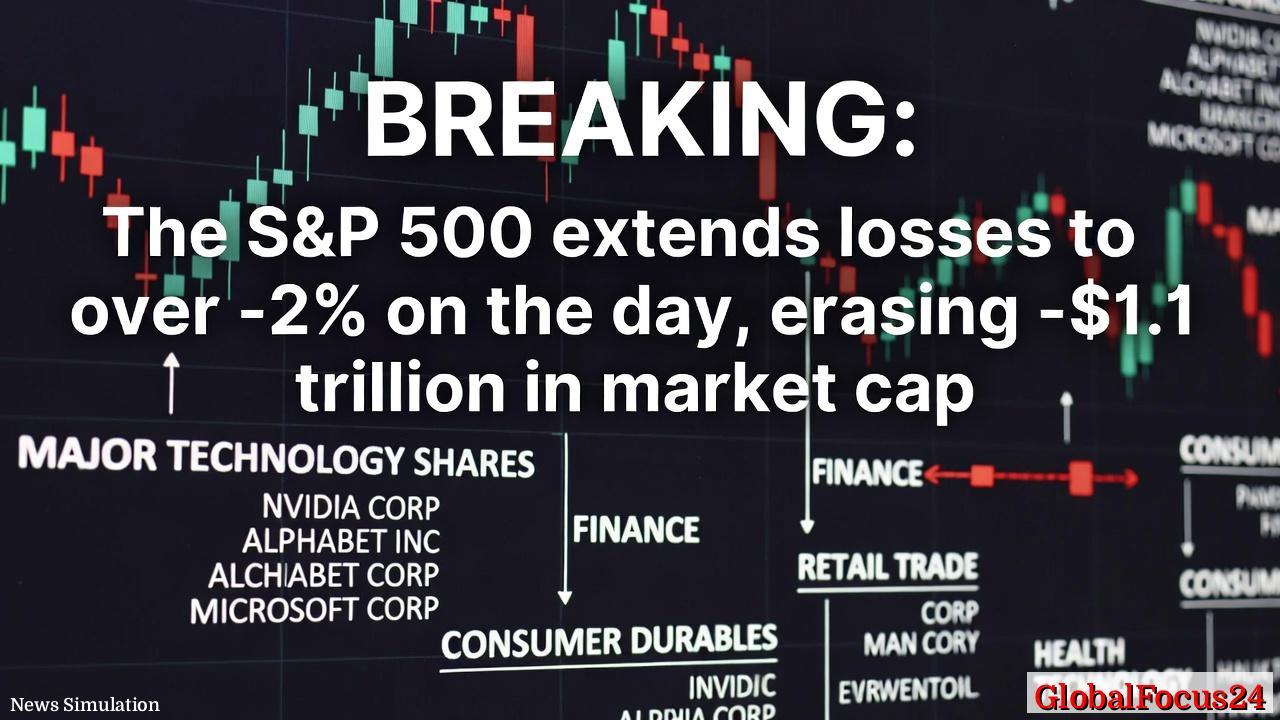
S&P 500 Slumps Over 2% as $1.1 Trillion in Market Value Vanishes Amid Tech-Led Selloff
The S&P 500 extended its losing streak on Friday, tumbling more than 2 percent and wiping out roughly $1.1 trillion in market capitalization as investors pulled back sharply from high-flying technology names. The market rout, led by heavyweights such as Nvidia, Alphabet, and Microsoft, underscored renewed concerns about corporate earnings, interest rates, and slowing global growth heading into the second quarter of 2026.
A Broad-Based Market Slide
All eleven major S&P 500 sectors ended the session in the red, marking one of the worst single-day declines of the year. Technology stocks bore the brunt of the selloff, with Nvidia dropping 3.73 percent, Alphabet sliding 2.85 percent, and Microsoft falling 2.24 percent. The losses reflected a broader retreat from risk assets following a week of disappointing economic data and mounting speculation that the U.S. Federal Reserve could hold interest rates higher for longer.
The Nasdaq Composite, heavily weighted toward technology, slumped nearly 3 percent, while the Dow Jones Industrial Average shed more than 600 points, its steepest daily decline since late 2025. Volume on major exchanges surged as institutional investors sought refuge in defensive positions such as utilities and consumer staples — which also ended lower, though by smaller margins.
Context: From Record Highs to Renewed Volatility
Friday’s downturn comes just weeks after the S&P 500 hit a new record high above 5,400, fueled by optimism over artificial intelligence, resilient consumer spending, and declining inflation. The index’s momentum had been led primarily by a handful of megacap technology firms, whose valuations swelled rapidly through 2025 on expectations of continued earnings outperformance.
But as first-quarter data began revealing cooler hiring, slower retail sales, and lingering inflationary pressures, enthusiasm faded. Investors are now reassessing whether valuations — especially in the semiconductor and cloud computing industries — remain sustainable if demand softens in the second half of the year.
A similar pattern unfolded in early 2022, when market euphoria around technology and digital assets gave way to sharp corrections amid rising rates. Analysts note that while the current environment is less speculative, the concentration of market gains in a few dominant firms has made indices more vulnerable to singular sector shocks.
Tech Giants at the Center of the Decline
The latest selloff once again centered around technology leaders that had driven much of the market’s two-year rally. Nvidia’s 3.73 percent plunge followed reports of moderating chip orders from data center clients, despite its record-breaking gains through late 2025. Alphabet’s losses deepened after analysts raised concerns that its cloud and advertising segments could face intensifying competition from both established rivals and emerging AI platforms. Microsoft, which had seen steady growth in software and cloud infrastructure revenue, fell in tandem with the broader downturn.
While no single piece of news appeared to trigger the declines, the cumulative effect of declining risk appetite and increased volatility bubbled to the surface. Traders cited options positioning and end-of-quarter portfolio rebalancing as potential accelerants for the selloff.
Economic Data Fans Rate Uncertainty
Adding to market anxiety were signs that core inflation had ticked slightly higher in February, keeping pressure on the Federal Reserve to remain cautious about reversing its monetary tightening campaign. Bond yields climbed as investors priced in fewer rate cuts for 2026, reversing expectations set earlier in the year. The benchmark 10-year Treasury yield edged back toward 4.6 percent, signaling a reassessment of risk across both equities and fixed income markets.
Economists warn that a higher-for-longer interest rate environment could weigh on business investment, particularly in growth sectors dependent on future earnings. That concern was reflected in declining valuations for technology and consumer discretionary stocks, which typically rely on lower borrowing costs to sustain expansion.
Historically, similar market contractions have followed periods of rate uncertainty. In 2018, a comparable 2 percent plunge in the S&P 500 followed Federal Reserve statements suggesting a more hawkish stance on rates. Then, as now, investor sentiment shifted abruptly, turning optimism into caution almost overnight.
Ripple Effects Across Other Sectors
The damage extended beyond the tech sector. Major financial institutions such as JPMorgan Chase and Bank of America lost around 1.5 percent each as bond markets priced in shrinking net interest margins. Retail and consumer durables stocks also fell sharply, reflecting concern that tighter credit conditions and softer real wage growth could dampen spending later in the year. Health technology and pharmaceutical names, typically safe havens during volatility, were not spared either — sliding nearly 1 percent on average.
Energy stocks, which have benefited from stable crude oil prices so far in 2026, also retraced after data showed a slight drop in U.S. industrial output. The decline highlighted the interconnectedness of sectors as the market digests multiple macroeconomic crosscurrents, including fluctuating commodity prices, global supply chain adjustments, and lingering geopolitical uncertainty.
Regional and Global Market Reactions
Overseas markets reflected a similar risk-off tone. Europe’s STOXX 600 sank 1.7 percent, weighed down by losses in technology and financial shares, while Asian indices ended mixed. In Tokyo, the Nikkei 225 closed marginally lower after a volatile session dominated by semiconductor weakness. Meanwhile, China’s CSI 300 dropped 0.9 percent amid ongoing investor caution over domestic consumption and property market reforms.
The synchronized decline underscored the tight correlation between U.S. and global markets, particularly in sectors tied to information technology and advanced manufacturing. As U.S. tech companies supply and rely on worldwide demand chains, shifts in American valuations often reverberate internationally within days.
Investor Sentiment and Market Outlook
Market strategists described Friday’s rout as both a healthy correction and a potential warning signal. The S&P 500’s swift reversal from record highs reflects heightened sensitivity to earnings guidance and macroeconomic indicators. Some analysts suggest that the steep losses could prompt a temporary rebound if investors view valuations as more reasonable following the selloff.
However, others caution that volatility may remain elevated through mid-April, when a new round of corporate earnings reports is expected. If profit margins narrow or forward guidance softens, the correction could deepen, particularly in high-growth sectors that have not yet diversified revenue streams.
Investor sentiment surveys conducted late in the week showed a notable jump in bearish outlooks, the largest shift since the market dips of October 2023 and August 2025. Yet, institutional fund managers remain largely invested in technology and communication services, indicating that any broader rotation toward defensive assets may be gradual rather than abrupt.
Lessons from Past Downturns
Market historians point to multiple instances where the S&P 500’s short-term losses masked a longer-term recalibration. During the post-dot-com downturn of 2000–2002, tech-heavy indices fell nearly 50 percent before stabilizing. While current valuations are supported by tangible profits rather than speculative projections, the psychological parallels remain strong: periods of excessive optimism often precede volatility as growth expectations normalize.
The correction also mirrors elements of the 2020 pandemic shock and the 2022 inflationary correction, when sudden macroeconomic surprises forced rapid repricing across sectors. In each case, the market rebounded once investors gained confidence that the economy could endure without prolonged earnings weakness. Analysts stress that while recent declines are significant, they do not yet approach the depth or persistence of past bear markets.
Economic Implications for the Months Ahead
The broader economic implications of Friday’s selloff will depend largely on how corporate and consumer sentiment evolve heading into the second quarter. A prolonged downturn in equity markets can curb household wealth growth, potentially reducing discretionary spending. Businesses may respond by tightening budgets or delaying expansions, which in turn could slow overall economic momentum.
Still, underlying fundamentals remain more stable than in earlier corrections. Unemployment remains near historic lows, manufacturing output shows early signs of stabilization, and global supply chains continue to recover from pandemic-era disruptions. These factors, analysts argue, could help cushion the impact of short-term market volatility.
Conclusion: A Market Searching for Direction
Friday’s 2 percent drop in the S&P 500 — erasing $1.1 trillion in market value — marks one of the sharpest pivots in sentiment since early last year. The retreat highlights how dependent recent gains have been on investor confidence in technology’s growth narrative and the prospect of lower borrowing costs. As traders recalibrate expectations for both earnings and interest rates, markets may face continued turbulence before stabilizing.
Whether the current decline proves to be a brief correction or the start of a deeper retrenchment will depend on the next round of economic data and corporate guidance. For now, the market’s message is clear: the balance between optimism and risk has shifted once again, leaving investors searching for stable ground in an increasingly uncertain environment.