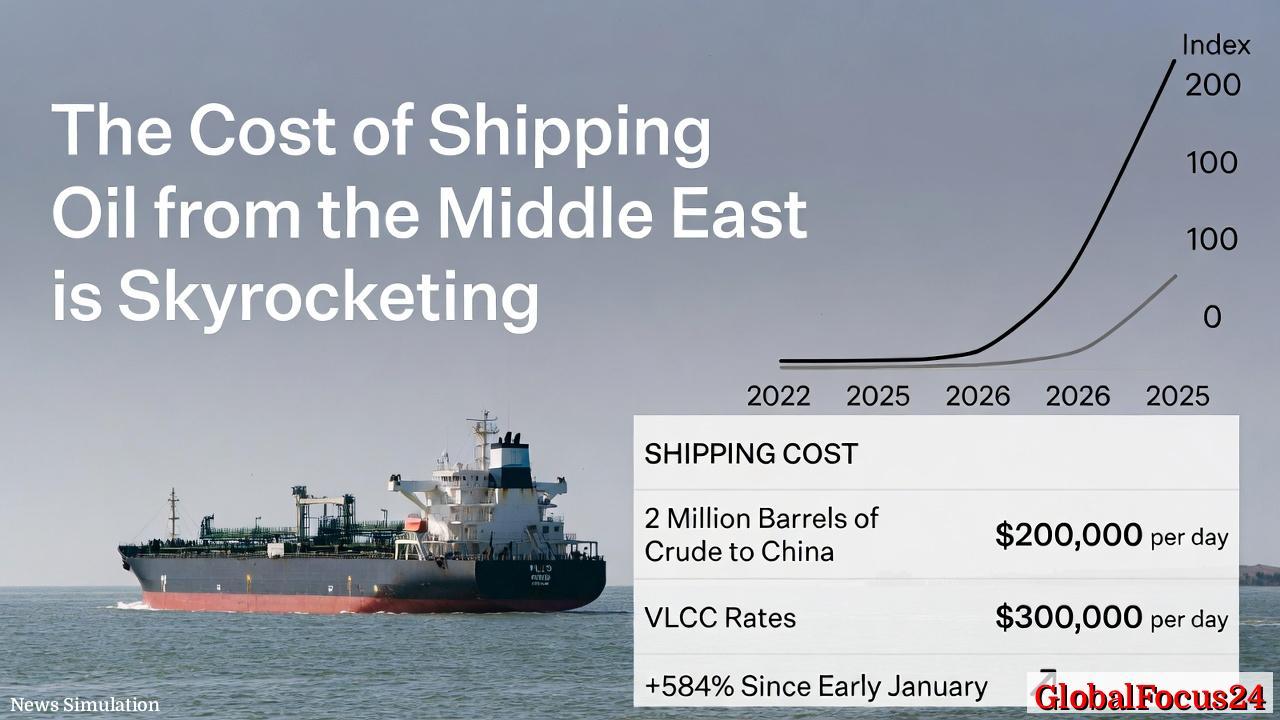
Supertanker Freight Rates Soar to Highest Levels Since the Pandemic Era
Surging Demand Sends VLCC Market Into Overdrive
Freight rates for very large crude carriers (VLCCs)—the massive oil tankers that transport millions of barrels of crude across the world's oceans—have soared to their highest levels in years, marking an extraordinary resurgence in the global shipping market. Earnings on the key route from the Middle East to China have surged to an unprecedented $300,000 per day, a level not seen since the chaotic trading days of the 2020 pandemic oil glut.
The jump underscores a combination of robust oil demand, tightening vessel supply, and shifting global trade flows that have upended traditional shipping economics. Industry data shows that the VLCC freight index has climbed steeply through early 2026, reaching around 200 points on the scale, compared with the muted levels between 0 and 100 that dominated through most of 2022 to 2025.
As global trade adapts to new geopolitical realities and supply chain adjustments, the energy shipping sector has once again become a bellwether of broader industrial momentum.
A Post-Pandemic Shipping Revival
The current spike in tanker rates harks back to one of the most volatile periods in modern maritime history—the early months of 2020. At that time, as global travel and fuel consumption collapsed amid COVID-19 lockdowns, oil producers raced to secure floating storage for surplus crude. Tanker owners saw profits soar briefly as ships became floating warehouses, commanding record hire prices.
That fleeting boom quickly gave way to a prolonged slump. For much of the next three years, tanker operators faced dwindling margins as global inventories normalized, shipyards released new capacity, and OPEC+ production cuts limited available cargoes. By 2023, average VLCC earnings had fallen below $40,000 per day, challenging profitability for even the most efficient fleets.
Now, as 2026 unfolds, the situation has reversed dramatically. Analysts point to a reshaped global energy map, marked by solid demand from Asian refiners, extended voyage distances due to trade rerouting, and a constrained fleet renewal landscape as the catalysts behind the rebound.
Demand Surge from Asia’s Refining Giants
At the center of the rate explosion lies China’s record appetite for imported crude, paired with steady demand growth from India and South Korea. Refiners in these countries have ramped up purchases to both rebuild inventories and meet rising domestic consumption following a recovery in industrial output and transportation fuels.
The Middle East-to-China route—one of the busiest and most strategic corridors for VLCC traffic—has seen daily fixtures climb at an unprecedented pace since December 2025. Persistent draws from Saudi Arabia, the United Arab Emirates, and Kuwait have filled loading schedules through the first quarter of 2026.
Chartering executives describe a market verging on frenzy, where crude producers are competing to secure tonnage amid a tightening supply pool. The result: charter rates have jumped nearly tenfold in just a few months, catapulting them into territory unseen since oil prices themselves crashed in 2020, when floating storage briefly soaked up global oversupply.
Fleet Tightness and De-carbonization Pressures
While demand recovery plays a key role, the supply side of the tanker equation has grown increasingly constrained. Shipowners have slowed new orders for VLCCs in response to regulatory uncertainty and the industry’s accelerating transition toward decarbonization.
The International Maritime Organization (IMO) continues to tighten emissions standards, forcing operators to consider whether current vessel designs will comply with long-term carbon intensity targets. As a result, many owners have deferred fresh investments in traditional oil-fuelled ships, choosing to retrofit existing tonnage or await clarity on alternative propulsion technologies such as LNG, methanol, or ammonia.
Compounding this reluctance, global shipyards—particularly in South Korea and China—remain heavily booked with orders for containerships and liquefied natural gas carriers, restricting tanker delivery slots through 2028. The reduced availability of modern VLCCs has intensified competition for existing ships, magnifying the impact of every incremental uptick in demand.
Geopolitical Realignments Extend Voyage Distances
In addition to Asia’s demand recovery and supply-side limits, geopolitical tensions have redrawn the map of crude flows. Sanctions on Russian oil since 2022 have forced shifts in sourcing and delivery routes, while Western restrictions have pushed Moscow to export more crude to India and China via long-haul shipments.
The redirection of these cargoes—combined with adjustments in Middle East output and disruptions through the Red Sea and Suez Canal—has lengthened voyage durations. Every extra week a tanker spends in transit reduces the effective global fleet capacity, tightening market balance even without new demand growth.
Alternative routing around Africa’s Cape of Good Hope, prompted by intermittent security threats and logistical bottlenecks in the Red Sea, further adds to voyage time and cost. These extended journeys, sometimes two to three weeks longer than traditional routes, translate into fewer available ships for new charters, pushing spot rates sharply higher.
Economic Ripples Across the Energy Supply Chain
The surge in freight costs has far-reaching economic implications. For oil producers, elevated shipping rates can erode the profit margin between export and delivered prices. Refiners, particularly those in Asia, face higher landed costs that may trickle down to consumers via increased gasoline, diesel, and petrochemical prices.
For global oil markets, high tanker rates can temporarily distort trade patterns, encouraging traders to time deliveries carefully or delay spot cargo purchases. In extreme cases, as seen during 2020, elevated freight costs can prompt the use of tankers as short-term storage assets once again.
Major refining centers such as Singapore and Dalian are already reporting tighter near-term crude supply, with some refiners reportedly switching to shorter-haul cargoes from West Africa or drawing down inventories to bridge the gap. These ripple effects illustrate how tightly integrated maritime logistics have become with global energy price formation.
Comparison With Regional Shipping Markets
The VLCC segment’s surge stands out even against a generally robust maritime backdrop. In the product tanker and Aframax markets, rates have also strengthened through early 2026 but lag behind the dramatic escalation seen in the ultra-large crude category.
For comparison, freight for Suezmax tankers on Middle East–to–Mediterranean routes has averaged around $110,000 per day, while smaller Aframaxes have fetched $70,000 per day on key Atlantic trades. By contrast, VLCCs—carrying up to two million barrels per voyage—remain the most closely watched indicator for the health and balance of the oil transport market.
Regionally, the Atlantic Basin has seen more modest gains as U.S. exports continue to grow steadily but lack the explosive surge of Asian import demand. Europe, meanwhile, faces a structurally different market dynamic, with renewable adoption and declining fossil fuel use moderating tanker activity from northern loading terminals.
Lessons From Previous Market Cycles
Historically, tanker booms have proven cyclical and short-lived. The previous major upswings—in 2004, 2008, and 2020—each faded as new vessel deliveries arrived or global demand slowed. Yet the current rally exhibits some unique features that could sustain elevated earnings longer than past cycles.
First, the industry enters this phase with fewer new ships on order relative to historical averages. Second, regulatory compliance costs tied to decarbonization are pressing owners to reduce sailing speeds—effectively tightening capacity. Finally, global crude trade appears to be entering a period of sustained realignment, with Asia absorbing a greater share of seaborne flows as Western markets plateau.
Still, industry veterans caution that such sharp spikes rarely remain stable. A rapid correction could follow if oil demand falters or if OPEC adjusts production targets in response to high freight costs disrupting trade flow efficiency.
Market Outlook for the Rest of 2026
Analysts expect volatility to remain intense through mid-2026. Seasonal maintenance at Asian refineries during the second quarter could temporarily ease demand, providing a brief correction before autumn restocking spurs another wave of shipments.
Several major brokers predict that while spot earnings above $200,000 per day may not be sustainable, average returns for the year could settle around $120,000 to $150,000—still well above historical norms. That would deliver one of the most profitable years in more than a decade for tanker operators.
However, shipping executives warn that the market remains sensitive to external shocks—from regional conflicts to port congestion or regulatory changes related to fuel emissions. Any combination of these could accelerate rate fluctuations in either direction.
A Turning Point for the Global Energy Fleet
Whether this marks the start of a sustained upcycle or a temporary surge, the current spike in supertanker freight rates reflects deeper structural changes across the energy logistics landscape. As global oil trade becomes more fragmented and longer-haul, the world’s fleet of crude carriers has again become a focal point of supply chain tension.
With VLCCs now earning figures reminiscent of 2020’s extremes, the spotlight has turned once more to the crucial but often overlooked arteries of global commerce—the ships silently bridging oceans with the world’s energy needs. For now, at least, the balance of power in the shipping world has tilted decisively toward the owners of these floating giants.