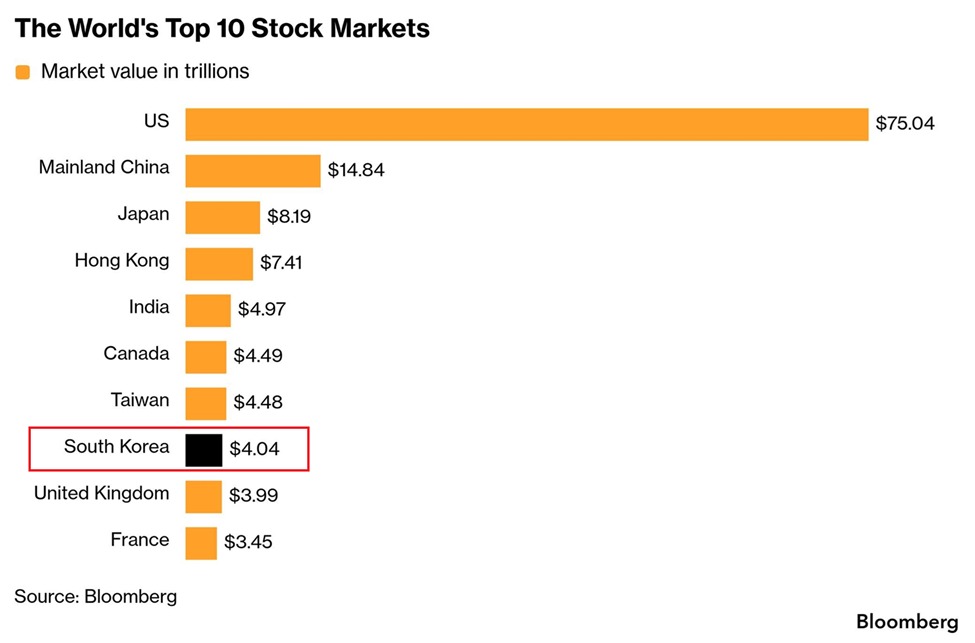
South Korea Overtakes UK to Rank as Eighth-Largest Global Stock Market by Market Capitalization
South Korea has surged to join the ranks of the world’s largest stock markets, surpassing the United Kingdom to become the eighth-largest by total market capitalization. The shift reflects a remarkable year-to-date surge driven by heavyweight technology players and a broader regional ecosystem that is increasingly tied to global demand for advanced semiconductors and artificial intelligence hardware.
Historical Context: A Shift in Market Leadership The evolution of global stock market capitalization has long reflected structural shifts in technology, manufacturing, and financial markets. In the early 2020s, the United Kingdom maintained a prominent position among top markets, supported by a mature financial services sector, a diversified industrial base, and listed companies spanning energy, technology, and consumer goods. Yet, history shows that relative market sizes can move quickly when a few large constituents recalibrate investor expectations and when sectors with high growth potential expand their share of indices.
For South Korea, the current milestone is the latest chapter in a longer arc of industrial transformation. The country’s economy has been transitioning from traditional manufacturing to high-tech leadership, anchored by memory chipmakers, consumer electronics brands, and a rapidly modernizing financial ecosystem. The Kospi index, home to more than 800 companies, has benefited from concentrated gains in a few megacap names, particularly in the AI memory chip segment. This shift illustrates how index composition and sector leadership can reframe a nation’s relative standing in global markets, even as broader macroeconomic conditions evolve.
Economic Impact: What the Reordering Means for Capital Flows and Corporate Finance The move by South Korea to the eighth-largest market by market capitalization carries several meaningful implications for investors, issuers, and policymakers.
- Capital inflows and asset allocation: As a larger, more influential market, South Korea now attracts a broader base of global investors seeking exposure to AI-enabled semiconductors and the companies driving the next wave of technology infrastructure. A higher profile market can lead to more diverse fund flows, including pension and sovereign wealth allocations that pursue long-term returns tied to growth in AI memory technology and data-center demand.
- Valuation dynamics and corporate access: When a country’s market capitalization expands, it often correlates with an increase in liquidity and improved access to capital for listed firms. For major Kospi constituents, including Samsung Electronics and SK Hynix, enhanced liquidity can support more favorable financing conditions for expansion, capital expenditure, and research and development initiatives. In turn, these dynamics can foster a more aggressive investment cycle across the broader ecosystem of South Korean listed companies.
- Sector concentration and diversification: The notable contribution of two AI memory chip giants to more than 40% of the Kospi index underscores both the opportunities and risks of sector concentration. While dominance by a few large players can accelerate index-level gains during favorable demand cycles, it can also render the market more sensitive to sector-specific shocks. That reality often prompts discussions among regional investors about diversification strategies and risk management.
- International comparisons and regional benchmarks: The UK’s market, while smaller in relative size than before, remains a global hub for financial services, energy, and creative industries. The North Atlantic comparison highlights how different growth trajectories, regulatory environments, and technology ecosystems shape market outcomes. South Korea’s rise reflects a high-growth, technology-intensive economy linking global AI and data-center demand with a robust domestic manufacturing base.
Regional Context: Asia-Pacific Markets in Focus South Korea’s ascent sits within a broader regional pattern of capital market expansion and diversification in Asia-Pacific. China’s ongoing market evolution, Japan’s stable financial infrastructure, and Taiwan’s semiconductor prowess collectively influence regional dynamics. The United States continues to dominate the global market capitalization landscape, with a multitrillion-dollar lead that underscores its continued importance as a benchmark for global investment performance. Yet, regional shifts—such as South Korea’s overtaking of the UK—signal a growing diversification of market leadership, driven by technology, export-oriented sectors, and evolving investor sentiment toward AI-enabled growth narratives.
Company Spotlight: Samsung Electronics and SK Hynix at the Core Two companies stand out as pivotal drivers of South Korea’s market capitalization surge: Samsung Electronics and SK Hynix. These two giants together contribute a sizable share of the Kospi’s market value, reflecting their global influence in memory chips, semiconductors, and consumer electronics. The health of the broader technology and memory-chip cycle, as well as supply-demand dynamics in data-center infrastructure, has a direct impact on the Kospi’s performance and, by extension, South Korea’s relative market standing.
- Samsung Electronics: A diversified tech conglomerate with leadership in consumer devices, memory, processors, and display technologies. Its performance often acts as a barometer for broader tech sentiment and capital-market confidence in the region.
- SK Hynix: A major memory-chip supplier with exposure to DRAM and NAND technologies. Its earnings and capital expenditure plans can influence investor expectations for semiconductor equipment cycles, capacity expansion, and next-generation memory products.
Operational and Regulatory Environment: Why Now? Several factors contribute to the timing and magnitude of South Korea’s market expansion:
- Corporate profitability and capital discipline: The capacity of leading firms to generate robust earnings, maintain healthy margins, and pursue disciplined capital returns has supported higher market valuations. Steady profit generation from technology and electronics segments reinforces investor confidence and can drive multiple expansion across the market.
- Global demand for AI hardware: The AI revolution hinges on a foundation of advanced memory, compute, and storage technologies. South Korean semiconductor champions are central to this supply chain, and their profitability and expansion plans are closely watched by investors seeking exposure to AI-related growth.
- Global interest-rate environment: The monetary policy landscape affects equity valuations and the attractiveness of equities versus fixed income. As interest rates stabilize or decline, investors may reallocate toward growth-oriented markets with exposure to tech and semiconductors, contributing to market capitalization growth.
- Exchange-rate considerations: Currency movements influence international investor appetite and the relative cost of investments. A favorable or favorable-adjusted exchange rate environment can encourage cross-border investment into Korean equities, supporting market expansion.
Liquidity and Market Structure: A Focus on Access and Depth Liquidity is a key driver of market capitalization. A deeper, more liquid market tends to attract larger funds, including passive strategies, exchange-traded funds, and active managers seeking efficient exposure to high-growth sectors. For the Kospi and its flagship constituents, liquidity growth can reduce trading costs, lower bid-ask spreads, and improve price discovery, all of which reinforce the market’s appeal to global investors.
Comparison to the UK: Distinct Trajectories and Market Profiles The United Kingdom’s market profile differs in several respects. The UK benefits from one of the world’s most developed financial centers, a diversified economy, and a long tradition of equity markets that support a wide array of sectors, from financial services to energy and beyond. While the UK has shown resilience and growth, its market capitalization growth in the cited period has lagged behind South Korea’s surge, illustrating how sector leadership and macroeconomic dynamics can reshape relative rankings even when both markets are sizable, globally connected, and deeply integrated with international capital markets.
Investor Sentiment and Public Reaction: A Global Dialogue Public sentiment around major market moves tends to circle around several themes: optimism about AI-enabled growth, concerns about concentration risk, and curiosity about the longer-term implications for corporate investment in innovation. Market observers note that the strength of a couple of large-cap tech firms can skew short-term performance, but the broader trajectory of the Kospi and South Korea’s listed ecosystem is shaped by ongoing investment in research and development, manufacturing capabilities, and export-oriented growth.
Implications for Global Markets: A Broader Perspective The shift in market capitalization rankings can ripple beyond national borders. For global asset allocators, it provides a signal to recalibrate regional exposure and consider the evolving role of Asia-based technology leadership within diversified portfolios. For policymakers, the development underscores the importance of maintaining competitive incentives for innovation, ensuring robust corporate governance, and fostering an environment where high-growth technology firms can scale efficiently while balancing financial stability and investor protection.
Regional Comparisons: Benchmarks and Performance Signals
- Asia-Pacific benchmarks: South Korea’s ascent contrasts with more gradual growth in other regional markets, highlighting how sector leadership and export-driven tech cycles can outperform broader regional indices during periods of AI and data-center demand expansion.
- European markets: The UK’s market remains critical for European and global finance, with strengths in services, energy, and innovative industries. The divergence in recent performance illustrates how regional regulatory environments, currency considerations, and sector mix influence market outcomes.
Strategic Considerations for Investors
- Diversification versus concentration: Investors may weigh the benefits of reflective exposure to top-weighted tech names against the risks associated with concentration risk, considering strategies that balance large-cap tech exposure with broader, value-oriented or diversified allocations.
- Monitoring AI-related demand: Keeping a pulse on semiconductor capex, memory-chip pricing, and data-center demand is essential to gauging ongoing upside potential for the Kospi’s heavyweight constituents.
- Currency and cross-border considerations: Currency movements can affect total returns for international investors. A thoughtful currency strategy can help manage exposure and optimize after-cost performance.
Conclusion: A Milestone with Forward-Looking Implications South Korea’s rise to become the eighth-largest stock market by market capitalization marks a notable milestone in the global financial landscape. The surge reflects the backbone of the country’s technology leadership, underpinned by Samsung Electronics and SK Hynix, and a broader ecosystem that benefits from AI-driven demand for memory and compute infrastructure. As markets continue to evolve, this development may influence investment strategies, risk assessments, and policy considerations across borders, signaling a shift in where capital calibrates expectations for growth in an increasingly technology-driven economy.