Solana Stablecoin Transactions Surge to Record $650 Billion in February Amid Rising Global Demand for Digital Dollar Assets
Solana Emerges as a Global Leader in Stablecoin Settlements
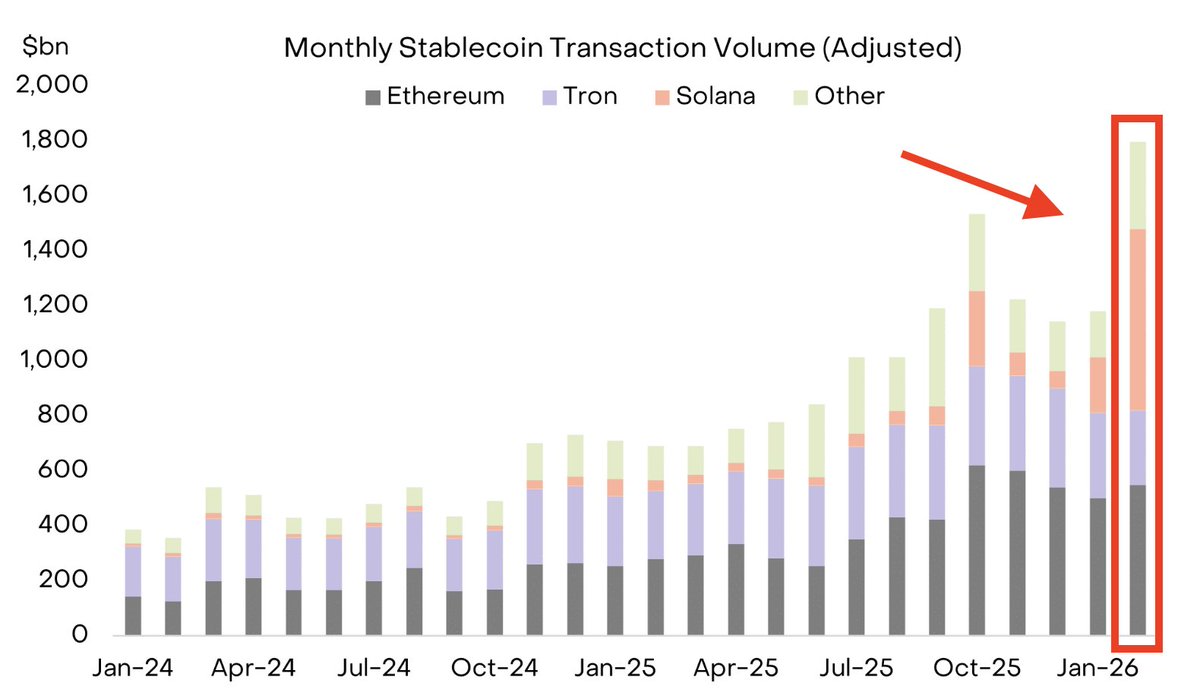
In February 2026, Solana processed a record-breaking $650 billion in stablecoin transactions, marking its strongest month to date and highlighting the blockchain’s rapid rise as a dominant network for digital dollar transfers. The surge pushed total global stablecoin settlement volumes to nearly $2 trillion for the month, nearly tripling Solana’s activity from January as geopolitical uncertainty and innovation within decentralized finance drove demand for digital monetary infrastructure.
The scale of Solana’s transaction volume now dwarfs traditional currency settlement channels, rivaling major payment networks and exceeding typical monthly trading volumes of some commodities and financial derivatives. For comparison, the CME Group’s gold futures market reached a record $208 billion in February — meaning stablecoin transactions on Solana were approximately nine times larger.
New Stablecoin Launches Accelerate Network Growth
The February rally was fueled in large part by the launch of two new major stablecoin products: Western Union’s USDPT token, designed for cross-border remittances, and Jupiter’s JUPUSD, a yield-bearing stablecoin that rewards users for holding liquidity within the network’s decentralized ecosystem.
USDPT represents Western Union’s entry into blockchain-based money movement, aiming to merge the company’s global reach with Web3-native settlement speed. Early adoption in Latin America, Southeast Asia, and parts of Africa drove a spike in cross-border transactions that flowed through Solana’s high-speed infrastructure.
JUPUSD, meanwhile, introduced new yield dynamics into the stablecoin market by redistributing a portion of protocol transaction fees to token holders. The concept resonated strongly with decentralized finance participants seeking alternatives to traditional DeFi yield farms, many of which had struggled with declining returns through 2025.
War-Time Demand Shifts Capital Toward Digital Alternatives
The latest spike in stablecoin transaction volume coincides with broader macroeconomic stress. The ongoing Iran War has produced heightened demand for digitally transferable dollar-denominated assets, particularly in emerging markets that face currency volatility, capital restrictions, or inflationary pressure.
As sanctions and shifting geopolitical alliances disrupt traditional payment rails, stablecoins have become a digital lifeline for global commerce, humanitarian transfers, and private cross-border settlements. Analysts note that volatility in energy markets and gold prices has historically driven investors to seek dollar stability — but in 2026, many are turning instead to programmable digital dollars for both safety and efficiency.
The combination of global news shocks and advancements in blockchain interoperability has created what several research firms describe as a “modern remittance supercycle,” with blockchain networks competing to serve as the rails for real-time, censorship-resistant financial transfers.
Historical Context: Stablecoins as the New Global Settlement Medium
Stablecoins — cryptocurrencies pegged to fiat currencies, typically the U.S. dollar — have evolved from niche instruments to mainstream financial settlement tools over the past decade. Initially popularized by early tokens such as Tether (USDT) and USD Coin (USDC) in the mid‑2010s, their usage has since expanded far beyond speculative trading.
In the early 2020s, stablecoins represented only a small fraction of cryptocurrency market activity. But following periods of volatility in 2022 and 2023, they increasingly became the preferred medium of exchange for decentralized applications, cross-border payments, and blockchain-based financial markets. By late 2024, monthly global stablecoin transfers surpassed $1 trillion, marking a structural shift in how digital commerce operates.
Solana’s share of that total rose sharply through 2025 as the network’s low transaction costs and sub-second finality drew liquidity away from Ethereum and other major networks. The result has been a measurable migration of decentralized payment flows, with analysts at several blockchain research firms noting that Solana’s share of global stablecoin transfer volume now exceeds 30%, up from under 10% a year earlier.
Infrastructure Efficiency and Cost Advantages
Part of Solana’s competitive advantage lies in its architecture optimized for throughput. Designed to handle tens of thousands of transactions per second at negligible cost, the network has become a natural conduit for stablecoin issuance and real-time settlement.
Transaction fees on Solana remain a fraction of those on older blockchains, averaging less than $0.001 per transaction, compared with Ethereum’s average fees ranging from $0.10 to $0.50 depending on network congestion. This efficiency enables not just speculative trading but mass micropayments, payrolls, and remittance corridors — areas that traditional financial systems often struggle to service efficiently.
Companies like Western Union and regional payment startups have capitalized on that infrastructure to build hybrid systems bridging fiat banking with blockchain ledgers. With Solana’s block times measured in milliseconds, these firms have achieved near-instant cash-out and conversion cycles, translating into tangible efficiency gains for consumers and institutions alike.
Economic Impact: Comparing Stablecoins to Traditional Assets
The $2 trillion global stablecoin settlement figure for February underscores how dramatically the digital payments landscape has shifted. For perspective, that figure approaches the scale of monthly U.S. Treasury trading volumes and exceeds global remittance flows for an entire year before blockchain adoption accelerated.
Stablecoins are increasingly viewed as on-chain equivalents of money-market funds, offering liquidity and dollar exposure without reliance on banking hours or geographic borders. Analysts suggest that this dynamic is beginning to blur the lines between decentralized finance and traditional payment services, creating new pressure for both banks and regulators to adapt.
By comparison, gold — long considered a store of value in times of crisis — continues to attract investors, but its liquidity flows remain modest relative to digital instruments. In February, CME Group gold futures contracts reached $208 billion in volume, a record high for that market, yet still a fraction of stablecoin transaction activity. This contrast highlights how digital assets have begun to rival centuries-old commodities in both scale and utility.
Regional Effects and Adoption Trends
While global in scope, much of the growth in February’s stablecoin volumes originated in Asia and the Middle East, regions experiencing heightened financial uncertainty due to disrupted trade routes and banking access limitations stemming from the Iran War. Companies operating in these regions increasingly rely on stablecoins to settle oil, machinery, and technology imports, reducing exposure to local currency swings.
Latin America has also emerged as a strong growth region. Persistent inflation in nations such as Argentina and Venezuela has prompted merchants and individuals to hold value in U.S. dollar–pegged tokens via low-cost blockchain wallets. With Western Union now offering blockchain integration through USDPT, cross-border transfers have become simpler for migrant workers sending money home, boosting real-world use cases beyond speculative investment.
North America and Europe, though slower to adopt stablecoins in everyday transactions, now see growing integration into institutional systems. Several fintech firms and crypto banks operate custodial gateways that allow businesses to settle invoices, payrolls, or trade invoices in tokenized dollars, bypassing the multi-day clearing times typical of wire systems.
Analysts Expect Further Growth in March
Crypto market data firms and research analysts expect Solana’s transaction volume to surpass February’s record as the network continues to onboard major issuers and payment processors in early March. Ongoing geopolitical instability and sustained demand for inflation-resistant, globally transferable digital dollars are expected to drive further adoption.
Investment banks have begun publishing comparative models projecting that blockchain-based settlement flows could represent 10–15% of global currency transactions by 2028, should current trends persist. Such a development would make stablecoins one of the fastest-growing financial instruments in history, rivaling the rise of online banking in both velocity and transformative potential.
Outlook: A Redefinition of Global Financial Plumbing
Solana’s record month underscores more than just the expansion of one blockchain network — it marks a milestone in the digital transformation of global finance. Stablecoins, once dismissed as a speculative tool for crypto traders, are now evolving into the connective tissue of a parallel, programmable monetary system.
As major corporations, remittance providers, and decentralized ecosystems adopt on-chain settlement rails, the boundary between digital assets and traditional finance continues to dissolve. With transaction volumes now measuring in the trillions monthly, the stablecoin economy is no longer experimental — it has become an integral component of the world’s payment infrastructure.
Whether driven by necessity in times of conflict or by innovation in times of growth, the rise of networks like Solana suggests a future where the global dollar flows ceaselessly across blockchains, instant, transparent, and accessible to anyone with an internet connection.