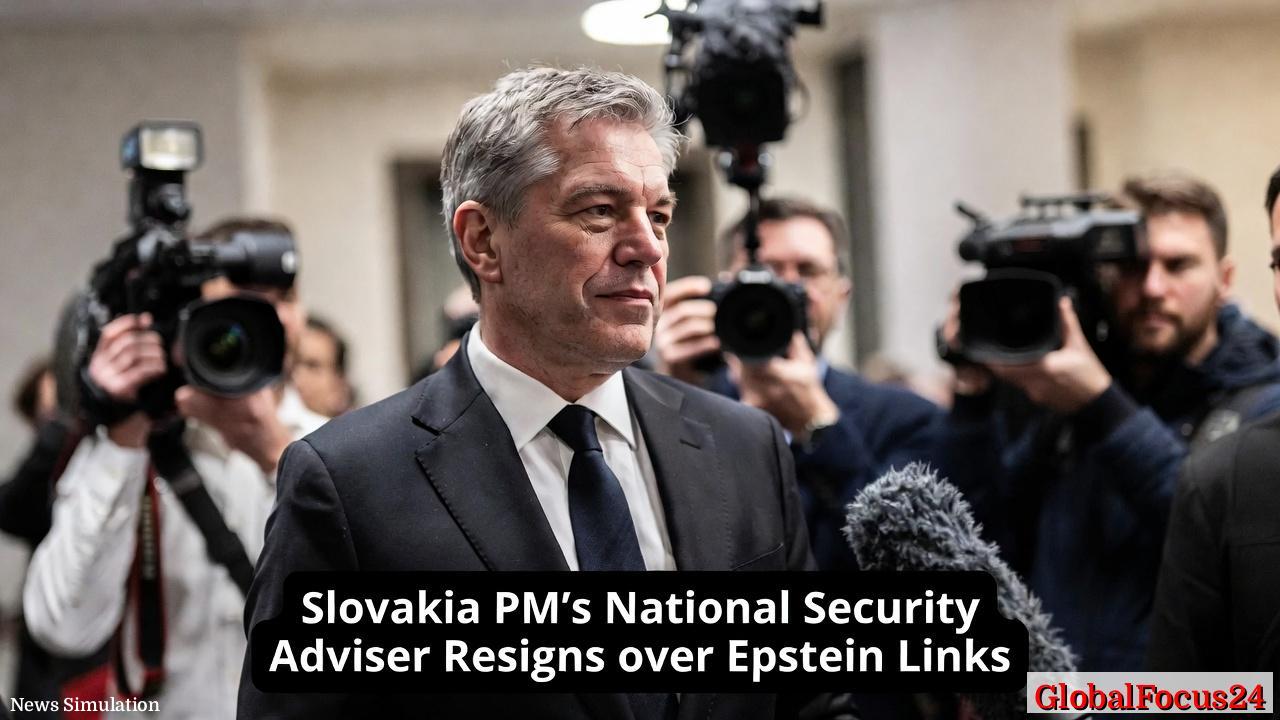
Slovakia Scrambles After Security Adviser’s Resignation Tollows Epstein Document Revelations
In a swift political maneuver, Slovakia’s Prime Minister Robert Fico accepted the resignation of Miroslav Lajčák, the country’s national security adviser, amid the release of previously undisclosed U.S. documents detailing communications with the late financier Jeffrey Epstein. The disclosures, part of a broader DOJ document dump, have spurred questions about diplomatic networks, trust within the government, and the broader implications for Slovakia’s foreign policy posture at a time of regional flux.
Historical context and diplomatic footprint
Miroslav Lajčák has long been a central figure in Slovak diplomacy. A veteran diplomat who has served in multiple government roles and as the European Union’s special representative for the Western Balkans, Lajčák’s career has bridged national interests with broader European security concerns. His resignation traces a longer arc in which Slovakia has sought to balance partnerships with the European Union, NATO allies, and regional neighbors while navigating an increasingly complex geopolitical environment in Central Europe.
The Epstein documents add a new layer to that history. Epstein’s network—composed of business leaders, financiers, and figures with political influence—has repeatedly drawn scrutiny for how relationships intersect with influence. While the released files do not show illegal activity by Lajčák, they illuminate a proximity between an influential diplomat and Epstein that has become a focal point for political risk assessment, especially for governments intent on maintaining credibility in international diplomacy.
Economic implications and regional comparisons
For Slovakia, the fallout from the resignation extends beyond internal politics to the perception of reliability and stability in diplomatic leadership. In a region where governance continuity is highly valued by foreign investors and international partners, leadership changes at the national security level can influence confidence in regulatory predictability and crisis responsiveness. The immediate economic impact may be diffuse, but over the medium term, markets and international partners will assess whether Slovakia’s national security advisory framework remains predictable and aligned with EU and NATO standards.
In comparison, neighboring Central European economies have faced similar episodes with different outcomes. Countries with longstanding reputations for stable civil service structures and transparent channels for political accountability often weather such revelations through clear, timely communication and adherence to norms of governance. While the Slovak government has emphasized the absence of evidence linking Lajčák to illegal activity in the released materials, the political optics of a resignation tied to a highly publicized conversation can influence investor sentiment, public trust, and cross-border cooperation, especially on security and defense collaboration.
Public reaction, media dynamics, and institutional resilience
Public response to Lajčák’s resignation has been mixed, reflecting broader debates about accountability, media scrutiny, and political resilience. Supporters credit the move as a prudent step to prevent political damage to the government’s leadership legitimacy. Critics question whether the resignation is a proportionate response or a political maneuver intended to temper fallout. In many democracies, the immediate aftermath of such disclosures sees a period of heightened media activity, followed by a focus on policy continuity and crisis management planning.
Institutions in Bratislava, and at the EU level, have underscored the importance of maintaining robust security and foreign policy infrastructures even as personnel changes occur. The government has signaled a commitment to steadying the secular processes that govern national security management, including clear communication channels with international partners, ongoing reform initiatives, and a focus on European defense alignment. That continuity is essential in a region where security concerns are not abstract but tied to evolving geopolitical tensions, energy dependencies, and cross-border crime prevention efforts.
Content of the disclosures and its diplomatic resonance
The DOJ document release contains a 2018 exchange in which Lajčák and Epstein discussed conversations about women in a manner described by observers as lighthearted, alongside mentions of a potential meeting with Russian Foreign Minister Sergei Lavrov. The exchange includes a provocative line from Lajčák referencing “the MI girl” in a context that has drawn public scrutiny and raises questions about professional boundaries in informal dialogues among high-ranking officials and advisers. A 2017 email shows Lajčák asking Epstein for assistance in getting a female film producer’s project shortlisted for the Oscars.
Analysts caution against conflating personal humor or professional networking with illegal activity based solely on these excerpts. Still, the revelations prompt a broader reckoning about ethical standards, personal discretion in high-stakes diplomacy, and how informal channels might influence official decision-making. In the global arena, where reputational capital can shape access to senior policymakers and security discussions, such disclosures—whether seen as incidental or symptomatic—inevitably influence how allies and competitors assess a government’s reliability.
Regional arrows of influence and the European security puzzle
Within Central Europe, Slovakia is often viewed through the lens of its EU membership, NATO alliance status, and proximity to fragile or rapidly shifting regional dynamics. The Epstein disclosures—intersecting personal networks with public policy—reflect a wider global pattern where soft power, personal connection, and formal authority intersect. The challenge for Slovakia is to maintain a credible posture on rule of law, anti-corruption standards, and transparent governance while continuing to engage with international partners on shared security challenges, such as cyber threats, border management, and counterterrorism cooperation.
In regional terms, Slovakia’s approach to security policy remains anchored in cooperation with neighboring states, EU institutions, and NATO mechanisms. The ability to sustain joint exercises, intelligence-sharing arrangements, and defense procurement coordination is pivotal for the country’s strategic posture. The resignation of a national security adviser, while significant symbolically, does not automatically derail these practical collaborations, but it does necessitate swift leadership transition, clear messaging, and reinforced governance protocols to preserve operational continuity.
What comes next for Slovakia’s security and diplomacy
The immediate priority for Slovakia is to appoint a successor who can restore confidence in the country’s national security architecture while upholding rigorous standards of professional conduct. Experts suggest a careful selection that emphasizes experience in international diplomacy, intelligence oversight, and crisis management, coupled with a demonstrable commitment to ethics and transparency. The appointment process will likely be closely watched by partners across the EU and NATO, who value predictable and principled leadership in a continent marked by evolving security threats and complex political transitions.
Beyond personnel, Slovakia faces a broader governance challenge: reinforcing formal channels of communication that reduce reliance on informal networks. Strengthening oversight of advisory roles, establishing clear boundaries for interactions with private individuals connected to public affairs, and codifying ethical guidelines can help prevent similar episodes. Such measures not only mitigate risk but also send a strong signal to international partners about Slovakia’s commitment to governance standards.
Historical lessons and public memory
Historical memory shapes how societies interpret moments of political contingency. In Slovakia, as in many democracies, the balance between preserving diplomatic efficiency and upholding public accountability has long guided governance. The current episode echoes a recurring theme: the line between professional discretion and personal conduct is narrow, especially at the intersection of diplomacy, national security, and public life. The way the government navigates this moment could influence public memory of the administration’s overall effectiveness in managing security policy, regional diplomacy, and economic resilience.
Public-facing messaging and the role of accountability
Clear, consistent communication remains central to preserving public trust. Officials have a responsibility to articulate what is known, what remains under review, and how the administration intends to maintain security and policy coherence. In practice, that means focusing on concrete policy steps—advancements in defense cooperation, cyber resilience investments, and anti-corruption safeguards—while acknowledging the seriousness of the disclosures and the steps taken to address them.
Economic resilience and investor confidence in context
From an economic perspective, Slovakia’s resilience hinges on stable governance and predictable policy environments. International investors seek clarity on risk management, regulatory certainty, and the government’s ability to maintain open channels with European partners. The immediate takeaway for markets tends to be a marginal rise in volatility followed by a cautious return to baseline if the leadership transition proceeds smoothly and governance reforms are publicly pursued. Energy security, industrial policy, and cross-border trade routes remain critical levers for sustaining growth and employment, particularly in manufacturing corridors that feed regional supply chains.
A mosaic of global echoes
While Slovakia’s episode is bounded in its immediate domestic scope, the global context cannot be ignored. Similar episodes have tested governments elsewhere, prompting reforms in ethics oversight, the professionalization of security services, and the institutional separation of diplomatic work from personal networks. The ultimate measure of success for Slovakia will be its ability to demonstrate that national security decisions are made through transparent processes, grounded in professional expertise, and insulated from personal entanglements that could erode trust among allies and citizens alike.
Conclusion and continuing coverage
The resignation of Slovakia’s national security adviser marks a pivotal moment for the country’s governance and international posture. As Bratislava navigates the aftermath, the emphasis will be on leadership transition, governance reforms, and reinforcing the mechanisms that sustain credible diplomacy in a complex regional landscape. The coming weeks and months will reveal how Slovakia maintains its strategic momentum in European security collaboration, economic resilience, and public accountability, all while managing the delicate balance between open inquiry and the duties of statecraft.
Public interest will likely persist as stakeholders assess the implications for Slovakia’s foreign policy credibility, regional alliances, and economic outlook. The episode serves as a reminder that the machinery of national security operates not only through formal directives but also through the interplay of personal networks, institutional norms, and the enduring demand for principled leadership in times of scrutiny.