Semiconductor Stocks Surge While Software Stumbles as Market Breadth Splits in Early 2026
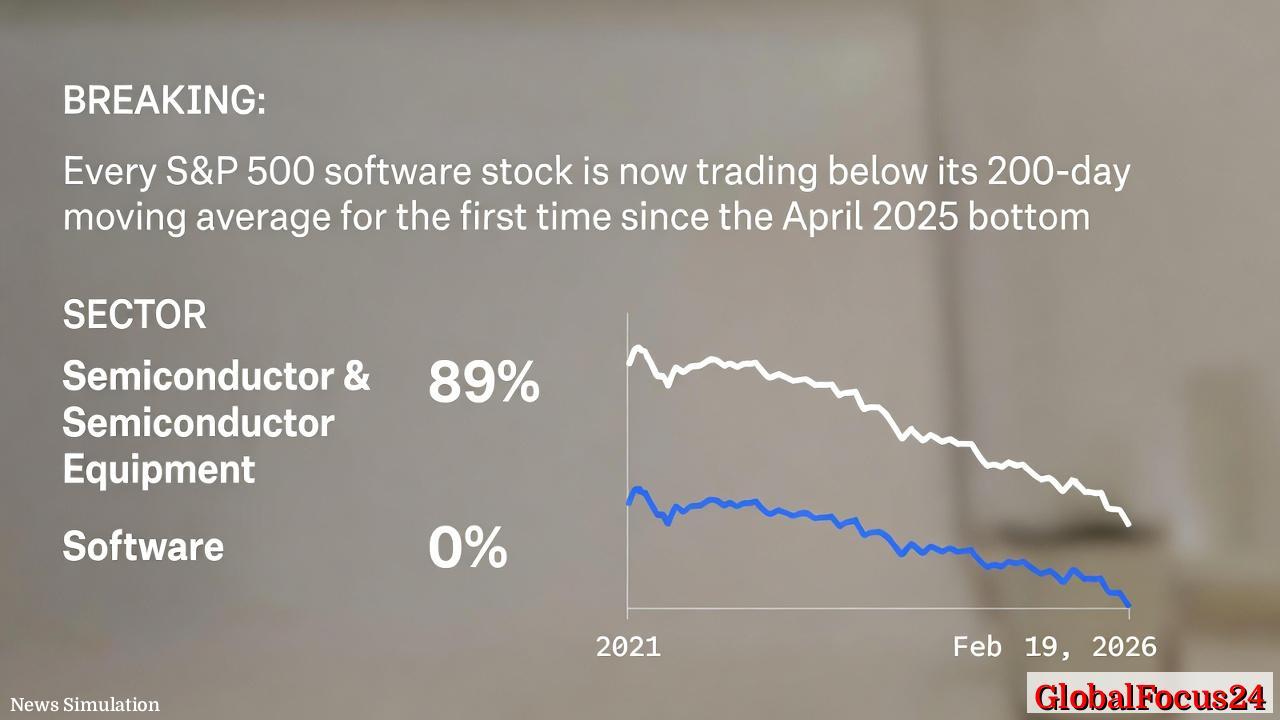
In a striking divergence inside the S&P 500, semiconductor-related stocks are displaying powerful upside momentum while software names have fallen into a deep slump, underscoring a “two-speed” technology market heading into 2026. As of February 19, 2026, 89% of the members in the S&P 500 Semiconductors & Semiconductor Equipment Industry Group are trading above their 200-day moving average, compared with 0% in the S&P 500 Software Industry Group.
A chart tracking the share of industry group members trading above their 200-day moving average from 2021 through February 19, 2026 highlights the stark divergence: the semiconductor group has recently held at elevated levels, climbing to 89%, while the software group—after swinging between near-0% and near-100% over the past five years—has collapsed to 0% in early 2026. The split is reshaping market leadership in U.S. equities and changing how investors think about growth, profitability, and risk within the broader technology complex.
Market Breadth Signals a Tale of Two Tech Sectors
The percentage of stocks trading above their 200-day moving average is a widely followed measure of market breadth, used to gauge how broad or narrow a rally or sell-off has become. When that percentage rises, it typically suggests a healthy, widely supported uptrend; when it falls, it can indicate that a sector’s advance is being driven by only a handful of names—or that a widespread downturn is underway.
In semiconductors, an 89% reading implies that nearly all of the group’s constituents are in sustained uptrends, reflecting persistent demand for chips tied to cloud computing, artificial intelligence, high-performance computing, automotive electronics, and industrial automation. The strength spans both chip designers and equipment manufacturers, signaling that investors expect elevated capital spending on fabrication capacity and continued growth in end-market demand.
Software, by contrast, finds itself with 0% of industry constituents above their 200-day moving average, a configuration that points to an unusually broad and intense sell-off. After oscillating between periods of strong participation and sharp pullbacks from 2021 through 2024, the group has slid to an extreme that suggests investors are aggressively repricing software valuations in the face of changing growth expectations, competition from new AI-native platforms, and concerns about margins.
From Pandemic Boom to AI Hardware Supercycle
The current divergence can be traced back to the different ways semiconductors and software experienced the pandemic and its aftermath. In 2020 and 2021, software benefited from a historic surge in demand driven by remote work, digital collaboration, e‑commerce, and cloud migration, powering a multiyear rally that pushed valuations to elevated levels and made software one of the market’s most favored growth segments. Many software names dramatically outperformed the broader S&P 500 during this period, supported by recurring revenue models and strong earnings growth.
Semiconductors also rallied in the early 2020s, but for different reasons. A global chip shortage, fueled by pandemic-era supply chain constraints and booming electronics demand, revealed the critical importance of chip capacity to the global economy. Governments responded with major policy initiatives and incentives to localize and expand production, while chipmakers and equipment providers announced large capital expenditure plans to meet anticipated future demand.
As the immediate pandemic effects faded, software’s momentum began to cool. Higher interest rates, tighter financial conditions, and a shift in investor preference toward profitability over pure top-line growth created headwinds for high-valuation software names. At the same time, customers scrutinized software budgets more closely, seeking efficiency and consolidation across vendors. The result was a more volatile path for software stocks, reflected in the fluctuating breadth readings seen between 2021 and 2024.
Semiconductors, meanwhile, increasingly became the backbone of the artificial intelligence and data center build-out story. As AI models grew larger and more complex, demand soared for advanced graphics processors, high-bandwidth memory, networking chips, and specialized accelerators. Equipment makers supplying lithography, deposition, etch, and inspection tools also benefited, as chip manufacturers raced to expand their capabilities for leading-edge and specialized processes. This trend helped semiconductor breadth remain resilient in recent periods and ultimately climb to its current elevated level.
Early 2026: Hardware Strength, Software Strain
By early 2026, the market has effectively drawn a sharp line between the perceived winners and laggards within technology. Semiconductor and semiconductor equipment stocks, supported by surging AI infrastructure spending and ongoing shifts in industrial and automotive demand, continue to attract capital and trade in strong technical uptrends.
Commentary from market strategists has emphasized that, beneathindex volatility, market breadth is improving outside the megacap growth leaders, with particular strength in hardware-oriented and cyclical areas. Within this backdrop, the semiconductor group stands out as one of the clearest beneficiaries, with the vast majority of its constituents participating in the uptrend rather than just a handful of dominant names.
Software, however, is facing one of its most challenging phases since at least the 2022 rate-hike cycle. Recent analysis points to concentrated weakness in software, including exchange-traded funds that track the group, which have slid toward oversold technical conditions as investors rotate away from the segment. Factors weighing on the industry include:
- Pressure on high-multiple growth names as investors demand clearer paths to profitability.
- Intensifying competition from AI-native platforms that may disrupt established business models.
- Signs of slower enterprise spending growth in some software categories as companies prioritize infrastructure, energy, and AI hardware investments.
These dynamics are reflected in the 0% breadth reading, signaling that the downtrend in software is broad-based across the group, rather than concentrated in a few weaker names.
Economic Impact of the Sector Split
The divergence between semiconductor and software stocks has implications far beyond equity market charts. Semiconductors sit at the center of a complex global supply chain and play a key role in productivity, industrial output, and national competitiveness. Strong performance in semiconductor shares reinforces the ability of these companies to fund capacity expansion, research and development, and new technology nodes—all of which feed back into the broader economy through capital investment and job creation.
Rising semiconductor valuations can lower the cost of capital for chipmakers and equipment providers, encouraging continued investment in new fabs, tools, and design efforts. This in turn supports ancillary industries, from construction and utilities to materials and logistics, particularly in regions that are positioning themselves as semiconductor hubs. Government incentives and public–private partnerships amplify this effect, as policy objectives around supply chain resilience and technological leadership align with corporate investment plans.
The weakness in software, on the other hand, may influence corporate spending behavior and labor markets in different ways. Software firms have been key drivers of hiring and wage growth in technology over the past decade, especially in high-cost urban centers. Periods of broad-based stock price pressure can lead companies to slow hiring, rein in compensation growth, or reassess expansion plans, with potential ripple effects on local economies that depend heavily on technology employment and tax revenues.
For enterprises, the shift in market leadership may also shape strategic priorities. Strong performance in semiconductor and hardware-related investments could encourage companies to focus on infrastructure and AI-enabling technologies, while becoming more selective about new software deployments. That rebalancing could alter the pace of digital transformation initiatives, even as AI adoption continues across sectors.
Regional and Global Dimensions
The semiconductor–software divide also has a regional dimension, since key players in each industry cluster in different geographies. U.S. and Asian markets are heavily exposed to semiconductor and chip equipment manufacturing, design, and supply chain activities, while software leadership is more concentrated in major U.S. and European technology hubs.
Regions that host major chip fabrication plants and equipment manufacturers stand to benefit from the current strength in semiconductor stocks and the investment momentum behind them. Large-scale fabrication projects require significant physical infrastructure, long-term energy commitments, and highly skilled engineering talent, making them important anchors for regional economic development.
Software-centric regions may experience a more mixed picture in the near term. While many software firms remain fundamentally profitable with strong balance sheets, the market’s shift in favor of hardware and AI infrastructure has reduced their relative equity-market prominence, at least for now. That could influence capital flows, venture activity, and public market valuations across local technology ecosystems.
At the global level, the divergence underscores broader competition around AI and digital infrastructure. Countries seeking to lead in AI and next-generation computing are investing heavily in semiconductor capacity, data centers, and the energy systems needed to power them. Software remains essential to turning those capabilities into usable tools and services, but the market’s current focus suggests that investors view the physical layer—the chips, networks, and power—as the most pressing bottleneck and, therefore, the most attractive opportunity.
Historical Context: Cycles of Leadership Within Technology
Historically, leadership within the technology sector has rotated among hardware, software, internet services, and other subsectors as economic conditions, innovation cycles, and investor preferences change. In the late 1990s and early 2000s, internet and telecom hardware companies dominated market narratives, only to be followed by the rise of enterprise software and cloud computing in the 2010s.
The current environment can be viewed as another chapter in this rotation. After a decade in which software, platforms, and services often commanded premium valuations and captured much of the attention, hardware—especially semiconductors—has reemerged as a central driver of technology performance. The breadth data, with almost all semiconductor names in sustained uptrends and all software names below their 200-day moving averages, captures that reversal with unusual clarity.
Past cycles suggest that extremes in breadth do not persist indefinitely. Software has previously recovered from periods of underperformance, particularly when new product cycles, pricing power, or platform shifts restored investor confidence. Likewise, semiconductors have historically experienced boom-and-bust patterns, with periods of overcapacity, pricing pressure, and earnings volatility following phases of intense investment.
What the Divergence Means for Investors and the Outlook
For investors, the divergence in breadth between semiconductors and software sends a clear signal about where market conviction currently lies. A nearly universal uptrend among semiconductor names suggests that the market sees continued earnings strength and sustained demand, particularly in areas tied to AI, cloud infrastructure, and high-performance computing.
The complete absence of software names above their 200-day moving average, by contrast, points to pervasive skepticism about near-term prospects for the group, even as many companies still generate recurring revenues and maintain solid margins. Some investors may interpret this weakness as a sign of structural challenges, while others may see it as a potential future opportunity if fundamentals prove more resilient than current prices imply.
Looking ahead, key questions include whether semiconductor strength can persist without interruption, how quickly AI-driven demand can be translated into sustainable earnings growth, and when software may find a floor and begin to stabilize. Changes in interest rates, corporate IT budgets, and policy decisions around industrial investment and data regulation could all influence the trajectory of both groups.
For now, the market is delivering a clear message: within the S&P 500, technology is no longer moving in lockstep. Semiconductors and semiconductor equipment are in a broad, powerful uptrend, while software has entered a deep and unusually uniform downturn, reshaping the balance of power across one of the market’s most important sectors.