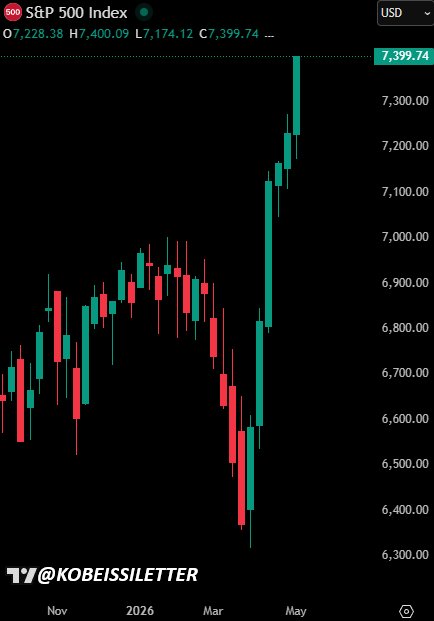
S&P 500 Surges Beyond 7,400: A Historic Milestone with Broad Implications
In a striking development for global financial markets, the S&P 500 rose above the 7,400 level for the first time in history, signaling a new chapter for U.S. equities and investor sentiment. The milestone, achieved after weeks of sustained gains, underscores a rare combination of robust corporate earnings, favorable monetary conditions, and renewed appetite for risk across sectors. As traders digest this record, analysts and policymakers are weighing what the move means for growth, capital allocation, and the broader economic landscape.
Historic context and the road to record highs
The S&P 500, a broad gauge of U.S. large-cap stocks, has tracked a long arc of volatility and recovery since the global disruptions of the past decade. Reaching above 7,400 represents more than a numeric threshold; it reflects a multi-year ascent anchored in improving earnings visibility, resilience in consumer demand, and the elasticity of technology and services sectors to global growth dynamics. Historically, such peaks tend to coincide with periods of:
- Elevated corporate profitability and margin expansion
- A supportive interest rate environment that balances inflation concerns with growth incentives
- Strong liquidity conditions from both private capital markets and institutional investors
This latest ascent builds on a pace that some market observers describe as compressed but sustainable, given the breadth of participation across sectors. While the index has crossed previous psychological barriers, the underlying drivers are practical and varied: technology firms continuing to scale, financials gaining from improved credit conditions, healthcare companies expanding through innovation, and consumer discretionary firms benefiting from resilient demand.
Economic impact and market composition
The movement above 7,400 reverberates through several layers of the economy. For investors, it signals confidence in the earnings trajectory of a diversified set of constituents within the S&P 500. Institutions and individual portfolios alike may recalibrate exposure, seeking to balance equity exposure with other asset classes amid evolving volatility dynamics. The gain in market capitalization—reported in rapid fashion over a short period—also reflects a broad-based re-pricing of risk, where investors expect sustainable earnings growth to outpace macro headwinds.
Key sectors contributing to the surge include:
- Technology and information services, where software platforms and semiconductor growth have continued to drive top-line expansion
- Consumer discretionary, supported by solid demand trends and pricing strategies that preserve margins
- Financials, aided by credit market normalization and rising loan volumes
- Health care, underpinned by innovation pipelines and demographic tailwinds
Beyond the index itself, the surge has implications for capital markets activity:
- Increased liquidity in equities can influence funding costs for corporate balance sheets, potentially lowering the hurdle rate for investment in growth initiatives
- Higher index levels often attract passive investment inflows, alongside active bets on segments with compelling growth profiles
- The breadth of the rally can provide a stabilizing force during periods of policy uncertainty, as investors search for durable, fundamentals-driven gains
Regional and global comparisons
To contextualize the S&P 500’s record run, it helps to compare with regional benchmarks and international markets. In many advanced economies, major indices have similarly tested new highs, reflecting a synchronized global recovery pattern in which technology-driven productivity gains and reopening economies play central roles. Yet the pace and concentration of gains can vary:
- Regional breadth: While the U.S. market displays a wide-based advance across sectors, some regions exhibit more sector-specific strength, such as energy or materials, depending on commodity cycles and local policy signals
- Monetary policy contours: The rate paths and inflation expectations in Europe, Asia, and North America shape cross-border capital flows, influencing equity valuations and risk premiums
- Earnings dispersion: U.S. corporations often demonstrate resilience in margins and reinvestment capacity, which can push indices higher relative to peers when global demand remains robust
From a historical vantage point, record highs can be markers of longer-term cycles. They do not guarantee permanence, but they do reflect a moment when markets assess that growth, productivity, and policy alignment are favorable enough to justify higher valuations. Investors typically watch for signs of overheating, shifts in volatility, and potential policy adjustments that could recalibrate risk premia.
Public reaction and perceived urgency
The milestone has sparked a range of public reactions, from cautious optimism to heightened scrutiny. Among business leaders, the message is often one of confidence in the underlying health of corporate America, tempered by prudent attention to inflation dynamics, supply chain normalization, and the ongoing need for innovation. Savers and retirees may view the record level as an incentive to review asset allocations, ensuring that portfolios align with risk tolerance and retirement timelines.
Media coverage and analyst perspectives frequently emphasize the balance between momentum and fundamentals. Analysts point to:
- The durability of earnings growth across core sectors
- The potential for wage dynamics and consumer spending to sustain demand
- The importance of corporate balance sheet strength and capital expenditure plans
This nuanced perspective helps investors distinguish temporary price movements from structural improvements, a distinction that matters for long-term financial planning.
Risk considerations and future outlook
As with any major market milestone, prudent risk management remains essential. While the surge signals optimism, several factors could influence the trajectory from here:
- Inflation and interest rates: The sensitivity of equity valuations to rate expectations remains a focal point, with even modest policy shifts capable of affecting multiples
- Earnings quality: Sustained gains depend on revenue growth and margin discipline, not just multiple expansion
- Geopolitical and macro uncertainty: Global events, trade dynamics, and energy markets can create volatility that tests the resilience of broad-based rallies
Investors often maintain diversified exposure while monitoring sector catalysts such as technological innovation, regulatory developments, and consumer behavior shifts. A disciplined approach that emphasizes cash flow, balance sheet health, and sustainable competitive advantages can help navigate potential pullbacks or consolidations.
The longer-term implications for the market structure
Beyond immediate considerations, the 7,400 milestone prompts reflection on the evolving market structure. A rising index level can influence corporate behavior, including:
- Investment in growth initiatives, research, and development
- Strategic acquisitions aimed at expanding scale and competitive moat
- Shareholder remuneration strategies, balancing buybacks with dividends to optimize capital deployment
For the economy at large, the signal of continued equity strength may support wealth effects that encourage consumer spending and investment. At the same time, policymakers and market participants watch for signs that equity gains are translating into real-economy benefits, such as job creation, wage growth, and productivity gains.
Historical parallels and regional nuance
Looking back, periods of rapid index appreciation often coincide with a favorable alignment of macro conditions and investor sentiment. Historical parallels highlight:
- The importance of a stable macro backdrop, with manageable inflation and credible monetary policy
- The role of technological leadership and productivity improvements in sustaining earnings momentum
- The interplay between market valuations and real economic indicators, where sustained growth reinforces confidence and vice versa
In regional terms, investors comparing the U.S. performance with peers may note differences in sector composition, regulatory environments, and investment climates. While the U.S. market has benefited from a technology-driven growth narrative and deep liquidity, other regions may rely more on traditional industries or commodity cycles, leading to varying performance trajectories.
Conclusion: a moment of significance with careful watchpoints
The S&P 500 crossing the 7,400 threshold marks a notable moment in financial markets, signaling robust investor confidence and resilience across a broad spectrum of sectors. While the milestone is not a guarantee of perpetual ascent, it reflects a framework in which earnings growth, prudent policy, and strategic capital expenditure align to support higher equity valuations. As markets digest this achievement, participants will be watching for continued earnings momentum, signs of durable demand, and clear signals from central banks about the path of interest rates. In the near term, the focus will be on sustaining momentum while managing potential risks, ensuring that the record run translates into meaningful, enduring benefits for the broader economy.