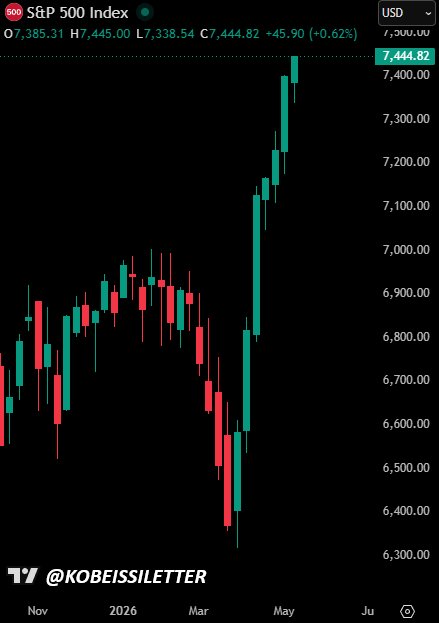
S&P 500 Reaches Record Highs as Market Cap Surges by $10.2 Trillion in Six Weeks
The S&P 500 has extended its rally into uncharted territory, climbing to new all-time highs as market optimism broadens across sectors. In a span of six weeks, the benchmark index has surged roughly 18% from its late-March low, delivering more than $10.2 trillion in cumulative market capitalization gains. This rapid rebound stands out as one of the most pronounced short-term recoveries in modern market history, reflecting a convergence of macro resilience, monetary policy expectations, and durable corporate earnings.
Historical context: a pattern of sharp recoveries after downturns To understand the current move, it helps to situate it within the broader arc of U.S. equity market cycles. Historically, major pullbacks have often been followed by vigorous rebounds driven by a combination of improved risk appetite and revaluation of equities against lower discount rates. The present stretch resembles prior episodes where liquidity injections and supportive policy environments converged with steadier economic data, supporting a shift from risk-off to risk-on sentiment. Yet every cycle carries its own nuances: the speed of this rally, the breadth of participation across sectors, and the persistence of earnings growth will shape how durable the gains prove over the coming quarters.
Economic impact: earnings resilience and investment flows A key driver behind the six-week surge is the resilience of corporate earnings. Despite periodic volatility, many companies have reported stronger-than-expected profits, healthier balance sheets, and confidence in demand fundamentals. The expansion in market capitalization mirrors investors’ belief that earnings trajectory can sustain elevated equity valuations without a corresponding deterioration in macro risk factors. The breadth of the rally—spanning technology, consumer cyclicals, healthcare, and industrials—suggests that investors are pricing in a broader economic expansion rather than a narrow, sector-specific rebound.
Capital markets observers point to several contributing forces behind the jump in prices and capitalization:
- Monetary policy signals: subtle shifts in expectations around interest rate trajectories have reinforced the view that borrowing costs will remain supportive for equities, while inflation trajectories appear to be moderating in the near term.
- Global demand dynamics: improving demand conditions in key export markets, along with a gradual waning of macro headwinds, have supported global supply chains and corporate revenues.
- Innovation and productivity gains: ongoing advancements in sectors such as software, semiconductors, and healthcare technology have bolstered long-term- growth prospects and investor appetite for equities.
- Fiscal policy and balance sheets: stable fiscal conditions and healthy household balance sheets have underpinned consumer demand and corporate investment, reinforcing confidence in continued earnings strength.
Regional comparisons: how landscapes differ across major markets The recent U.S. equity rally has notable parallels and distinctions when compared with regional markets. In many developed markets, equities have benefited from a similar risk-on stance, but the pace and magnitude often reflect country-specific factors such as currency dynamics, sovereign yields, and sector compositions.
- United States vs. Europe: While both regions have seen upward momentum, U.S. equities have maintained a comparatively stronger technology and growth orientation. European markets, influenced by cyclical sectors and variable energy prices, have shown a more mixed recovery pace, with some volatility tied to energy price fluctuations and regional policy shifts.
- Asia-Pacific contrasts: In Asia-Pacific, the performance mosaic has been influenced by China’s policy environment, supply chain realignments, and divergent growth trajectories. Some markets benefited from a rebound in manufacturing indicators, while others faced recurring regulatory and structural challenges. The net effect has been a nuanced, country-by-country picture rather than a uniform regional trend.
- Global risk sentiment: Across regions, the synchronized improvement in risk sentiment has supported capital inflows into equities, albeit with local factors shaping timing and sector leadership. Investors continue to monitor inflation expectations, central bank communications, and geopolitical developments that could alter cross-border capital flows.
Sectoral dynamics: leadership and laggards As the S&P 500 advances to new highs, sector leadership reveals investors’ evolving priorities. Historically, rapid recoveries tend to be led by cyclical and growth-oriented groups, while defensive sectors offer steadier, but relatively slower, upside. The current environment shows positive momentum across several pillars:
- Technology and communication services: The technology complex often drives early-stage recoveries through strong earnings momentum, capital-efficient growth, and robust demand for cloud services, semiconductors, and digital communications.
- Consumer discretionary and materials: Durable demand in consumer-facing industries supports higher earnings expectations, complemented by constructive outlooks for materials tied to infrastructure and manufacturing cycles.
- Healthcare and energy: The healthcare sector remains a proxy for demographic trends and innovation, while energy markets reflect the interplay between supply discipline and global demand recovery, influencing valuations in both traditional and alternative energy segments.
Valuation considerations: balancing optimism with risk Valuation remains a central lens through which investors assess whether current highs reflect sustainable fundamentals or extended multiples. A broad market rally of this nature invites scrutiny of price-to-earnings ratios, interest rate sensitivity, and the potential for mean-reversion in earnings surprises. Savvy market participants often weigh the following considerations:
- Earnings quality: durable revenue streams, pricing power, and margin expansion contribute to the credibility of elevated valuations. Companies with strong cash flow generation tend to outperform when confidence about the macro backdrop remains intact.
- Interest rate trajectory: even if near-term inflation pressures ease, longer-term rates influence discount rates used to value stocks. A gradual normalization of rates could support further upside while moderating the risk of multiple compression.
- Economic growth path: the sustainability of the current growth impulse, including consumer spending, investment demand, and export activity, will determine whether the market can extend gains without accompanying inflationary pressures.
Public sentiment and risk factors: reading the mood of the market Public reaction to a new high in the S&P 500 is often a mix of cautious optimism and heightened attention to risk management. Investors may deploy a variety of strategies to manage exposure as markets test elevated levels:
- Diversified exposure: broad-based index investing continues to attract capital as a simple way to capture the overall market trend while limiting idiosyncratic risk.
- Tactical positioning: some traders may tilt toward sectors with favorable earnings visibility or cyclicals that tend to outperform during periods of accelerating growth.
- Risk controls: volatility-derived measures and hedging strategies can help cushion potential pullbacks, particularly if inflation surprises reemerge or if geopolitical tensions escalate.
regional snapshot: market breadth and liquidity Trading liquidity has generally remained robust, supporting the swift transitions seen in price action. A broad-based market rally implies that many constituents are participating in the advance rather than a narrow subset driving gains. This breadth can offer a stabilizing force, reducing the risk of a sharp, single-sector correction. Investors should remain mindful of liquidity conditions, especially in smaller capitalization segments or in markets facing unique structural challenges.
Implications for investors: navigating a high-markets environment For investors, the current rally presents opportunities and considerations:
- Core exposure to equities remains a viable growth engine for long-term portfolios, particularly when the economic backdrop shows signs of resilience and earnings momentum persists.
- Portfolio diversification across asset classes and geographies can help modulate risk while still allowing participation in upside potential.
- Ongoing monitoring of macro indicators, central bank communications, and corporate guidance will be essential to adjust allocations in a timely manner.
Conclusion: the road ahead for a market in rarefied air The six-week rise in the S&P 500, adding more than $10 trillion in market capitalization and pushing to record highs, underscores a moment of strong investor confidence and macro resilience. While the pace and durability of gains remain in focus, the historical pattern suggests that sustained upside depends on a combination of durable earnings growth, cautious monetary policy signaling, and favorable global demand dynamics. As regional markets align with domestic indicators, the broader narrative remains one of cautious optimism—grounded in earnings strength, liquidity, and a continued search for value in an environment of evolving inflation and policy expectations. Investors and analysts alike will be watching closely how this momentum translates into real-world economic activity, corporate investment, and regional competitiveness in the months ahead.