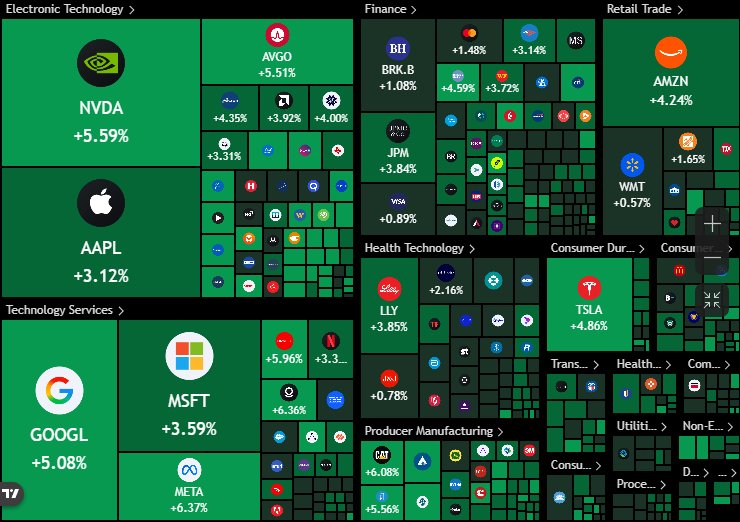
S&P 500 Surges 2.9%, Adding $1.7 Trillion in Market Value in Largest One-Day Gain Since 2025
The U.S. stock market roared to life on Tuesday, as the S&P 500 soared 2.9% to close at its highest level in over six months, adding an estimated $1.7 trillion in market capitalization. The rally marked the benchmark index’s strongest single-day gain since May 2025, fueling optimism that investor confidence may be stabilizing after months of volatility.
A Wave of Optimism Across Wall Street
Major indexes rallied sharply, with all 11 sectors of the S&P 500 posting gains. Technology and financials led the advance, driven by strong quarterly results from mega-cap firms and renewed hopes for a soft landing for the U.S. economy. The Dow Jones Industrial Average climbed more than 800 points, while the Nasdaq Composite jumped nearly 3.5%, reinforcing the view that appetite for risk assets is rebounding.
Traders and analysts pointed to several catalysts behind the surge: easing Treasury yields, resilience in corporate earnings, and growing speculation that the Federal Reserve may adopt a more dovish tone in its upcoming policy meetings. Inflation, while still above target, appears to be moderating on several key indicators, offering the Fed potential breathing room to pause or adjust its rate-tightening stance.
Breaking Down the Market’s Momentum
Tuesday’s rally was broad-based, with nearly 90% of S&P 500 constituents finishing higher. Tech giants such as Apple, Microsoft, and Nvidia all jumped to new monthly highs, buoyed by robust demand for artificial intelligence and cloud computing infrastructure. Financial institutions also gained, as slowing inflation expectations pushed investors away from defensive assets and back toward equities.
Energy and materials stocks benefited from a rebound in commodity prices, particularly oil, which rose to $83 per barrel amid signs of stronger global demand. Consumer discretionary shares, including major retailers and automakers, advanced amid improving sentiment about household spending power as wage growth outpaces inflation for the first time in nearly two years.
Historical Context: Echoes of 2025’s Rally
The last time the S&P 500 notched a gain of this magnitude was May 2025, when markets rallied in response to an unexpectedly strong corporate earnings season and early indications that inflationary pressures were easing. That surge marked the beginning of a short-lived recovery that was later tempered by renewed volatility in late 2025 amid geopolitical tensions and mixed economic data.
This week’s rebound carries a similar tone of cautious optimism. Investors, still mindful of last year’s turbulence, remain focused on whether this upturn represents the start of a sustained bull phase or a temporary relief rally. Historically, one-day spikes of this magnitude often precede shorter-term volatility but can signal a turning point when supported by improving fundamentals.
Federal Reserve and Economic Data in Focus
Much of the market’s trajectory now hinges on upcoming Federal Reserve communications and economic data releases. The next set of inflation readings, including the Consumer Price Index (CPI) and Producer Price Index (PPI), are expected to determine whether policymakers maintain their current interest rate levels or consider a shift toward easing later this year.
The Fed’s recent statements have emphasized data dependence and the need for patience in assessing the economic effects of prior rate hikes. Employment figures remain strong, and consumer spending continues to hold up despite higher borrowing costs — signs that the U.S. economy remains resilient. However, analysts caution that underlying risks such as rising commercial real estate vacancies, persistent budget deficits, and slowing global trade still pose challenges.
Regional Markets Reflect Broader Global Trends
The latest U.S. market rally had ripple effects across global markets. European equities opened higher Wednesday, tracking Wall Street’s upbeat momentum, with major indices in London, Frankfurt, and Paris all rising between 1% and 2%. Asian markets, including Japan’s Nikkei 225 and South Korea’s KOSPI, also saw gains as investors digested the improved sentiment from U.S. markets overnight.
In comparison, emerging markets showed mixed reactions. Some gained from the weakness in the U.S. dollar, which typically benefits developing economies by reducing debt-servicing costs, while others lagged due to lingering concerns about global trade headwinds and commodity price volatility. The synchronized uptick among developed markets suggests a cyclical rebound in global risk appetite not seen in several months.
Strength in Market Fundamentals
Market analysts attribute the latest surge not just to sentiment but also to strengthening fundamentals. Corporate earnings growth remains positive on a year-over-year basis for the first quarter of 2026, with sectors such as technology, industrials, and healthcare outperforming expectations. Capital expenditures are rising again after slowing through much of 2025, and consumer confidence has ticked upward, reflecting optimism around stable employment conditions.
Bond markets, too, played a crucial role in fueling the equity rebound. The yield on the 10-year Treasury note fell to 3.74%, down from 3.91% at the start of the day, easing pressure on growth stocks and signaling renewed investor demand for duration risk. Historically, falling yields have often preceded stronger equity performance, especially when driven by improved expectations for inflation moderation rather than fears of economic decline.
Investor Psychology Shifts Toward Optimism
After months of oscillation between fear and hope, market psychology appeared to shift more decisively toward optimism on Tuesday. The Chicago Board Options Exchange Volatility Index (VIX), often considered Wall Street’s “fear gauge,” dropped nearly 9% to its lowest level since August 2025. Lower volatility readings typically indicate that traders are more confident about near-term stability, though analysts warn that complacency can build quickly in such environments.
Several investment strategists described the rally as a “re-rating moment,” in which investors adjust their expectations for corporate profits and macroeconomic stability. As one portfolio manager noted, “The market is beginning to price in the possibility that we’ve reached the end of the tightening cycle — and that’s a meaningful psychological shift.”
Economic Impact: From Portfolios to Public Confidence
The $1.7 trillion increase in U.S. market capitalization translates into significant wealth effects for investors, pension funds, and retirement accounts. When stock values rise swiftly, consumer sentiment and discretionary spending often follow, reinforcing economic growth through a feedback loop of improved confidence. This dynamic helped fuel previous expansions in 2013, 2017, and 2021, when equity gains bolstered retail sales and home purchases.
Still, some economists caution that the wealth effect may take time to manifest broadly, as unequal distribution of stock ownership limits the direct benefit for most households. Moreover, rising asset valuations place renewed pressure on the Federal Reserve to balance financial stability with inflation containment. The central bank’s communications in coming weeks will be key to maintaining equilibrium between market enthusiasm and policy caution.
Comparisons With Global Indices
Globally, the S&P 500’s leap outpaced gains in most major markets. The STOXX Europe 600 rose 1.4%, while Japan’s Nikkei 225 gained 1.9%. China’s benchmark CSI 300, however, edged up only modestly as investors there grappled with sluggish property markets and mixed export data. Relative strength in U.S. equities underscores the perception that the American economy remains better positioned than many of its peers to weather high interest rates and shifting global demand.
Currency movements also reinforced that narrative. The U.S. dollar dipped slightly against major trading partners, reflecting expectations that the rate differential between the U.S. and other advanced economies may narrow later this year. In contrast, the euro and yen both strengthened modestly, providing some relief to import-heavy sectors overseas.
Outlook: Sustainable Recovery or Temporary Relief?
Whether Tuesday’s remarkable rally signals the start of a sustained upward trend or simply a short-term burst of optimism remains uncertain. Market historians note that powerful single-day gains often occur during periods of heightened volatility — sometimes preceding long-term recoveries, but at other times marking temporary pauses before renewed declines.
To sustain momentum, investors will be watching for confirmation from economic data that growth can persist without reigniting inflation. If earnings continue to exceed forecasts and inflation continues to moderate, the stage may be set for a more enduring rally through the second half of 2026.
Conclusion: A Turning Point in Sentiment
The S&P 500’s 2.9% surge and $1.7 trillion in added market value represent a striking display of renewed faith in the resilience of the U.S. economy. After a challenging year marked by uncertainty, Tuesday’s performance may stand as an inflection point — one where investors began to look forward rather than backward.
While risk factors remain, the day’s rally underscores the strength of market confidence and the enduring appeal of U.S. equities as a barometer for economic optimism. Whether this optimism evolves into a sustained recovery will depend on corporate performance, consumer resilience, and — more than ever — the next moves by the Federal Reserve.