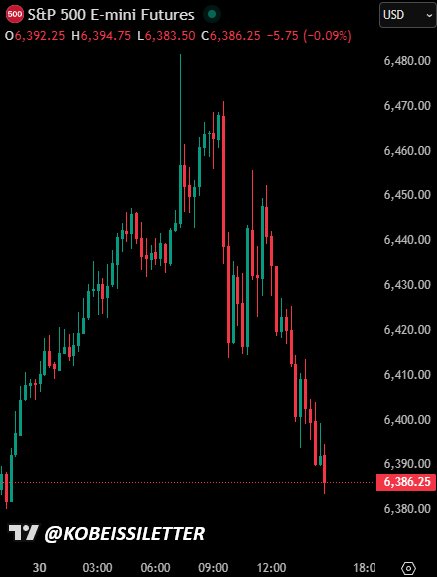
S&P 500 Futures Slide Over 100 Points as Investor Caution Rises Amid Geopolitical Tensions and Surging Oil Prices
S&P 500 futures erased early gains on Tuesday, reversing a strong pre-market rally and falling more than 100 points from session highs. After briefly climbing to 6,494 in overnight trading, the benchmark E-mini futures contract turned negative, last trading near 6,386.25 as investor sentiment soured. The abrupt reversal highlights growing unease in global markets, driven by escalating geopolitical tensions in the Middle East and renewed strength in crude oil prices.
Early Gains Fade as Risk Sentiment Deteriorates
Futures began the Asian and early European sessions on a strong note, buoyed by signs of stabilizing global demand and optimism surrounding upcoming U.S. economic data. However, momentum faded as energy prices surged once again, reigniting fears of inflationary pressures and tighter monetary conditions. Traders cited light trading volumes ahead of key economic announcements later in the week, which may have amplified market volatility.
The reversal mirrors a broader theme across financial markets this quarter — fragile optimism colliding with persistent macroeconomic headwinds. Since February, futures tied to the S&P 500 have struggled to hold onto gains as periodic recoveries have been undermined by external shocks, from fluctuating energy costs to unexpected central bank remarks.
Geopolitical Risks Rekindle Volatility
The latest downturn comes amid a renewed flare-up of tensions in the Middle East, where recent developments have raised concerns about supply disruptions and regional instability. Energy markets responded swiftly, pushing Brent crude above $98 per barrel for the first time in months. Higher oil prices, while buoying energy stocks, tend to weigh on broader equity indices by raising concerns over costs, inflation, and consumer spending potential.
Historically, spikes in crude oil prices have acted as a drag on U.S. equity markets. During prior geopolitical crises — such as the 1990 Gulf War or the 2019 drone strikes on Saudi oil facilities — sharp energy price increases were often followed by periods of market turbulence and weaker equity performance. Investors appear wary that a similar pattern could play out again, particularly after a year of resilient but uneven market growth.
Inflation Concerns Back in Focus
The volatility in futures underscores the market’s sensitivity to inflation risks. After months of steady progress on price stability, recent data showing sticky service-sector inflation has challenged forecasts that anticipated easier monetary conditions in 2026. Rising oil prices threaten to complicate that effort, potentially forcing the Federal Reserve to maintain higher rates for longer.
While Fed officials have maintained a cautious tone, futures markets have gradually trimmed expectations for the pace of rate cuts this year. As of Tuesday, traders were pricing in less than two full 25-basis-point reductions by year-end, down from earlier projections of three or more. The recalibration of policy expectations has weighed on equity valuations, particularly in interest-rate-sensitive sectors such as technology and real estate.
Historical Market Context
The S&P 500’s recent price action follows a familiar pattern in market history where sharp pre-market rallies have been quickly unwound by macroeconomic stress. Similar reversals were seen in 2008, 2020, and 2022, when optimism over economic resilience was overshadowed by systemic uncertainties. Analysts note that futures-driven market movements often precede wider corrections or adjustments in investor positioning, as traders reassess risk exposure ahead of new information.
In the context of the current cycle, the benchmark index has remained within striking distance of record highs set earlier in 2026. However, with valuations elevated and earnings expectations tightening, any catalyst — from geopolitical shocks to energy volatility — can trigger swift rotations out of risk assets. The futures market serves as an early warning signal of that shift.
Comparing Regional Market Trends
The cautious tone in U.S. futures echoed sentiment across global exchanges. European indices gave up morning gains as well, weighed down by energy inflation concerns and soft manufacturing data from Germany. In Asia, markets were mixed; Japan’s Nikkei 225 slipped modestly after a strong quarter, while Chinese equities managed small gains amid local stimulus hopes.
In contrast, commodity-linked markets outperformed. Energy producers in Australia and Canada benefited from higher crude prices, underscoring the divergence between resource-heavy and consumption-driven economies. Analysts observed that the recent turbulence in equity futures has been accompanied by renewed interest in hard assets such as gold, which extended its climb toward $2,200 per ounce — near all-time highs.
The Role of Oil and Energy Equities
Energy markets are once again proving central to global financial dynamics. With oil prices approaching $100 per barrel, investors are recalibrating portfolios to hedge against potential commodity shocks. U.S. energy majors saw pre-market gains as refiners and producers benefited from bullish crude demand projections, yet those moves were not enough to offset declines in broader market indices.
Over the past decade, the correlation between the S&P 500 and crude oil prices has fluctuated, often turning negative during extended periods of inflation anxiety. When oil prices climb too rapidly, equity markets typically treat it as a tax on growth. This dynamic tends to compress profit margins in consumer-facing sectors, dampen sentiment in retail and manufacturing, and increase pressure on central banks to stay restrictive.
Economic Impact and Market Implications
The drop in futures adds to uncertainty about the sustainability of the U.S. economic expansion. Despite robust employment and healthy corporate earnings, headwinds from higher borrowing costs and energy-driven inflation could restrain growth later this year. Economists warn that while output remains solid, demand-sensitive components of GDP — such as housing, durable goods, and consumer services — may experience renewed stress if inflation ticks higher.
A comparison with previous inflation peaks illustrates the risk. During the 1970s and early 1980s, persistent energy shocks caused a cycle of stagflation that forced the Federal Reserve into a prolonged tightening stance. Although conditions today are different, the structural parallels — rising energy prices, tight labor markets, and fragile geopolitical conditions — keep investors on alert for a similar scenario.
Market Outlook and Future Scenarios
Analysts believe the immediate path forward will hinge on upcoming economic releases, particularly data on inflation, employment, and consumer confidence. If oil prices continue to rise or geopolitical tensions escalate, futures could face further downward pressure. Conversely, any signs of diplomatic resolution or easing energy costs may help stabilize risk appetite.
For long-term investors, the recent volatility serves as a reminder of the market’s cyclical nature. Equity corrections after extended rallies are not uncommon, especially when valuations stretch beyond historical averages. Some strategists view the pullback in futures as a healthy consolidation phase rather than the start of a prolonged downturn, emphasizing that corporate fundamentals remain relatively solid across key sectors.
Broader Market Sentiment
Investor psychology has shifted noticeably over recent sessions. After months of steady gains, the sudden reversal in futures has rekindled caution across both retail and institutional channels. Traders report growing demand for defensive assets, such as Treasury bonds and safe-haven currencies, even as yields remain elevated. The U.S. dollar strengthened modestly against major peers on Tuesday, reflecting a broader flight to safety.
Volatility measures also ticked higher, with the CBOE Volatility Index (VIX) rising above 19 — its highest level in nearly a month. While not signaling full-blown panic, the uptick suggests investors are positioning for potential market swings in the near term.
Conclusion: Markets on Edge as Risks Mount
Tuesday’s retreat in S&P 500 futures underscores how swiftly sentiment can shift in an uncertain global landscape. The combination of geopolitical risk, energy price volatility, and recalibrated monetary expectations has created a complex environment where optimism remains tentative. Market participants now face a balancing act — weighing promising economic fundamentals against the persistent risks that come with elevated valuations and unpredictable external shocks.
As trading continues into the week, all eyes will be on the intersection of energy markets, central bank policy, and geopolitical developments. Whether this latest dip represents a short-term setback or the beginning of a broader recalibration remains to be seen, but one thing is clear: after months of relative calm, volatility has returned to the forefront of the global investment narrative.