Senate Control in Focus as 2026 Elections Approach: Markets Weigh the Odds and Impacts
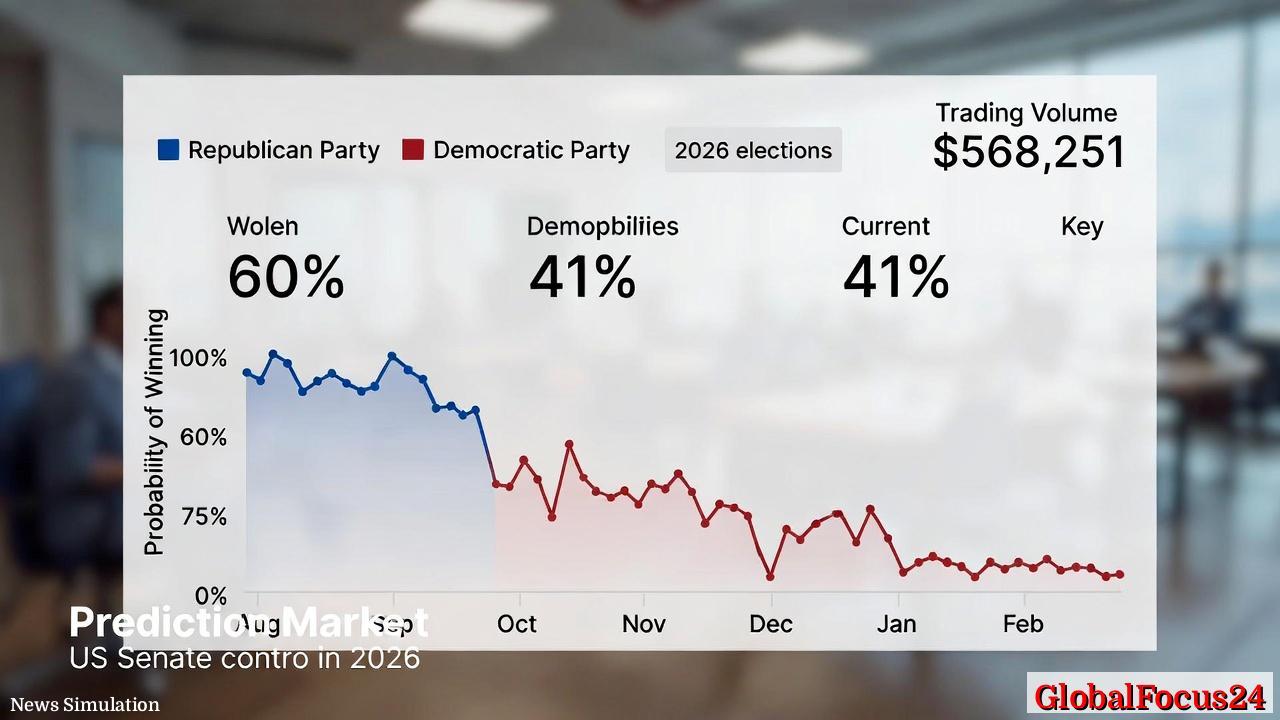
A pivotal moment in American politics approaches as analysts and investors monitor projections for control of the U.S. Senate in the 2026 elections. Prediction market data show the Republican Party with a 60% probability of winning control of the Senate, while the Democratic Party stands at 41%. The chart tracking probabilities from August through February reveals a shift: Republican odds started near the mid-70s percent range earlier in the cycle and have eased to the current level, while Democratic odds have risen in tandem. Trading activity on the market has grown, with volumes approaching $568,251, as participants assess likely post-election dynamics. The market resolves based on which party holds the Senate after the November 3, 2026 elections.
Historical context and the arc of Senate contests The Senate has long served as a barometer for national political mood, with control often hinging on a handful of competitive races and the broader alignment of party coalitions. Since the 20th century, cycles have shown that midterm dynamics, presidential endorsement echoes, and local issues at the state level can tilt the balance. In recent decades, the Senate has exhibited a degree of per-seat volatility, where a single competitive race can alter the chamber’s partisan composition and, by extension, the legislative calendar.
The 2026 cycle continues that tradition, featuring a mix of incumbents defending seats in states with evolving partisan loyalties, as well as open-seat battles where retirement or redistricting has introduced alternative candidate pools. Analysts track a constellation of factors: incumbency advantage in safe or swing-state environments, candidate quality and fundraising strength, statewide political climate, and national sentiment toward the governing party. While market probabilities convey a formal sense of likelihood, they also reflect collective judgments about how voters may respond to ongoing policy debates, economic conditions, and high-profile issues on the campaign trail.
Economic context and potential policy implications The economic backdrop entering the 2026 election includes a landscape shaped by inflation trends, labor market resilience, and a portfolio of fiscal and regulatory concerns that differ in emphasis between the two major parties. A Senate under any configuration will influence the trajectory of legislative priorities, from appropriations decisions to the confirmation of executive nominees and the trajectory of federal regulatory initiatives. Market participants watch for signals about potential shifts in tax policy, innovation incentives, energy policy, and healthcare reform—each with implications for business investment, consumer prices, and regional economic performance.
- Tax and spend considerations: Even with divided government dynamics, the Senate’s composition can affect the pace and depth of tax policy changes, infrastructure commitments, and targeted government programs. Regions with strong manufacturing bases, technology sectors, or energy hubs may assess how proposed reforms could alter cost structures, supply chains, and capital expenditure plans.
- Energy and climate policy: The balance of power can influence environmental regulations, permitting processes, and energy infrastructure projects. Regions dependent on fossil fuels or renewable energy development will be particularly attentive to any shifts in federal support or constraints that could affect job markets, project timelines, and investment risk.
- Healthcare and prescription pricing: Senate majorities can shape bipartisan or party-line approaches to healthcare policy, drug pricing, and Medicaid considerations. The economic ripple effects extend to insurers, healthcare providers, and pharmaceutical innovators, with regional variability based on state adoption of programs and local demand.
Regional comparisons and how different parts of the country may experience the election’s effects Across the United States, the impact of Senate control is not uniform. Economic structures, demographic trends, and local policy priorities create distinct responses to federal policy signals.
- Northeast and Midwest: These regions have dense urban economies, advanced manufacturing, and substantial public-sector employment. Voter concerns often center on healthcare access, infrastructure quality, and consumer protections. A Senate with varied priorities could influence funding for transit projects, clean energy initiatives, and urban resiliency programs, affecting city budgets and private investment plans.
- South and Mountain West: Energy development, higher education ecosystems, and small-to-mid-sized metro areas shape regional priorities. Federal policy on energy production, permitting timelines, and research funding can directly affect job growth in energy, aerospace, and technology sectors. Market watchers pay close attention to how a potential shift in Senate control could alter the pace of infrastructure spending and regional competitiveness.
- West Coast: Innovation-driven economies, substantial venture activity, and environmental policy emphasis create a unique set of expectations. Federal support for research funding, semiconductor manufacturing, and climate resilience measures can influence regional investment, talent pipelines, and housing-market dynamics in several major markets.
Public reaction and the broader political narrative Public sentiment around a potential Senate outcome often blends pragmatism with partisan storytelling. Voters and community leaders weigh how a chamber aligned with or against the executive branch’s agenda could affect daily life, from the stability of healthcare premiums to the speed of highway and port upgrades. In some states, voters view the election as a referendum on economic stewardship, while in others the focus centers on social or regulatory issues. The public reaction in campaign hubs and regional capitals tends to blend concern with cautious optimism about economic opportunity and long-term growth.
Structural factors influencing predictability Several structural realities shape the predictability of Senate outcomes:
- Incumbency dynamics: Incumbent senators often benefit from name recognition and established fundraising networks, but challengers can capitalize on shifts in party sentiment or dissatisfaction with national leadership.
- State-level climate: Some states exhibit resilient partisan loyalties, while others are battlegrounds where slight margins in polling can translate into substantial seat changes on election night.
- Electoral cadence: The timing of primaries, debates, and candidate announcements interacts with early voting trends, mail-in ballots, and turnout forecasts to shape final results.
- Fundraising and outside spending: The magnitude and distribution of campaign spending can influence voter outreach, outreach efficiency, and issue framing, particularly in tight races.
Implications for markets and policy planning Investors and policymakers closely watch Senate dynamics because the chamber’s balance can alter the timing and content of policy initiatives. Businesses may adjust capital allocation plans, supply chain diversification, and hiring strategies in response to anticipated regulatory certainty or volatility. Local governments consider how federal appropriations and programmatic funding might be affected by the chamber’s composition, influencing municipal finance and project prioritization.
- Corporate strategy: Companies in sectors sensitive to federal policy—such as healthcare, energy, infrastructure, and technology—often review legislative calendars and potential committee chairmanships to gauge regulatory risk and grant opportunities.
- Regional development: Regions poised to benefit from federal investment in infrastructure or research may intensify lobbying and grant-seeking efforts as electoral outcomes clarify funding pathways.
- Risk management: Financial markets incorporate Senate composition into risk models, particularly when paired with presidential policy signals, to assess probabilities of policy shifts that could impact interest rates, inflation, and growth trajectories.
Looking ahead: what to watch in the weeks before Election Day As voters head toward the November 2026 ballot, several indicators will help observers gauge how the Senate race may unfold:
- Polling trajectories: Changes in statewide polls, especially in swing districts or states with historically close margins, can signal shifts in the broader national mood.
- Debate performance and issue saliency: How candidates frame policy priorities during televised debates and town halls often influences voter consideration in the final stretch.
- Fundraising momentum: The capacity to mobilize donors and grassroots networks can translate into turnout, canvassing presence, and outreach efficiency in key jurisdictions.
- Early voting patterns: Early ballots can provide early signal of turnout dynamics and party enthusiasm levels, shaping post-election analysis and confidence in final results.
A cautious lens on forecast limitations Forecasts for political outcomes, including Senate control, involve inherent uncertainty. Prediction markets, polling, and political analysis each offer probabilistic insights rather than definitive predictions. Voter turnout, last-minute endorsements, or unforeseen events can shift trajectories rapidly. Stakeholders should view market probabilities as one input among many, useful for framing potential scenarios and risk assessment rather than as a guaranteed forecast.
Conclusion: the 2026 Senate landscape and its broader significance The ongoing assessment of Senate control in the 2026 elections underscores the deep link between federal governance and regional economies. As market participants interpret probabilities and weigh the potential policy shifts associated with either party’s predominance, communities across the country watch closely. The outcome will influence the pace of legislative action, the direction of regulatory frameworks, and the strategic planning of businesses and governments alike. In this climate, observed market signals, historical precedent, and region-specific economic conditions together illuminate a dynamic and consequential electoral season that will shape the policy environment for years to come.