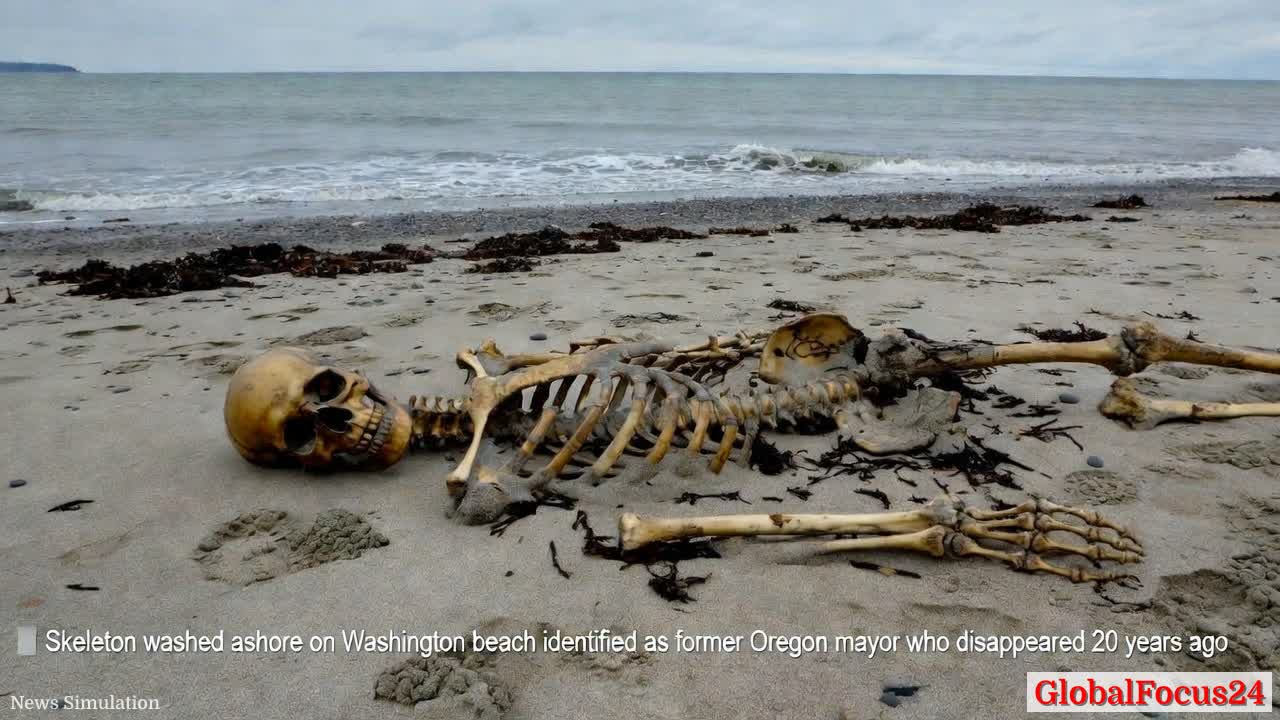
Human Remains Found on Washington Beach Identified as Missing Oregon Mayor After Two Decades
Long-Missing Oregon Official Identified Through Modern Forensic Advances
After twenty years of uncertainty, investigators have confirmed that human remains discovered on a Washington State beach belong to a former mayor from Fossil, Oregon, who vanished without a trace two decades ago. The identification, made possible by advancements in forensic DNA technology, has finally brought closure to the mystery surrounding the disappearance and to the family that has waited years for answers.
The skeletal remains, discovered in September 2006 along a stretch of coastline in southwest Washington, were initially cataloged as unidentified due to the lack of viable leads. Despite extensive early efforts, investigators were unable to discern the individual’s identity, and the case remained dormant in local archives for years.
Now, the man’s name — long absent from police reports but remembered in the Fossil community — is once again part of public record. His identification has rekindled memories of the small-town leader and cast new attention on how modern forensic innovations are resolving cold cases once thought unsolvable.
Discovery and Early Investigation
The remains were first found by a beachgoer walking near the mouth of the Columbia River in Pacific County, Washington. At the time, the scene revealed only scattered skeletal fragments consistent with prolonged exposure to coastal conditions. Investigators could not immediately determine whether foul play had been involved, and efforts to match the remains to missing persons across Oregon and Washington proved inconclusive.
The case, like many similar coastal discoveries of the mid-2000s, soon grew cold as forensic technology at the time offered limited tools for identifying remains exposed to the elements. Dental and skeletal analysis yielded potential demographic clues but no firm match to any known missing individuals.
Local authorities eventually preserved DNA samples with the hope that future technology might bring clarity—a prescient decision that ultimately made the new identification possible.
The Disappearance of a Small-Town Mayor
The former mayor, whose public service made him a well-known figure in Fossil, Oregon, had vanished abruptly twenty years before the positive identification was announced. Fossil, a rural community in north-central Oregon known for its prehistoric fossil beds and close-knit population, was shaken when the mayor failed to return home one evening in the early 2000s.
According to historical accounts, extensive searches across Wheeler County and surrounding areas yielded no trace of him or his belongings. The mystery deepened over time, with residents divided between theories of an accident, voluntary disappearance, or possible wrongdoing. Law enforcement records from that period describe the investigation as one of the longest in county memory, encompassing hundreds of hours of searches by volunteers and local deputies.
The case eventually went cold when no physical evidence surfaced. For two decades, the disappearance of the former Fossil mayor was remembered in local conversation as one of Oregon’s enduring small-town mysteries.
Technological Breakthrough in Forensic Identification
The confirmation of the remains’ identity comes as part of a broader wave of forensic breakthroughs made possible by advanced DNA comparison methods. Modern techniques, including autosomal DNA sequencing and genealogy-based matching, have transformed the landscape of cold case investigations across the United States.
In the Fossil mayor’s case, forensic specialists working in collaboration with Washington’s Missing and Unidentified Persons Unit reanalyzed preserved biological samples and compared them to DNA from surviving relatives. The match was confirmed within months, after twenty years of ambiguity.
This process mirrors similar successes across the region. Oregon and Washington law enforcement agencies have increasingly turned to advanced DNA technologies to identify long-unclaimed remains. In Oregon alone, several missing person cases from the 1980s and 1990s have recently been solved through genetic genealogy, underscoring both the scientific progress and emotional consequences of such breakthroughs.
Family and Community Response
Following confirmation of the identification, authorities contacted the late mayor’s family to share the news. While the announcement revived painful memories, relatives expressed gratitude for the closure after so many years of silence. Local officials in Wheeler County acknowledged the recovery as an emotional milestone for a community that had long wondered about the fate of one of its civic leaders.
Residents from Fossil and neighboring towns have recalled the mayor as a devoted local figure who encouraged tourism, supported small businesses, and worked to preserve Fossil’s heritage as a historical destination. For many, the news has prompted reflection on the fragility of memory and the importance of preserving local history.
Community leaders have indicated that a small memorial or commemoration may be planned in Fossil to honor the late mayor and to recognize the eventual resolution of the town’s longest unsolved mystery.
Broader Context: Coastal Discovery and Identification Challenges
The Pacific Northwest coastline has a history of mysteries tied to its rugged geography. Each year, authorities along Washington and Oregon beaches handle dozens of cases involving unidentified remains. Factors such as ocean currents, erosion, and wildlife activity often complicate efforts to determine where remains originated or how the individuals died.
In the early 2000s, before widespread access to high-resolution DNA technology, many of these cases went unresolved. Over time, however, regional law enforcement agencies began consolidating unidentified persons databases and partnering with academic and private laboratories specializing in cold case analysis.
That collaboration has led to measurable progress. Between 2020 and 2025, more than fifty cases in the Pacific Northwest involving unidentified remains were successfully linked to missing persons, according to state forensic reports. These successes not only clear long-standing caseloads but also restore identity to the deceased—an act investigators describe as vital to both families and civic history.
Historical Echoes and Changing Investigative Methods
Historically, the forensic field has undergone profound changes since the early 2000s. When the Fossil mayor disappeared, DNA databases were still relatively small, and inter-state cooperation among law enforcement agencies was slower than today’s digital networks allow. The simple preservation of evidence for potential future analysis was, in many cases, the only proactive step feasible for investigators.
The re-examination of archived remains decades later showcases how far technology has come. Modern forensic teams use methods that can extract genetic material from degraded bone fragments and link that data to family trees through publicly available genealogical information.
In this case, the cross-jurisdictional communication between Oregon and Washington authorities proved decisive. It reflects a growing trend in cold case resolution, where state and local agencies combine historic recordkeeping with twenty-first-century analytics to restore forgotten identities.
Economic and Social Impact on Rural Communities
Beyond the scientific achievement, cases like this carry important social and emotional weight for rural communities such as Fossil. In small towns where each resident is widely known, the disappearance of a civic leader leaves a long shadow. The uncertainty surrounding such losses can affect community morale and even local governance, as leadership transitions occur under unresolved circumstances.
Economically, Oregon’s rural municipalities often depend on heritage tourism and cultural continuity. The closing of a decades-old mystery can renew local attention and encourage efforts to preserve historical narratives that define the town. In Fossil’s case, the renewed public interest serves as a reminder of its storied past and the resilience of its people.
Regional analysts note that such identification cases may also strengthen public trust in law enforcement. When detectives demonstrate persistence and transparency in long-term investigations, community members are more likely to engage in civic processes and assist in future cases.
Regional Comparisons and Future Prospects
The successful identification aligns with a pattern seen across the Pacific Northwest, where updates in forensic capabilities are transforming old investigations. Washington State, in particular, has invested heavily in its crime laboratory infrastructure, upgrading tools for genetic sequencing and developing partnerships with national forensic databases. Neighboring Oregon has followed suit, creating coordinated systems for cross-border missing persons comparisons.
Other regional examples, such as recent identifications in coastal Tillamook County and in Oregon’s Deschutes River Canyon area, show similar timelines: decades of uncertainty followed by breakthroughs thanks to DNA matching. Each instance reinforces the message that persistence, paired with evolving technology, can eventually solve even the most challenging mysteries.
As technology continues to improve, law enforcement agencies expect to resolve many more historical cases. The identification of the Fossil mayor’s remains stands not only as a personal resolution for one family but also as a broader symbol of how science and determination can restore the missing chapters of human stories lost to time.
A Measure of Closure
With confirmation now public, the case of the missing Fossil mayor concludes after twenty years of uncertainty and two decades of questions. While investigators have not disclosed whether foul play was involved, the identification itself is a meaningful end to a long search.
For the town of Fossil and the broader Pacific Northwest community, the resolution brings both relief and reflection. It closes a lingering wound in local history and highlights the transformative potential of modern forensic science to reconnect the past with the present — one long-lost identity at a time.