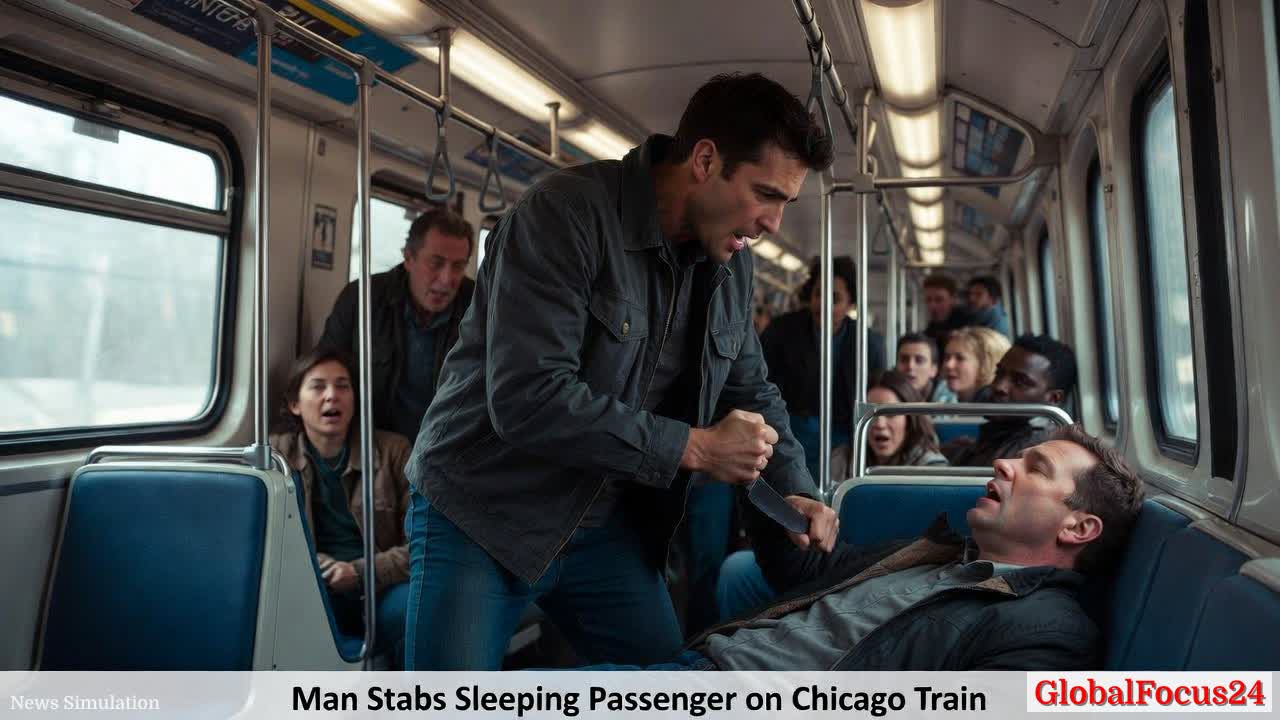
Man Recorded Himself Fatally Stabbing Sleeping Passenger on Chicago’s Blue Line Train
Shocking Blue Line Attack Raises New Concerns About Transit Safety
A 40-year-old man is accused of recording himself fatally stabbing a sleeping passenger aboard a Chicago Transit Authority (CTA) Blue Line train early Saturday morning, in what prosecutors described as a “brutal and senseless” attack. The victim, identified as 37-year-old Dominique Pollion, was found bleeding in his seat after the assailant fled the train. The incident marks another violent episode on the same train line where, just two months earlier, a woman was set on fire in an unrelated attack — intensifying calls for urgent safety reforms on Chicago’s public transit system.
The Attack and Its Capture on Video
According to court documents, the suspect, Demetrius Thurman, boarded the Blue Line around 2:00 a.m. holding a smartphone and a knife. Surveillance footage and recovered videos indicate that Thurman appeared to begin recording moments before approaching Pollion, who was asleep in his seat. Prosecutors say Thurman stabbed Pollion multiple times in the chest and abdomen while continuing to film.
As Pollion woke up in pain and tried to move away, Thurman allegedly followed, switching his phone to selfie mode as the victim collapsed. The horrifying scene reportedly played out in near silence inside the nearly empty railcar, save for the sounds of the train passing through underground stations in the early morning hours.
When the Blue Line train arrived at the Clark/Lake station, a passenger found Pollion unresponsive and alerted transit security. Officers and first responders initially struggled to identify the extent of Pollion’s injuries because he was wearing several layers of clothing. Paramedics took him to Northwestern Memorial Hospital, where he was pronounced dead shortly after arrival.
A Swift Arrest Following Digital Trail
Investigators used surveillance video and facial recognition technology to identify Thurman, who was located and taken into custody the following day along Canal Street. At the time of his arrest, prosecutors said he was wearing the same clothing seen in the videos. A search warrant executed on his phone revealed the footage of the attack, including clips recorded before and after the stabbing, as well as a separate video of Thurman allegedly commenting on the incident while standing on the station platform.
In one disturbing moment, authorities say the suspect can be heard saying, “Somebody got his ass,” referencing Pollion after leaving the scene. Police also noted that Thurman had a documented history of mental health issues, though his exact diagnosis has not been made public. He now faces a charge of first-degree murder and remains held without bond pending a February 3 court appearance.
The Recent History of Violence on the Blue Line
This killing comes just two months after another harrowing event on the same transit line. In November, commuter Bethany MaGee, 26, was attacked with gasoline and set on fire at the very same Clark/Lake station. She suffered life-threatening burns over more than 60% of her body. That case prompted widespread outrage and renewed scrutiny of CTA’s safety record.
The Blue Line, one of Chicago’s busiest rail routes, stretches from O’Hare International Airport through downtown and into the city’s western neighborhoods. It operates 24 hours a day, serving thousands of riders who depend on it for overnight travel. But recent years have seen a marked increase in violent crimes on the system, including robberies, assaults, and vandalism, leading some commuters to express growing fear about riding alone at night.
A System Under Pressure
The Chicago Transit Authority has struggled to balance public expectations for safety with the practical realities of staffing and surveillance. Since 2020, transit ridership across major U.S. cities has fluctuated sharply due to the pandemic, altering patrol patterns and resource allocation. Chicago’s rail network, which covers more than 100 miles of track, has required added security while simultaneously contending with operator shortages and budget constraints.
In response to mounting criticism, the CTA has partnered with the Chicago Police Department (CPD) to deploy additional officers and unarmed security contractors across multiple lines. Cameras now cover nearly the entire rail system, but law enforcement officials admit that surveillance alone cannot prevent incidents from unfolding. Officials say they are seeking long-term solutions that integrate community engagement, social services, and visible patrols to deter violent behavior before it escalates.
Mental Health and Urban Transit Crimes
Authorities have reported that many serious transit-related crimes in recent months have involved suspects suffering from untreated mental illness. The Blue Line case appears to fit that troubling pattern. Experts note that public transportation often becomes an intersection point for individuals experiencing homelessness, addiction, or psychological distress, complicating both safety and policy responses.
Mental health advocates urge investment in crisis intervention teams and improved access to treatment rather than relying solely on policing. Yet, for many Chicagoans, the focus remains on the immediate need for physical security and peace of mind when riding to work or school. The attack on Pollion has intensified the debate over whether the city is doing enough to make the CTA system safe for all passengers.
Public Reaction and Fear Among Riders
The news of Pollion’s death has reverberated through Chicago’s neighborhoods and commuter communities. Riders have described feelings of fear and frustration, citing a perceived erosion of safety since the pandemic. On social media, many shared horror at the details of the video evidence, while others questioned how a person wielding a knife could move so freely through a late-night train without being stopped.
Local advocacy groups are pressing city officials and the CTA board for immediate reforms, including better staffing of security personnel during overnight hours, improved communication systems for emergencies, and stronger collaboration between mental health professionals and transit officers.
Comparisons Across Major U.S. Transit Systems
Violence and disorder on public transit are not unique to Chicago. Other major U.S. cities — including New York, Los Angeles, and San Francisco — have faced similar challenges as economic hardship, housing instability, and post-pandemic behavioral shifts strain urban infrastructure.
In New York City, for instance, police reported a surge in subway assaults between 2021 and 2023, prompting Gov. Kathy Hochul to authorize the deployment of state troopers and the National Guard to the system in 2024. Los Angeles has shifted to a “community policing” model for its Metro lines, emphasizing outreach programs for vulnerable passengers. San Francisco’s Bay Area Rapid Transit (BART) system has also invested heavily in surveillance technology and staff training after experiencing multiple violent incidents in 2022 and 2023.
These comparisons underscore a broader national trend: transit crime remains a persistent issue even as cities rebound economically. The emotional toll on riders often exceeds the statistical risk, making public confidence as important a measure of success as crime rates themselves.
Economic and Civic Implications
Public transit safety has far-reaching economic consequences. Chicago’s downtown recovery depends heavily on the perception that commuting is safe and reliable. Businesses rely on employees and customers using the CTA to reach offices, restaurants, and entertainment venues. Persistent crime can weaken that foundation, discouraging tourism, diminishing ridership, and reducing fare revenue that supports system maintenance.
The federal government has recently intensified oversight of local transit agencies. Chicago faces a deadline to demonstrate progress in safety enforcement or risk reductions in federal funding. The threat of financial penalties has spurred new policy conversations at City Hall about sustainable ways to secure the network without overextending police resources.
Looking Ahead: Balancing Safety and Accessibility
As the case against Thurman proceeds, the tragedy is forcing public officials to confront difficult questions about responsibility and prevention. Chicago’s mayor and transportation leaders have pledged to expand security staffing and incorporate real-time video analytics to aid faster responses to incidents.
Still, for many commuters, the urgency lies not in policy announcements but in visible change. Riders say they want to see more patrol officers, cleaner stations, and faster emergency communication when crimes occur. Transportation analysts argue that restoring confidence will require not only security improvements but also addressing the social conditions that give rise to such violence in the first place.
As investigators continue to review the digital evidence that captured Dominique Pollion’s final moments, the attack has become a stark symbol of urban vulnerability — a reminder that even in bustling transit hubs, safety can never be taken for granted. Chicago now faces a pivotal test of how swiftly and effectively a major city can rebuild trust in one of its most vital public systems.