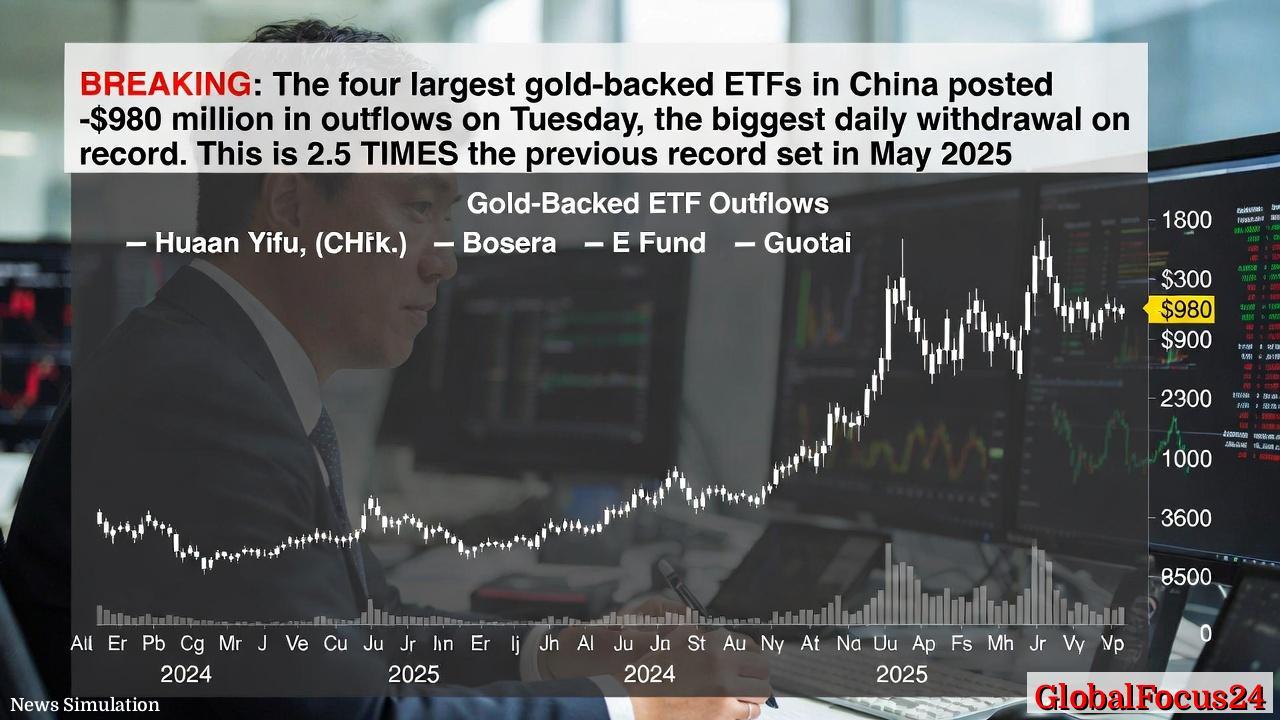
China Gold ETFs See Record Outflows Amid Global Market Volatility
A sharp retreat swept through China's gold exchange-traded funds (ETFs) as investors pulled funds at a pace not seen in the product’s history, signaling a sudden shift in risk sentiment and portfolio strategy after a period of elevated volatility in global markets. The four largest Chinese gold ETFs—Huaan Yifu, Bosera, E Fund, and Guotai—registered unprecedented daily withdrawals that eclipsed all prior records, underscoring how a rout in asset prices can ripple through even traditionally defensive assets like gold.
Historical backdrop: gold as a barometer of risk Gold has long served as a barometer of investor risk appetite. In periods of stress or uncertainty, investors typically flock to gold as a store of value or as a hedge against inflation and currency weakness. The recent outflow from major Chinese gold ETFs stands in contrast to this longstanding tendency. Historically, daily fund flows for these products tended to hover near neutral levels, with occasional inflows during episodic market stress or geopolitical tension in 2024 and 2025. The current episode suggests a reassessment of tactical allocations among domestic investors, with some turning away from bullion-focused strategies in favor of alternative exposures or liquidity preservation, even within a traditionally defensive asset class.
Market dynamics driving the shift Several interconnected factors appear to have converged to drive the outflows:
- Short-term volatility and price action: After a period marked by elevated volatility across global financial markets, traders and fund managers reassessed risk positions. Rapid price swings can amplify outflows as momentum-based funds rebalance and as investors seek to reduce exposure to assets perceived as sensitive to macro surprises.
- Liquidity considerations: In uneasy markets, investors may prioritize liquidity. Gold ETFs, while accessible, can still face redemption pressures and counterparty risk concerns that prompt redemptions during stressed periods.
- Alternative hedges and yields: As yields on other asset classes fluctuated with monetary policy expectations, some investors rotated away from gold ETFs toward assets offering tangible carry or higher liquidity, such as high-quality bonds or cash equivalents. This rotation can manifest as broad-based outflows from bullion-linked products.
- Domestic policy and macro context: Within China, policy signals and macro indicators—ranging from inflation readings to consumer demand and import data—shape appetite for precious metals. The latest outflows may reflect a reassessment of gold’s role in diversified portfolios under evolving domestic monetary and fiscal conditions.
Regional comparisons: how China’s gold ETF flows compare with peers China’s experience contrasts with several regional patterns observed in prior years:
- In many leading markets, gold ETF inflows have tended to spike during episodes of global risk aversion or currency weakness, serving as a hedge against equity volatility. The current outflow in Chinese listings underscores how domestic investors may react differently than global peers when macro conditions shift.
- Among Asian markets, other gold-focused vehicles also responded to a blend of macro cues, though the magnitude of the Chinese outflows suggests unique pressures within China’s asset-management ecosystem, including fund-structuring, liquidity preferences, and investor base composition.
- Globally, the phenomenon highlights the evolving role of gold ETFs as tactical rather than structural hedges in some periods, with flows sensitive to risk-on/risk-off cycles rather than a fixed narrative around gold’s safe-haven status.
Economic implications: what the withdrawals signal for markets and investors The outflows from China’s four largest gold ETFs carry several implications for market structure and investor behavior:
- Investment strategy adjustment: The move points to a broader recalibration of risk budgets among institutional and retail investors. When core hedges are sold, portfolios may become more exposed to equity and commodity cycles, potentially increasing volatility in related markets.
- Liquidity and market depth: Large-scale outflows can tighten liquidity in the underlying ETF share classes and affect the ease with which investors can execute trades. Market participants may watch liquidity metrics closely in the days ahead as redemption pressures unfold.
- Gold’s price correlation: The demand shift could influence short-term price dynamics for physical gold and futures, depending on how the outflows interact with physical-market demand, jewelry consumption, and industrial usage—factors that can modulate price trajectories beyond pure financial flows.
- Regional policy considerations: As policymakers monitor capital flows and risk management within the domestic financial system, sustained outflows from popular hedging vehicles can influence regulatory perspectives on product design, liquidity requirements, and investor protection measures.
What investors should watch next For market participants and observers, several indicators and developments will help gauge the trajectory of flows and the implications for asset allocation:
- Flow tracking for major Chinese gold ETFs: Daily and weekly data will illuminate whether the outflows were an outlier or part of a broader trend. An uptick in inflows after a period of volatility could signal a stabilization phase.
- Price action in gold and related instruments: Short-term volatility in gold prices, along with movements in bullion futures, will offer clues about how demand dynamics are shifting in response to the outflows.
- Macro and policy signals: Key Chinese macro indicators, inflation data, and ongoing policy guidance will shape expectations for gold’s role as a hedge or diversification tool in Chinese portfolios.
- Cross-asset correlations: Analysts will likely assess how gold ETF flows correlated with equity, bond, and currency markets during the rout to understand broader risk sentiment shifts.
Regional diversification and investor behavior The current episode highlights the continuing importance of diversification strategies across regions and asset classes. While gold has historically functioned as a defensive instrument, market conditions can alter its attractiveness. For some investors, a broader mix of hedges—including commodities, real assets, and currency exposure—may better weather sessions of heightened volatility. In addition, the importance of liquidity risk management within ETF structures remains front and center, especially when large holders decide to exit a fund rapidly.
Historical context: tracing the evolution of China’s gold market China’s gold market has undergone rapid growth and transformation over the past decade. The nation has developed a sophisticated ecosystem for precious metals, ranging from refined supply chains to retail and institutional demand. The proliferation of gold-backed investment products reflects a broader trend toward accessible, exchange-traded exposures that allow a wide range of investors to participate in metallic price movements. The latest outflows must be interpreted within this broader arc of market development, where investor behavior can swing between cautious hedging and opportunistic trading as markets evolve.
Implications for regional benchmarks and comparisons As investors and analysts evaluate the broader regional landscape, China’s experience with gold ETF outflows may prompt a re-examination of how regional benchmarks capture hedging demand and risk tolerance. Comparisons with neighboring markets can shed light on whether similar patterns emerge under parallel macro shocks or if structural differences in fund wallets, distribution networks, and retail participation drive divergent outcomes. The ability of regional indices to reflect real-time risk sentiment will continue to be tested as flows unfold.
Conclusion: a moment of recalibration for bullion exposure The record outflows from China’s leading gold ETFs mark a notable moment in the ongoing evolution of how investors manage risk in a dynamic global landscape. While gold remains a foundational element of many diversified portfolios, the current environment—characterized by volatility, liquidity considerations, and shifting macro signals—illustrates that even traditional hedges can experience rapid reevaluation. As the market digests these developments, observers will monitor whether flows stabilize, whether gold prices find a new equilibrium, and how Chinese investors reconfigure their approach to hedging and diversification in the months ahead.