Record $64 Billion Outflows from SPY and QQQ ETFs Signal Historic Shift in Investor Behavior
Unprecedented Capital Flight from Major Index ETFs
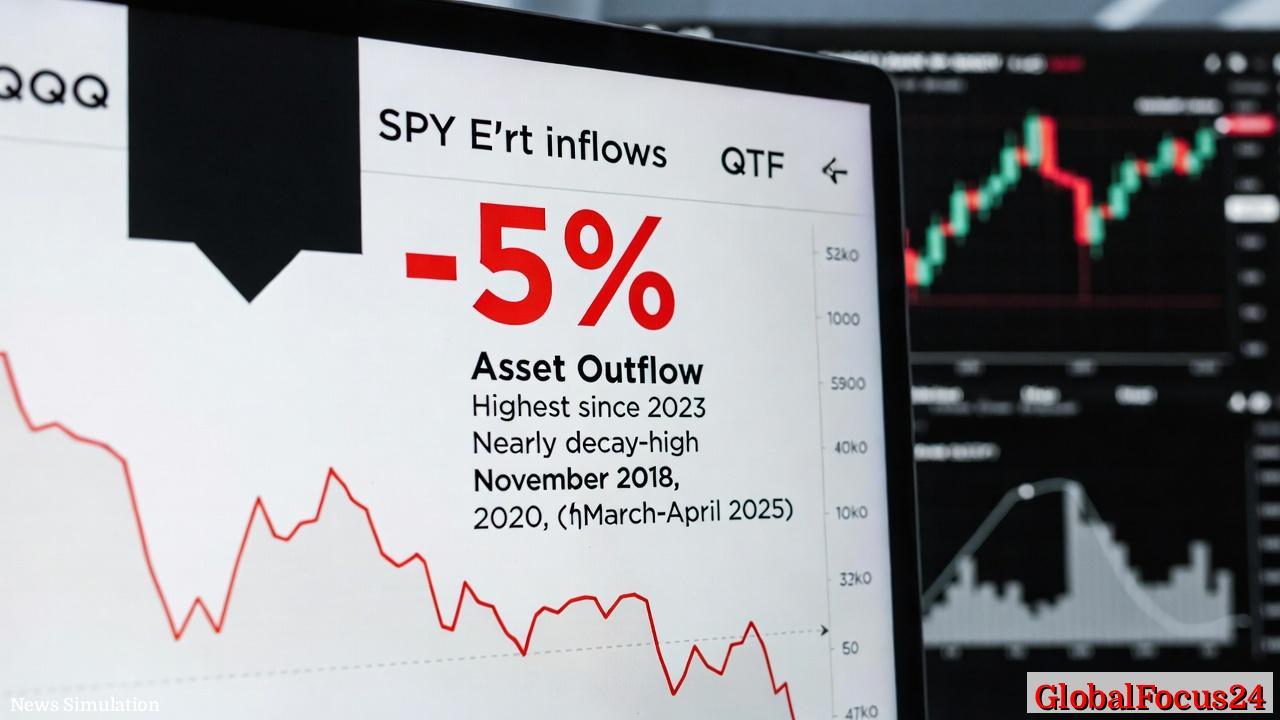
A historic wave of investor withdrawals has swept through two of the largest exchange-traded funds in the United States, with the SPDR S&P 500 ETF (SPY) and the Invesco QQQ Trust (QQQ) recording a combined $64 billion in outflows over the past three months. The magnitude of the pullback marks the largest capital exodus ever recorded for the pair, underscoring a sharp reversal in market sentiment.
The withdrawals follow a period of strong inflows totaling approximately $50 billion during the three months ending in November, highlighting a dramatic shift in investor positioning within a relatively short timeframe. Market participants, once eager to maintain exposure to large-cap U.S. equities and technology-driven growth stocks, are now increasingly retreating to the sidelines.
The scale of the outflows is notable not only in absolute terms but also relative to historical benchmarks. The recent $64 billion withdrawal nearly doubles the previous decade-high recorded in 2018 and exceeds the capital flight seen during periods of acute market stress, including the early 2020 pandemic-driven sell-off and the volatility experienced in March and April 2025.
Percentage Declines Highlight Broad-Based Exit
Measured as a share of assets under management, the three-month outflow reached approximately 5 percent, the highest level since the first quarter of 2023. While this remains below the peak of 8 percent recorded in April 2018, the current pace of withdrawals signals a widespread reassessment of risk among institutional and retail investors alike.
Such percentage-based metrics are critical for understanding the depth of investor sentiment. While large absolute figures can reflect the sheer size of modern ETFs, proportional declines reveal how aggressively investors are reallocating capital. The current trend suggests not merely profit-taking, but a broader repositioning away from equity-heavy portfolios.
Historical Context: From Passive Boom to Strategic Retreat
SPY and QQQ have long been pillars of the passive investing revolution, offering low-cost, liquid exposure to the S&P 500 and Nasdaq-100 indices, respectively. Over the past two decades, these funds have attracted trillions in capital, fueled by a combination of strong equity performance, low interest rates, and the growing popularity of index-based strategies.
The 2010s were particularly transformative, as investors increasingly shifted away from actively managed funds toward ETFs. SPY, launched in 1993, became one of the most traded securities in the world, while QQQ emerged as a preferred vehicle for gaining exposure to high-growth technology companies.
However, periods of large outflows have historically coincided with moments of macroeconomic uncertainty or market recalibration. In 2018, for instance, rising interest rates and trade tensions triggered a sharp pullback in equities, leading to significant ETF withdrawals. Similarly, the early months of the COVID-19 pandemic in 2020 saw investors rapidly exit risk assets amid global economic disruption.
The current episode, while not tied to a singular shock event of comparable magnitude, reflects a confluence of factors that are reshaping investor expectations.
Drivers Behind the Current Outflows
Several key forces appear to be contributing to the recent surge in ETF withdrawals:
- Elevated market valuations following extended equity rallies, particularly in large-cap technology stocks.
- Shifting interest rate expectations, which have altered the relative attractiveness of equities versus fixed-income assets.
- Increased market volatility, prompting risk-averse investors to reduce exposure.
- Portfolio rebalancing after significant gains in U.S. equities over the past year.
- Growing interest in alternative asset classes, including commodities, cash equivalents, and international equities.
The Nasdaq-100, heavily weighted toward technology and growth companies, has been especially sensitive to changes in interest rate outlooks. Higher rates tend to compress valuations for growth stocks by increasing discount rates applied to future earnings. As a result, QQQ has been particularly exposed to shifts in monetary policy expectations.
SPY, while more diversified, has also faced pressure as investors reassess earnings growth prospects across sectors.
Economic Implications and Market Impact
The scale of the outflows carries meaningful implications for financial markets and the broader economy. Large ETF withdrawals can contribute to increased market volatility, particularly when they coincide with reduced liquidity or concentrated selling in heavily weighted stocks.
Because SPY and QQQ track major indices, sustained outflows can amplify price movements in underlying securities. This dynamic is especially relevant in today’s market, where passive investing plays a dominant role in price discovery.
Additionally, the shift away from equities may signal broader concerns about economic growth, corporate earnings, or financial conditions. While the withdrawals themselves do not directly cause economic slowdowns, they can reflect and reinforce changing investor expectations.
From a capital allocation perspective, the movement of funds into safer assets such as Treasury securities or money market funds can influence interest rates and credit conditions. Increased demand for fixed-income instruments may help lower yields, while reduced equity investment can impact corporate financing and expansion plans.
Comparison with Global Markets
The trend observed in U.S.-focused ETFs contrasts with developments in certain international markets, where investor flows have been more mixed. In Europe, for example, equity funds have seen relatively stable flows, supported by lower valuations and differing monetary policy trajectories.
In emerging markets, capital flows have been influenced by currency dynamics, geopolitical considerations, and commodity price movements. Some regions have experienced inflows as investors seek diversification away from U.S. assets, while others have faced outflows due to local economic challenges.
The divergence highlights the global nature of capital markets and the role of regional factors in shaping investment decisions. While SPY and QQQ remain central to global portfolios, their recent outflows suggest a recalibration of U.S. equity exposure within a broader international context.
Retail vs Institutional Behavior
Both retail and institutional investors have contributed to the recent outflows, though their motivations may differ. Retail investors, who have played an increasingly prominent role in ETF markets, may be reacting to recent volatility and seeking to lock in gains or limit losses.
Institutional investors, including pension funds and asset managers, are more likely to be engaged in strategic rebalancing. As equity allocations exceed target levels due to market appreciation, institutions often reduce exposure to maintain portfolio balance.
The rise of algorithmic and systematic trading strategies also adds complexity to flow dynamics. Automated models that respond to volatility, momentum, or macroeconomic indicators can accelerate inflows and outflows, amplifying market trends.
Liquidity and Market Structure Considerations
Despite the record outflows, SPY and QQQ remain among the most liquid financial instruments globally. Their deep trading volumes and robust market-making mechanisms have helped absorb the recent wave of selling without triggering severe dislocations.
However, the episode raises broader questions about market structure in an era dominated by passive investing. As ETFs continue to grow in size and influence, their flow patterns can have increasingly pronounced effects on underlying markets.
Regulators and market participants have previously examined the resilience of ETFs during periods of stress, particularly following the volatility seen in March 2020. While the current outflows have not led to systemic disruptions, they serve as a reminder of the interconnected nature of modern financial markets.
Outlook for Equity ETFs
The future trajectory of SPY and QQQ flows will likely depend on several evolving factors, including interest rate policy, corporate earnings trends, and macroeconomic conditions. A stabilization in volatility or renewed confidence in growth prospects could attract investors back into equities.
At the same time, the recent outflows may represent a more structural shift toward diversification and risk management. Investors are increasingly balancing equity exposure with alternative assets and seeking to navigate a more complex economic environment.
Market participants will continue to monitor fund flows as a key indicator of sentiment and positioning. While short-term movements can be volatile, sustained trends often provide valuable insights into broader market dynamics.
A Turning Point for Passive Investing?
The record $64 billion outflow from SPY and QQQ marks a significant moment in the evolution of passive investing. After years of steady inflows and growing dominance, the recent reversal highlights the cyclical nature of investor behavior.
Whether this episode represents a temporary pause or a more enduring shift remains to be seen. What is clear, however, is that even the most established investment vehicles are not immune to changing market conditions.
As investors reassess risk, return, and diversification in an uncertain environment, the flows into and out of major ETFs will continue to serve as a barometer for the direction of global financial markets.