Record-Breaking Inflows Signal Global Surge of Confidence in South Korean Equities
Unprecedented Capital Movement Into South Korean Markets
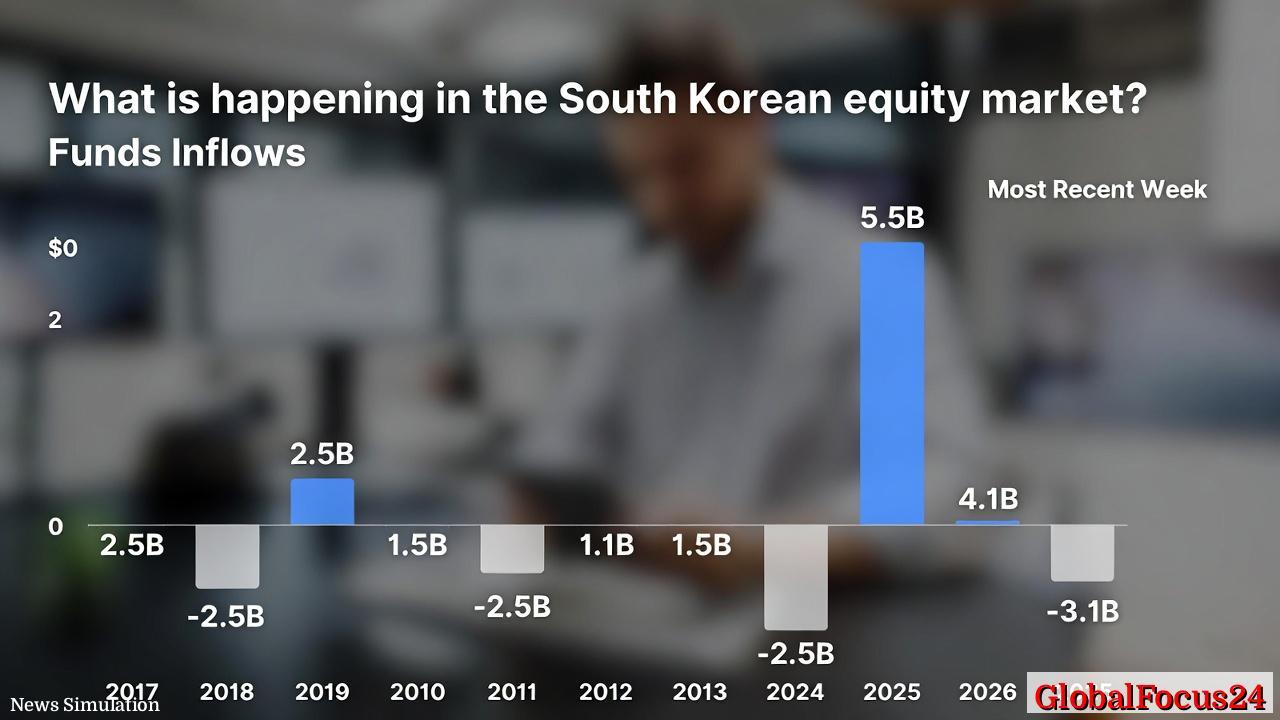
South Korean equity funds have witnessed an extraordinary wave of investment inflows, setting new records and signaling a strong resurgence of confidence among global investors. In the most recent week, South Korean equities recorded inflows of $5.2 billion, the largest weekly amount on record. This remarkable surge follows inflows of $3.5 billion the previous week and $1.7 billion two weeks earlier, indicating intense momentum and sustained foreign interest in one of Asia’s most dynamic markets.
The four-week moving average of inflows reached $3.1 billion, a level three times higher than any previous peak seen since 2017. Such magnitudes of capital entry underscore a significant shift in investor sentiment toward South Korea’s economic outlook, corporate earnings potential, and relative valuation appeal within the global emerging market landscape.
South Korea’s Market Rebound and Global Context
This surge in investment comes at a turning point for the KOSPI and KOSDAQ indices, which have both rebounded from a prolonged period of volatility tied to global inflation pressures, tightening monetary cycles, and concerns about export dependency. Over the past six months, the KOSPI has advanced significantly, driven by semiconductor and battery stocks that have attracted renewed attention amid the global push for artificial intelligence, green technology, and advanced manufacturing.
By comparison, neighboring markets such as Japan and Taiwan have also seen inflows, but none on this scale. In Japan, investors have flocked to equities supported by corporate governance reforms and yen weakness; Taiwan’s semiconductor boom has maintained steady capital inflows. However, South Korea’s record-setting figures suggest a unique confluence of factors: undervalued tech giants, attractive earnings multiples, and expectations that policy initiatives could further unlock shareholder value.
Historical Context: The Post-2017 Investment Cycle
To understand the significance of the current rally, it helps to look back at the historical trends in South Korean equity flows. Since 2017, foreign investment activity in Korea has fluctuated sharply in response to trade tensions, interest rate cycles, and global demand for high-tech components. Periods of inflow, such as mid-2020 during the global liquidity surge, were followed by steep reversals amid inflation spikes and rate hikes in advanced economies.
Between 2017 and 2025, weekly fund flows rarely exceeded $2.5 billion, with typical movements fluctuating between -$2.5 billion and $2 billion. The latest readings—surpassing $5.5 billion on weekly charts—represent a marked departure from historical norms. Analysts interpret this as a transition from tactical, short-term positioning toward conviction-based investment strategies focused on Korea’s structural competitiveness in semiconductors, electric vehicles, and green-energy production.
Driving Forces Behind the Investment Boom
Several converging factors have fueled the record-breaking inflows into South Korean equities:
- Semiconductor Recovery: The global chip industry has moved out of its cyclical downturn, with rising demand from AI, data centers, and mobile devices. South Korean firms, particularly those in DRAM and NAND production, are benefiting from improving prices and utilization rates.
- Currency Stability: The South Korean won has stabilized following several months of depreciation, improving returns for foreign investors and reducing exchange-rate volatility risks.
- Attractive Valuations: Despite recent gains, South Korean equities trade at valuations lower than many regional peers, offering a compelling entry point.
- Corporate Reforms: Growing emphasis on shareholder-friendly policies, including higher dividends and buybacks, has prompted renewed optimism from global funds long concerned about capital efficiency.
- Geopolitical Positioning: Relative resilience amid regional tensions has reinforced Korea’s status as a stable hub within East Asia’s increasingly complex economic environment.
Together, these elements have made South Korea one of the most attractive destinations for portfolio diversification in early 2026.
Comparisons Across Asia’s Emerging Markets
When seen in the broader Asian context, South Korea’s resurgence stands out sharply. While India continues to dominates with its rapid GDP growth and capital market expansion, inflows there have been more measured in recent weeks, reflecting valuation concerns. China, meanwhile, remains weighed down by property-sector challenges and subdued consumer confidence, causing foreign investors to search for alternative exposure within the region.
In contrast, South Korea’s structural advantages—from advanced manufacturing clusters to world-leading technology value chains—offer exposure to the global digital economy without the policy unpredictability seen in larger regional markets. Fund managers are increasingly classifying South Korea as a semi-developed or “advanced emerging” market, a categorization that further broadens its investor base.
Economic Impact on the Domestic Market
Domestically, the surge in equity inflows carries meaningful economic implications. Rising asset prices improve household and corporate balance sheets, which can support broader consumption and investment activity. The financial sector, buoyed by stronger equity issuance and fund participation, benefits from enhanced liquidity and tighter credit spreads.
At the same time, policymakers must manage potential side effects associated with rapid capital inflows—such as upward pressure on the won or overheating in specific asset segments. Historically, the Bank of Korea has balanced monetary stability with an openness to foreign participation, aiming to prevent distortions while sustaining capital-market vitality. Current data suggest that inflows remain largely long-term in nature, mitigating the risk of sudden reversals.
Investor Outlook and Market Sustainability
Market strategists view the strength of recent inflows as sustainable—at least in the near term—thanks to a combination of improving earnings forecasts and continued macroeconomic stability. South Korea’s projected GDP growth for 2026, while modest relative to its peers, is expected to accelerate through higher export volumes and stable domestic demand.
Equity analysts note that foreign investors are not only targeting blue-chip technology firms but also mid-cap and growth-oriented sectors tied to digital content, biotechnology, and renewable energy. This diversification reflects a more mature investment environment, where confidence extends well beyond a handful of flagship corporations.
If this pattern holds, the current wave could mark the beginning of a longer cycle of equity investment more reminiscent of South Korea’s early 2000s growth era—albeit under very different global conditions.
Lessons From Past Cycles
Past episodes of inflow surges in emerging Asia have occasionally proven transient—reversing quickly in response to global shocks such as interest rate hikes or geopolitical disruptions. Analysts point to the importance of structural underpinnings rather than external liquidity alone in sustaining market momentum.
In South Korea’s case, several reforms since the late 2010s have strengthened transparency, improved governance standards, and enhanced digital infrastructure in the capital market. As a result, the base of domestic institutional investors has grown, providing a balancing force that can absorb fluctuations in foreign participation. This resilience places Korea in a stronger position than in past cycles to handle volatility without systemic disruption.
Global Sentiment and the Risk Landscape
While sentiment is clearly positive, global investors remain attentive to potential headwinds. Key risks include renewed trade tensions, softening demand for consumer electronics, and shifts in U.S. monetary policy that could tighten global liquidity. Nevertheless, most institutional surveys indicate that South Korea currently ranks among the top three preferred destinations for equity allocation in the Asia-Pacific region, alongside India and Japan.
Given ongoing diversification trends in global portfolios, the Korean market’s combination of technological depth, corporate transparency, and policy predictability appears uniquely positioned to attract continued inflows even amid external uncertainties.
The Road Ahead
With weekly inflows reaching record-breaking levels and the four-week moving average tripling historical peaks, South Korea has emerged as a focal point for global capital in early 2026. The pace of recent inflows far surpasses historical benchmarks and underlines a broader re-rating of the nation’s equity market potential.
While challenges remain, the underlying narrative is one of renewed conviction in South Korea’s long-term prospects—anchored by innovation, competitiveness, and a stable financial framework. As the nation’s markets continue to evolve, the current surge may well mark the foundation of a new era in Asia’s investment landscape—one where South Korea stands not only as a beneficiary of global capital flows but as a central player in shaping them.